
Evaluation of Nutrient and Organoleptic Properties of Complementary Foods Formulated From Quality-Protein Maize, Orange-Flesh Sweet Potato, Soybean And Date Flour
DOI:
https://doi.org/10.33003/fjs-2026-1023-5365Keywords:
Complementary foods, Design expert, Quality Protein Maize, Orange Flesh Sweet Potato, Soybean and Date flourAbstract
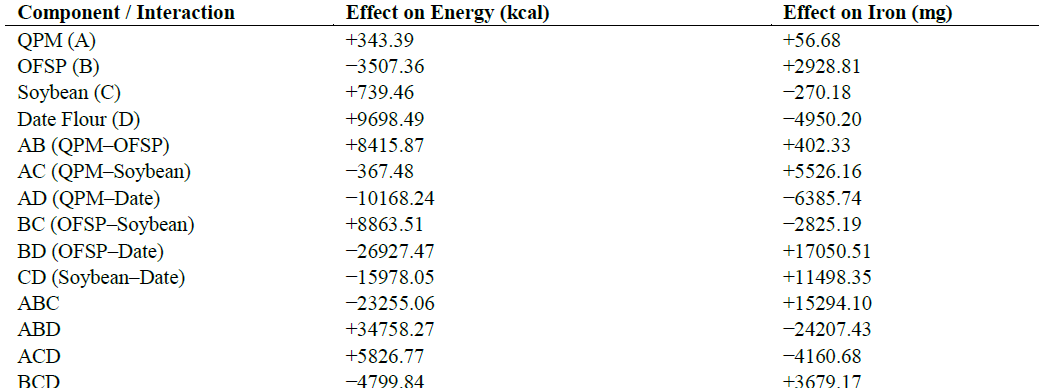
Adequate infant and young child nutrition are essential for optimal growth, cognitive development, and survival. In many low- and middle-income countries, including Nigeria, poor complementary feeding practices and reliance on nutrient-poor cereal-based diets contribute to malnutrition and micronutrient deficiencies. This study formulated and evaluated three complementary food blends (QOSAD 1, QOSAD 2, and QOSAD 3) from Quality Protein Maize (QPM), Orange-Fleshed Sweet Potato (OFSP), soybean, and date flour as affordable and nutrient-dense alternatives. Formulations were optimized using Design Expert software and data were analyzed for proximate composition, micronutrient content, antinutritional factors, amino acid profile, and sensory attributes using Statistical Package for Social Science (SPSS) version 23.0 software 2011 to test the level of significance (p<0.05), Turkey Test was used to separate the means where significant differences. The results showed significant synergistic effects among ingredients on energy and iron contents. Energy densities of the formulations exceeded the WHO minimum recommendation of 400 kcal/100 g, with QOSAD 2 recording the highest value (445.23 ± 3.57 kcal/100 g). Protein content ranged from 6.81% to 10.99%, while QOSAD 3 contained the highest iron (56.70 ± 0.10 mg/100 g), zinc (5.30 mg/100 g), and provitamin A carotenoid (1,059.20 µg/100 g) contents. Antinutritional factors were within safe limits. QOSAD 2 exhibited superior protein quality and recorded the highest scores for flavour, texture, and overall acceptability on a 9-point hedonic scale.
References
REFERENCES
Adegbusi, S. S., Akinyemi, O. S., & Olagunju, A. I. (2022). Nutritional potential of soybean in complementary food formulations for infants and young children. Journal of Food Science and Nutrition Research, 5(2), 120–128.
Adebayo, O. A., Yusuf, A. A., & Adeyemi, I. A. (2020). Protein calorie contribution and nutritional quality assessment of complementary foods. Nigerian Food Journal, 38(1), 45–53.
Adepoju, O. T. (2022). Determination of antinutritional factors in plant-based foods using standard analytical methods. African Journal of Food Science, 16(3), 85–93.
Adigwe, O. P., Edeh, G. C., & Nwosu, J. N. (2023). Development and nutritional evaluation of complementary foods from locally available food materials. Food Science and Nutrition, 11(4), 2105–2118.
Alebiosu, O. O., Akinola, O. S., & Adewale, A. O. (2024). Nutritional and functional properties of date fruits in food product development. International Journal of Food Sciences and Nutrition, 75(2), 145–154.
Allen, L. H. (2012). Complementary feeding and nutritional quality of infant foods in developing countries. Nutrition Reviews, 70(Suppl. 2), S29–S33.
Al-Shahib, W., & Marshall, R. J. (2021). The fruit of the date palm: Its possible use as the best food for the future. International Journal of Food Sciences and Nutrition, 54(4), 247–259.
Anigo, K. M., Ameh, D. A., Ibrahim, S., & Danbauchi, S. S. (2010). Nutrient composition of complementary foods formulated from locally available food materials in Kaduna State, Nigeria. African Journal of Food Science, 4(9), 551–556.
Association of Official Analytical Chemists (AOAC). (2011). Official methods of analysis (18th ed.). AOAC International.
Association of Official Analytical Chemists (AOAC). (2019). Official methods of analysis (21st ed.). AOAC International.
Babarinde, G. O., & Fabunmi, O. A. (2019). Quantification of phytate, tannin, and oxalate contents in food samples using standard analytical methods. Journal of Food Composition and Analysis, 80, 85–92.
Bedada, D., Hika, W., & Chala, A. (2021). Nutritional quality and formulation of complementary foods from locally available ingredients. Heliyon, 7(8), e07855.
Carr, F. H., & Price, E. A. (1926). Colour reactions attributed to vitamin A. Biochemical Journal, 20(3), 497–501.
Edejer, T. T., Bos, E. R., & Acharya, A. (2015). Child nutrition and survival in developing countries. World Health Organization.
Eromosele, C. O., Eromosele, I. C., & Mordi, R. C. (2019). Determination of vitamin A content in food samples by spectrophotometric methods. Nigerian Journal of Nutritional Sciences, 40(2), 75–82.
Faber, M., Benadé, A. J. S., & Spinnler Benadé, A. J. (2014). Dietary diversity and complementary feeding practices in developing countries. Maternal and Child Nutrition, 10(4), 581–593.
FAO/WHO/UNU. (2007). Protein and amino acid requirements in human nutrition. World Health Organization.
Ghosh, S., & Prelas, M. A. (2020). Determination of amino acid composition using high-performance liquid chromatography. Journal of Chromatographic Science, 58(7), 612–620.
Global Hunger Index. (2024). Global Hunger Index 2024: Hunger and food insecurity worldwide. Concern Worldwide and Welthungerhilfe.
Jadhavar, V. V., Kulkarni, S. S., & Patil, A. S. (2022). Complementary feeding practices and infant nutritional outcomes. International Journal of Community Medicine and Public Health, 9(5), 2120–2128.
Kabeer, M. A., Rahman, M. M., & Islam, M. S. (2023). Complementary feeding practices and nutritional requirements of infants aged 6–23 months. BMC Nutrition, 9(1), 45.
Liu, K., Wang, H., & Murphy, P. A. (2020). Processing and utilization of soybean flour in food products. Food Research International, 137, 109722.
Mabhaudhi, T., Chibarabada, T., & Modi, A. T. (2024). Food-based approaches to improve complementary feeding and child nutrition in Africa. Food Security, 16(1), 45–58.
Mukuria, A. G., Martin, S. L., Egondi, T., Bingham, A., & Thuita, F. M. (2016). Role of cultural beliefs and practices in complementary feeding. Maternal and Child Nutrition, 12(2), 236–247.
NAFDAC. (2018). Guidelines for food product development and analysis in Nigeria. National Agency for Food and Drug Administration and Control.
Nankam, P. A., Kouebou, C. P., & Womeni, H. M. (2021). Sensory evaluation of complementary foods using a 9-point hedonic scale. Food Research, 5(4), 312–319.
Nnam, N. M., Ezeh, C. C., & Nwankwo, C. U. (2025). Development of nutrient-dense complementary foods from indigenous food crops. Journal of Nutrition and Food Sciences, 15(1), 100–112.
Nuss, E. T., & Tanumihardjo, S. A. (2022). Quality protein maize for improved nutritional outcomes in developing countries. Advances in Nutrition, 13(2), 435–447.
Okoronkwo, C. C., Eze, J. I., & Okeke, C. U. (2023). Nutritional significance of orange-fleshed sweet potato in combating vitamin A deficiency. African Journal of Food, Agriculture, Nutrition and Development, 23(1), 21542–21558.
Onwuka, G. I. (2018). Food analysis and instrumentation: Theory and practice. Naphtali Prints.
Osei, K. A., Boateng, E. F., & Owusu, G. (2021). Processing and nutritional evaluation of quality protein maize flour. Journal of Cereal Science, 98, 103176.
Parvin, R., Akhtaruzzaman, M., & Islam, M. N. (2014). Nutritional adequacy of breast milk and complementary feeding practices. International Journal of Nutrition and Food Sciences, 3(5), 385–392.
Schaafsma, G. (2012). Advantages and limitations of the protein digestibility-corrected amino acid score (PDCAAS) as a method for evaluating protein quality in human diets. British Journal of Nutrition, 108(S2), S333–S336.
UNICEF. (2020). Programming guidance: Infant and young child feeding. United Nations Children's Fund.
UNICEF. (2024). Nigeria nutrition situation report 2024. United Nations Children's Fund.
Wang, Y., Zhang, X., Liu, H., & Chen, J. (2021). Simultaneous determination of water-soluble vitamins in food matrices using HPLC. Food Chemistry, 345, 128–136.
World Food Programme. (2024). Malnutrition: Causes, consequences and interventions. World Food Programme.
World Health Organization. (2004). Vitamin and mineral requirements in human nutrition (2nd ed.). World Health Organization.
World Health Organization. (2021). Infant and young child feeding: Guideline update. World Health Organization.
Downloads
Published
Issue
Section
License
Copyright (c) 2026 Ahmed Saka, Auwalu Garba, Sani Ibrahim, Abdulkadir Muhammad

This work is licensed under a Creative Commons Attribution 4.0 International License.


