
Socio-Economic Determinants of Input Use and Agronomic Practices among Yam Farmers in Cross River State, Nigeria
DOI:
https://doi.org/10.33003/fjs-2026-1023-5383Abstract
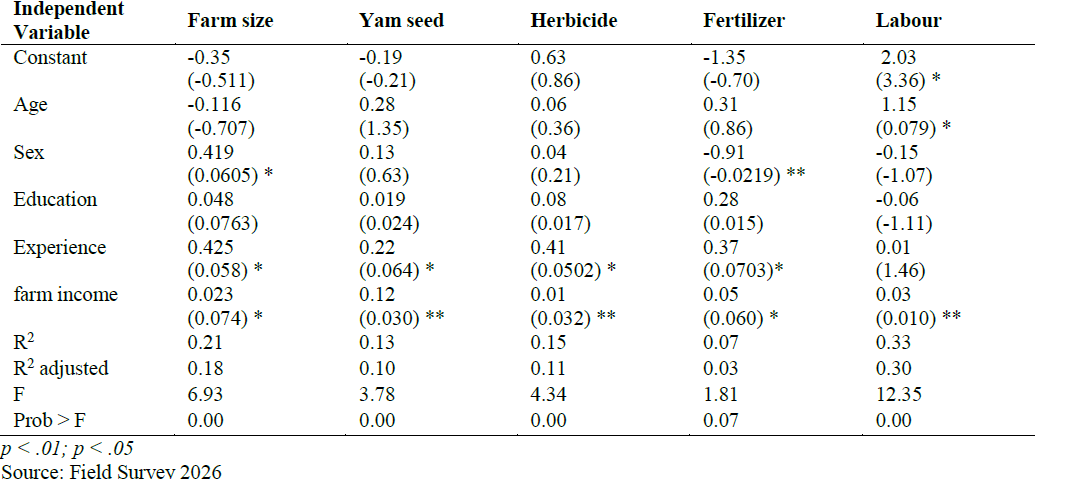
The study examined the Socio-Economic Determinants of Input Use and Agronomic Practices among Yam Farmers in Cross River State, Nigeria. The methodology indicates a final sample of 150 yam farmers and descriptive statistics were used to characterize agronomic practices, while multiple linear regression was used to examine input-use relationships. Result showed that sex (0.419) and farming experience (0.425) were positive and significant for farm size at 5% level. The estimated coefficients for farming experience (0.22) and farm income (0.12) were positive and significant for use of seed yam at 10% and 5% levels respectively. Similarly, analysis showed that only farming experience (0.41) contributed positively and significantly to use of herbicide at 10% level. The estimated coefficient for sex (-0.91) was negative and significant for use of fertilizer at 5% level. Findings showed that only age (1.15) contributed positively and significantly to use of labour at 10% level. Education was positive and significant for farm size (0.0763), seed (0.024), herbicide (0.017) and fertilizer (0.015) respectively at various levels of significance. Similarly, farm income was significant and positive for all the variables measured. Result indicates that a unit increase in farm income increases the use of all the variables measured by their corresponding coefficients The following policy recommendations were made based on the findings of this study: increase in the education of yam farmers should be encouraged to increases the use of the identified positive variables in cultivation of yam in the area
References
Agbachom E.E., Ettah O. I., Effiong J. B., Iyam M. A.,Okeme I., Uwah E. D., Edet
O. G. Abanyam V. A. and E. A. Ajah (2024). Yam value chain analysis
among smallholder farmers in South-South Nigeria; African Journal
of food, Agriculture, nutrition and development; 24 (4) 26293 –
26311
Amaefula, A (2021). Yam production and its determinants in Nigeria; Nigerian
agricultural journal; 52 (3); 116-124
Food and Agriculture Organization (FAO) (2022). Yam production indices in
Nigeria: a case of Benue State Yam production Statistics, Abuja,
Nigeria
Komolafe, S.E., Adesiji, G.B. and Akanbi, S.O. (2022). The contribution of yam
farming activities to livelihood of farmers in Ekiti State, Nigeria.
Jambura Agribusiness Journal, 4(1), 1–12
IITA. (2009b). Yam-growing technique. Retrieved from http://r4dreview.org
Izekor, O. B. and Olumese, M. I. (2010). Determinants of yam production and
profitability in Edo State, Nigeria. Journal of general agriculture. 6
(4), 30-35.
National Bureau of Statisttics (NBS) (2022). Yam consumption and production
in Nigeria. Retrieved from https://www.nigerianstat.gov.ng
/pdfuploads/ Yam Consumption and
Production in Nigeria.pdf.
National population commission, (2011). Census enumeration survey N. P. C.
Abuja, Nigeria. 2, 6-8. Nigeria.
Nwezi, E. A. &. Umebali ,E. E. (2021). socio-economic and production resources
influence on yam production among cooperative farmers in
Anambra State, Nigeria; Global Journal of Applied, Management and
Social Sciences (GOJAMSS); .21 (1); 120 – 131
Olatinwo, L. K. , Yusuf, O. J., Komolafe, Sola E. and Ibrahim, A. (2022). Adoption
of improved yam production practices amongst farmers in kwara
State, Nigeria; Journal of Sustainable Development in Africa; 24 (3);
1-12
Shiwachi, H. and Toyohara H (2005). Current status and future of yam
production. Tropical Agricultural Development; 49 (5): 323-328.
Shiwachi, H., Kikuno, H., Fashola, R and Asiedu, R. (2008). Enhancing off-season
yam production in Nigeria; African Journal of Agricultural Resource;
3 (6): 407-411.
Downloads
Published
Issue
Section
Categories
License
Copyright (c) 2026 Ettah Otu Ikoi, Edet Onome George, Fakuta Balthiya Alfred, Ettah Goddy Ikoi, Ofem Ikpi Ikpi

This work is licensed under a Creative Commons Attribution 4.0 International License.


