AI-Powered Student Academic Performance Prediction: A Dual-Model Random Forest Approach for Risk Classification and Score Forecasting
DOI:
https://doi.org/10.33003/fjs-2026-1023-5393Keywords:
Artificial Intelligence, Student performance prediction, Random Forest, Educational Data Mining, Risk classification, Machine Learning, Flask APIAbstract
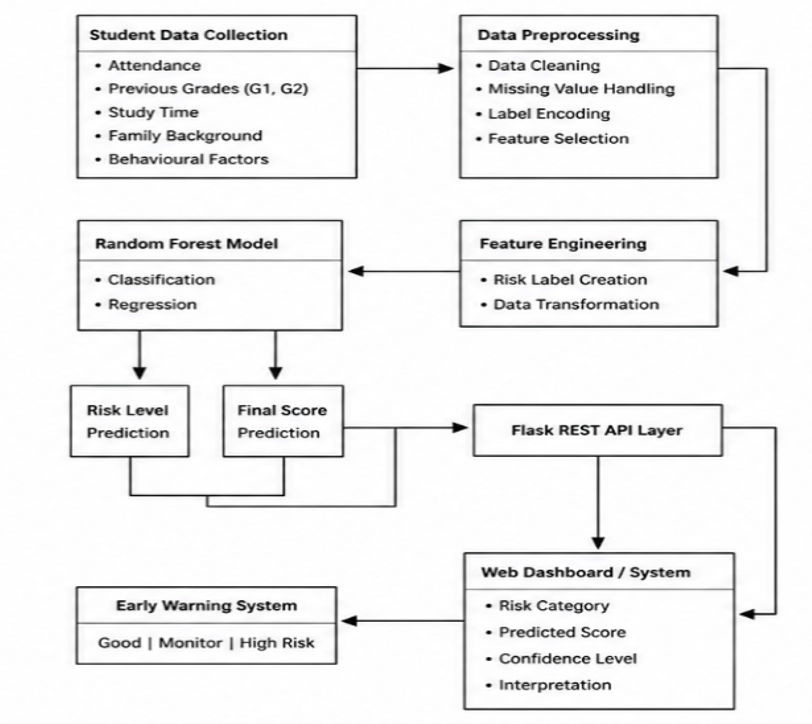
The increasing availability of student data presents opportunities for educational institutions to identify learners at risk of poor academic outcomes; however, conventional monitoring practices remain largely manual, periodic, and reactive. This study developed and implemented an Artificial Intelligence (AI)-powered system for early academic risk identification and final examination score prediction. Using the UCI Student Performance Dataset, comprising 395 secondary school students and 32 demographic, family, academic, and lifestyle attributes, the study transformed the continuous final grade (G3) into three risk categories: Good, Monitor, and High Risk. A dual-output Random Forest architecture was subsequently developed, comprising a classifier for risk categorisation and a regressor for final score estimation. An 80:20 train-test split, involving 316 training and 79 testing records, was employed with a fixed random seed to support reproducibility. The classifier obtained 86.08% accuracy, a macro F1-score of 0.86, and 0.93 recall for High-Risk students, indicating strong potential for early intervention. The regression model produced a Mean Absolute Error of 1.11 points and an R² of 0.83. Feature analysis identified previous-period grades (G1 and G2) as the dominant predictors of final achievement. The models were integrated into a Flask RESTful API and browser-based educator dashboard providing real-time predictions, confidence estimates, and automated explanations. Overall, the findings demonstrate that the proposed dual-model architecture offers an accurate, interpretable, and deployable approach for proactive academic risk management.
References
K. Alalawi, R. Athauda, and R. Chiong, "Harnessing institutional data for actionable pedagogical insight: A review," J. Educ. Data Sci., 2024.
L. Wang and C. J. Chen, "Understanding factors influencing student academic performance," Educ. Technol. Res., 2025.
R. Isaeva, N. Karasartova, K. Dznunusnalieva, K. Mirzoeva, and M. Mokliuk, "Tools and approaches for addressing student performance challenges," Int. J. Educ. Innov., 2025.
A. Almalawi, B. Soh, A. Li, and H. Samra, "Machine learning and data mining for student performance accuracy: A review," Comput. Educ. AI, 2024.
J. Wang and Y. Yu, "Machine learning approach to student performance prediction of online learning," PLOS ONE, vol. 20, no. 1, e0299018, 2025, https://doi.org/10.1371/journal.pone.0299018.
B. Carballo-Mendívil, A. Arellano-González, N. J. Ríos-Vázquez, and M. D. P. Lizardi-Duarte, "Reactive intervention models in higher education," Lat. Am. J. Educ. Tech., 2025.
A. Boretti, "Institutional costs of reactive student support models," Higher Educ. Policy J., 2026.
E. F. Agyemang, J. A. Mensah, O. Ampomah, L. Agyekum, J. Akuoko-Frimpong, A. Quansah, and O. Akinlosotu, "Predicting students' academic performance via machine learning algorithms: An empirical review and practical application," Comput. Eng. Intell. Syst., vol. 15, no. 1, p. 86, 2024, https://doi.org/10.7176/CEIS/15-1-09.
N. Santiketa, S. Chaikhan, U. Ninrutsirikun, and N. Wattanakitrungroj, "Student academic performance prediction using machine learning with various features and scenarios," in Proc. ICSEC 2024, IEEE, pp. 1–6, https://doi.org/10.1109/ICSEC62153.2024.10807584.
A. Turkmenbayev, E. Abdykerimova, S. Nurgozhayev, G. Karabassova, and D. Baigozhanova, "The application of machine learning in predicting student performance in university engineering programs: A rapid review," Front. Educ., vol. 10, art. 1562586, 2025, https://doi.org/10.3389/feduc.2025.1562586.
A. H. Hoti, X. Zenuni, M. Hamiti, and J. Ajdari, "User evaluation of a machine learning-based student performance prediction platform," Organizacija, vol. 58, no. 3, pp. 296–310, 2025, https://doi.org/10.2478/orga-2025-0018.
Elbouknify, I., Berrada, I., Mekouar, L., Iraqi, Y., Bergou, E.H., Belhabib, H., Nail, Y., & Wardi, S. (2025). AI-based identification and support of at-risk students: A case study of the Moroccan education system. ArXiv, abs/2504.07160..
https://doi.org/10.48550/arXiv.2504.07160
Kelly, Menezes, A. G., Andre, & Carlos. (2019). Supervised learning in the context of educational data mining to avoid university students dropout. in Proc. IEEE ICALT 2019, pp. 207–208, https://doi.org/10.1109/icalt.2019.00068
M. Nachouki, E. A. Mohamed, R. Mehdi, and M. Abou Naaj, "Student course grade prediction using the random forest algorithm: Analysis of predictors' importance," Trends Neurosci. Educ., vol. 33, 2023, https://doi.org/10.1016/j.tine.2023.100214.
K. L. Lam et al., "Use of random forest analysis to quantify the importance of structural characteristics," Food Hydrocoll., vol. 108, p. 106001, 2020, https://doi.org/10.1016/j.foodhyd.2020.106001.
P. Cortez and A. M. G. Silva, "Using data mining to predict secondary school student performance," in Proc. 5th Future Bus. Technol. Conf. (FUBUTEC 2008), pp. 5–12, EUROSIS.
A. I. Gufroni, P. Purwanto, and F. Farikhin, "Academic performance prediction using supervised learning algorithms in university admission," JOIV: Int. J. Inform. Visualization, vol. 9, no. 1, pp. 184–194, 2025, https://doi.org/10.62527/joiv.9.1.2974.
F. Pedregosa et al., "Scikit-learn: Machine learning in Python," J. Mach. Learn. Res., vol. 12, pp. 2825–2830, 2011.
P. Gowda, "Best practices in REST API design for enhanced scalability and security," J. AI Mach. Learn. Des., vol. 2, no. 1, pp. 827–830, 2024, https://doi.org/10.51219/JAIMLD/priyanka-gowda/202.
Downloads
Published
Issue
Section
Categories
License
Copyright (c) 2026 Aolat Olanike Giwa-Raheem, Abdulbasit Olamide Hussein, Taofik Abiodun Ahmed

This work is licensed under a Creative Commons Attribution 4.0 International License.