
owledge and Baseline Awareness of Human Papillomavirus (HPV) as a Potential Factor in Cervical Cancer among Female Adolescents in Secondary Schools in Oyo
DOI:
https://doi.org/10.33003/Keywords:
Human Papillomavirus (HPV), cervical cancer, HPV Vaccine, Female Adolescents, reproductive tract, National Programme on Immunization (NPI)Abstract
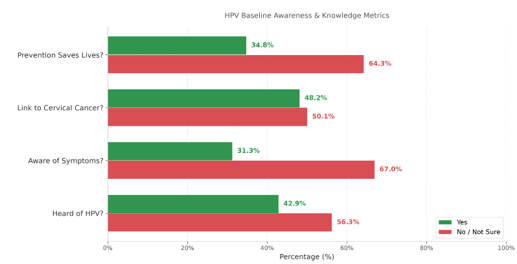
Cervical cancer remains a leading cause of cancer-related mortality among women in Nigeria. Despite the integration of the Human Papillomavirus (HPV) vaccine into the national immunization schedule to target female adolescents, vaccine hesitancy driven by poor baseline knowledge and suboptimal awareness presents a significant bottleneck to eradication efforts. This cross-sectional school-based study was carried out to assess the baseline awareness and health attitudes regarding HPV among 245 female secondary school adolescents in Oyo State. Data on socio-demographic characteristics, baseline study, and awareness of the link between HPV and cervical cancer were collected using validated, self-administered structured questionnaires. Data were analyzed using descriptive statistics. The mean age of the participants fell predominantly within the 15–17 years range (62.8%, n=155), and participants were primarily Yoruba (87.4%, n=216). Basic awareness of HPV was low: only 43.3% (n=107) had never heard of the virus, and 56.7% (n=140) had no prior exposure. The internet and social media were the leading information channels (26.7%, n=66), outperforming healthcare workers (17.0%, n=42). Strikingly, 68.0% (n=168) were completely unaware of HPV symptoms, and 58.7% (n=145) confessed total ignorance regarding specific clinical manifestations. Furthermore, while 44.9% (n=111) recognized that HPV causes cervical cancer, only 34.8% (n=84) understood that preventing HPV infection directly reduces cervical cancer risks. Female adolescents in Oyo present deficient public health knowledge and low awareness regarding HPV and its oncogenic links to cervical cancer. Digital landscapes offer the most viable window for intervention.
References
Abiodun, O. A., Olu-Abiodun, O. O., Sotunsa, J. O., & Oluwole, F. A. (2021). Impact of health education intervention on knowledge and perception of cervical cancer and human papillomavirus vaccination among female adolescents in Nigeria. Journal of Cancer Education, 36(4), 851–858. https://doi.org/10.1186/1471-2458-14-814
Adedimeji, A. A., Olorunfemi, G., & Alawode, O. (2021). Knowledge, attitude, and acceptability of human papillomavirus vaccine among adolescents and their parents in Nigeria: A systematic review. African Journal of Reproductive Health, 25(3), 112–125. https://doi.org/10.29063/ajrh2023/v27i3.12
Adeniyi, A. (2024). Digital media avenues and reproductive health literacy among school-aged adolescents in South-West Nigeria. African Journal of Health Education, 28(2), 114–125.
Adeniyi, F. I. (2023). Intention and concerns about HPV vaccination among in-school adolescents in Ibadan, Oyo State, Nigeria. Nigerian Medical Journal, 64(3), 352–364.
Cochran, W.G. 1977. Sampling Techniques. 3rd ed. New York: John Wiley & Sons.).
Creswell, D. J., & Creswell, J. W. (2018). Research Design: Qualitative, Quantitative, and Mixed Methods Approaches (Fifth Edition ed.). California 91320, United Kingdom: SAGE Publications, Inc. Retrieved April 30, 2024, from https://spada.uns.ac.id/pluginfile.php/510378/mod_resource/content/1/creswell.pdf.
Ezenwa, C. O., Ndibuagu, E. O., & Ugwueze, C. V. (2024). Health Belief Model constructs as predictors of human papillomavirus vaccination intentions among young adults in Nigeria. BMC Public Health, 24(1), 342.
Fagbule, O., Kanmodi, K., Aliemeke, E., Ogunniyi, K., Ogbeide, M., Victor, S., Isola, T., Adewuyi, H., Omoleke, S., & Kanmodi, P. (2020). Knowledge of HPV and HPV vaccine among senior secondary school students in Nigeria: Implications on cancer prevention strategies, the CHANCE Study. Population Medicine, 2, 1–10. https://doi.org/10.18332/popmed/127237.
Greaney, A. M., Sheehan, A., Heffernan, C., & Hogan, J. (2012). Research ethics I: Responsibility and informed consent. British Journal of Cardiac Nursing, 7(1), 34-38.
Kolo, M. A., Ibrahim, A. H., & Bello, M. (2021). Digital health and the youth: Social media as a primary source of reproductive health information among Nigerian students. Journal of Health Communication in Africa, 12(2), 45–59.
Lawal, Q. O., Lawal, I. K., Carter, C. S., & Khan, S. (2023). Cervical cancer burden in Nigeria: Review of current situation. Gynecology & Reproductive Health, 7(1), 1–5. https://doi.org/10.33425/2639-9342.1211.
Mark P. Janubas, Laila S. Lomibao. The Relationship between Engagement and Mathematics Achievement of Nontraditional Students: A Meta-Analysis. Journal of Innovations in Teaching and Learning. 2025; 5(1):19-25. https://doi.org/10.12691/jitl-5-1-4
Nwozor, C. M., Okoye, C. J., & Anajekwu, B. C. (2023). Baseline awareness of human papillomavirus (HPV) infection and vaccine acceptability among youth demographics in Southeastern Nigeria. International Journal of Preventive Medicine, 14(1), 88.
Obiri-Yeboah, D., Crayson, K., & Baidoo, I. (2023). Bridging the gap: Structuring school-based human papillomavirus (HPV) vaccine education in West Africa ahead of national rollouts. Vaccine, 41(12), 1987–1995.
Odetola, T. D., & Ekpo, K. E. (2022). Symptom awareness and clinical manifestation recognition of sexually transmitted infections among school-aged adolescents in Nigeria. Journal of Pediatric and Adolescent Gynecology, 35(3), 310–316.
Ohaeri, B., Adefolaju, A., & Onyeneho, C. (2020). Knowledge, attitudes and perceptions of Nigerian parents towards human papilloma virus (HPV) vaccines. European Journal of Midwifery, 4, 4. https://doi.org/10.18332/ejm/114886.
Okeke, S. U. (2024). Fighting cervical cancer in Africa: Taking a closer look at human papillomavirus 35. African Journal of Laboratory Medicine, 13(1), Article 2243. https://doi.org/10.4102/ajlm.v13i1.2243.
Olubayo GT, Bakare A, Salako J, Olufayo OE, Bakare AA. (2026). Early implementation and contextual determinants of the human papillomavirus vaccine rollout and uptake in Nigeria: a mixed-methods study. Frontier Public Health. 2; 14:1834756. https://doi.org/10.3389/fpubh.2026.1834756. PMID: 42311987; PMCID: PMC13271000.
Peter O, Oborevwori E, Osagie E, Akhigbe P, Idemudia NL, Obuekwe O, Eki-Udoko FE, Schlecht N, Bromberg Y, Okoh-Aihe PO, Osazuwa-Peters N, Coker MO; HOMINY Study Group (2026). From Awareness to Action Study: Improving Human Papillomavirus Knowledge, Screening and Vaccine Uptake Among Mother-Adolescent Pairs in the HOMINY Study in Nigeria: A Longitudinal Study. Journal of the International AIDS Society 29 Suppl 2(Suppl 2):e70164. https://doi.org/10.1002/jia2.70164. PMID: 42499163; PMCID: PMC13400979.
Podsakoff, P. M., MacKenzie, S. B., Lee, J. Y., & Podsakoff, N. P. (2003). Common method biases in behavioral research: A critical review of the literature and recommended remedies. Journal of Applied Psychology, 88(5), 879-903. https://doi.org/10.1037/0021-9010.88.5.879. PMID: 14516251.
Quan, N. K., & Liamputtong, P. (2023). Social surveys and public health. In P. Liamputtong (Ed.), Handbook of social sciences and global public health (pp. 1025–1043). Springer Nature Switzerland AG. https://doi.org/10.1007/978-3-031-25110-8_68
World Medical Association (WMA) (2013). World Medical Association Declaration of Helsinki: Ethical principles for medical research involving human subjects. Journal of the American Medical Association, 310(20), 2191-2194.
Downloads
Published
Issue
Section
Categories
License
Copyright (c) 2026 Olusola Olayiwola, Oyindamola Ayegbusi, Favour Olanrewaju, Ademola Alaba, Adeola-Kehinde Olaleye

This work is licensed under a Creative Commons Attribution 4.0 International License.


