
Phytochemical Profile and In Vitro α-Amylase and α-Glucosidase Inhibitory Activities of a 70 % Ethanol Extract of Green Apple (Malus Domestica Borkh) Fruits
DOI:
https://doi.org/10.33003/fjs-2026-1022-5633Keywords:
Malus domestica, Phytochemicals, α-amylase, α-glucosidase, Enzyme inhibition, Phenolic compounds, FlavonoidsAbstract
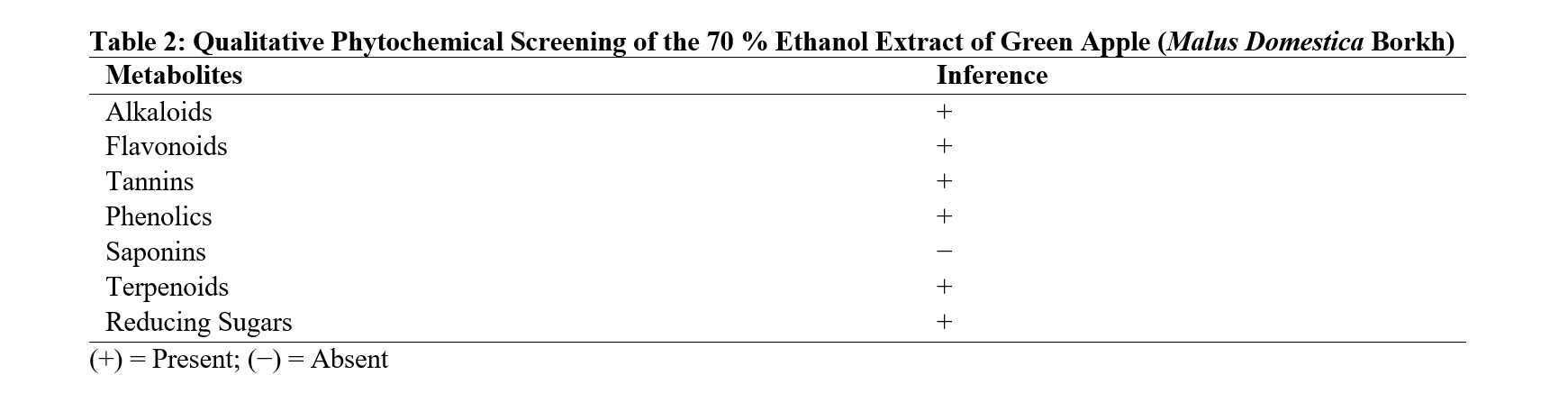
Malus domestica belong to (Family Rosaseae) have been reported to be widely consumed as a fruit and contains diverse bioactive phytochemicals with potential health-promoting activities. This study evaluated the phytochemical profile and inhibitory properties of in vitro α-amylase and α-Glucosidase using standard procedures. The plant material was extracted with 70% ethanol and subjected to qualitative and quantitative phytochemical analysis using standard procedures. The inhibitory activities against α-amylase and α-glucosidase were evaluated at concentrations of 62.5–1000 µg/mL, using acarbose as the reference inhibitor, and IC₅₀ were determined. Qualitative phytochemical screening revealed the presence of alkaloids, flavonoids, terpenoids, tannins, and glycosides. The extract had a total phenolic content of 116.699 ± 0.493 mg GAE/g extract and a total flavonoid content of 24.063 ± 0.071 mg CE/g extract. The α-amylase inhibitory activity of the extract increased from 28.989 ± 0.978% at 62.5 µg/mL to 84.201 ± 0.261% at 1000 µg/mL, compared with 88.190 ± 0.208% and 90.181 ± 0.128%, respectively, for acarbose. The IC₅₀ values were 159.600 µg/mL for the extract and <62.5 µg/mL for acarbose, indicating greater α-amylase inhibitory potency of the reference inhibitor. For α-glucosidase, the extract produced inhibition values ranging from 36.758 ± 15.453% to 56.238 ± 3.932% across the tested concentration range, while acarbose produced inhibition values ranging from 46.335 ± 4.580% to 56.475 ± 2.416%. The corresponding IC₅₀ values were 124.020 µg/mL for the extract and 143.715 µg/mL for acarbose.
References
Abimbola, A. M., Baba, I. A., Yenusa, E. Z., Omanibe, S. J & Oladimeji, I. H (2013). Anti-trypanosomal effect of Peristrophe bicalyculata extract on Trypanosoma brucei brucei-infected rats. Asian Pacific Journal of Tropical Biomedicne. 3: 523-531.
American Diabetes Association. (2023). Standards of medical care in diabetes—2023. Care, 46 (Suppl. 1), S1–S291. https://doi.org/10.2337/dc23-Sint
Bernfeld, P. (1955). Amylases, alpha and beta. Methods in Enzymology, 1, 149–158. https://doi.org/10.1016/0076-6879(55)01021-5
Ceriello, A. (2005). Postprandial hyperglycemia and diabetes complications: Is it time to treat? Diabetes, 54(1), 1–7. https://doi.org/10.2337/diabetes.54.1.1
Laoufi, H., Benariba, N., Adjdir, S., & Djaziri, R. (2017). In vitro α-amylase and α-glucosidase inhibitory activity of Ononis angustissima extracts. Journal of Applied Pharmaceutical Science, 7(2), 189–195. https://www.japsonline.com/admin/php/uploads/2171_pdf.pdf
Lasraj, N., Buhrim, M., & Kharchoufa, L. (2022). Phytochemical analysis, α-glucosidase and α-amylase inhibitory activities and acute toxicity studies of extracts from pomegranate (Punica granatum) bark. Foods, 11(9), Article 1353. https://doi.org/10.3390/foods11091353
Lv, Y. (2016). Triterpenes and phenolic compounds in Apple fruit (Malus domestica Borkh.) [Doctoral dissertation, Swedish University of Agricultural Sciences]. Epsilon Open Archive. https://pub.epsilon.slu.se/13001/1/Lv_Y_160128.pdf
Melnic, V., Bunea, A., Chira, R. I., Bunea, C. I., Socaci, S., & Mitre, V. (2021). Phytochemical content and antioxidant activity of Malus domestica Borkh peel extracts. Molecules, 26(24), Article 7636. https://doi.org/10.3390/molecules26247636
Monnier, L., Mas, E., Ginet, C., Michel, F., Villon, L., Cristol, J. P., & Colette, C. (2007). Activation of oxidative stress by acute glucose fluctuations compared with sustained chronic hyperglycemia in patients with type 2 diabetes. JAMA, 295(14), 1681–1687. https://doi.org/10.1001/jama.295.14.1681
Ota, A., & Ulrih, N. P. (2017). An overview of herbal products and secondary metabolites used for management of type two diabetes. Frontiers in Pharmacology, 8, Article 436. https://doi.org/10.3389/fphar.2017.00436
Prasad, R.C., Umeza, B.Y.. Afzal Khan, A.K., Nayaka, S.R., & Jayaraman, T. (2026). In vitro Antioxidant and Antiglycemic Effects of Malus domestica, Musa acuminata Colla, Mangifera indica, Citrus reticulata and Punica granatum Fruits Peel Extracts. International Journal of Pharmaceutical Investigation. 16 (2):702-7.
Tadera, K., Minami, Y., Takamatsu, K & Matsuoka. T. (2006). Inhibition of alpha-glucosidase and alpha-amylase by flavonoids. Journal of Nutritional Science and Vitaminology 52(2):149-53. https://doi.org/10.3177/jnsv.52.149
Vermerris, W., & Nicholson, R. (2008). Isolation and identification of phenolic compounds. In Phenolic compound biochemistry (pp. 151–196). Springer. https://doi.org/10.1007/978-1-4020-5164-7_5
World Health Organization. (2022). Global report on diabetes. WHO. https://www.who.int/publications/i/item/9789240015128
Downloads
Published
Issue
Section
Categories
License
Copyright (c) 2026 Anas Abba, Abdullahi Mustapha Huguma, Aliyu Mas'ud Idris, Abubakar Sadiq Wada, Lawal Azeez Babatunde

This work is licensed under a Creative Commons Attribution 4.0 International License.


