
Effects of Heavy Metal Pollution on Soil Index Properties: Implications for Foundation Site Assessment Implications for Foundation Bearing Capacity
DOI:
https://doi.org/10.33003/fjs-2026-1017-5672Keywords:
Heavy Metal Contamination, Soil Index Properties, Atterberg Limits, Foundation Site Assessment, Geotechnical EngineeringAbstract
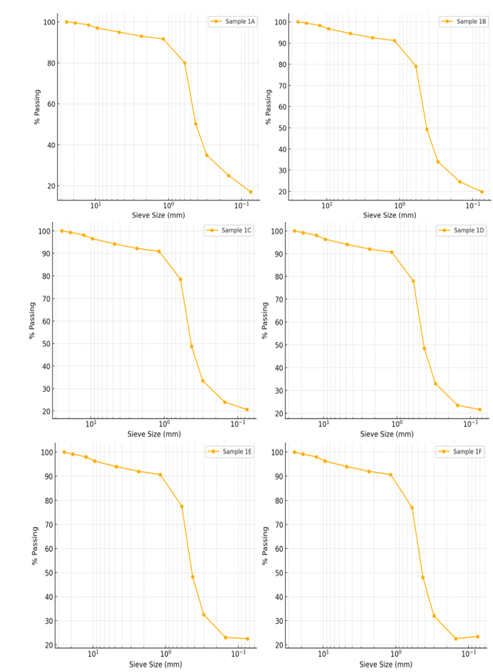
Heavy metal contamination can modify the engineering behaviour of soils and may complicate foundation site assessment. This study evaluated the association between selected heavy metal concentrations and soil index properties using six disturbed soil samples (1A–1F) collected from the Uwelu Spare Parts Market, Benin City, Edo State, Nigeria. Atomic Absorption Spectroscopy (AAS) was used to determine Pb, Cd, Zn, Mn, As, Cr, Ni and Cu concentrations, while particle size distribution and Atterberg-limit tests were conducted using standard geotechnical procedures. Across the six samples, Pb ranged from 0.680–0.765 ppm, Cd from 0.691–0.870 ppm and Zn from 0.526–0.590 ppm. Liquid limit increased from 18.8% to 26.5%, plastic limit decreased from 15.7% to 11.5%, and plasticity index increased from 3.1% to 15.0%. The AASHTO classification changed from A-2-4 at 1A through A-2-5 at 1B–1C to A-2-6 at 1D–1F. Pearson correlation and simple linear regression were retained only as exploratory analyses because the six observations are insufficient for robust multivariable inference. The results show that heavy-metal concentrations and soil consistency properties vary together across the sampled locations, whereas particle-size distributions are comparatively similar. The findings support the inclusion of geoenvironmental screening alongside conventional index-property testing during preliminary foundation site assessment; they do not constitute a direct determination of foundation bearing capacity.
References
Abdelaziz, A. M., Abd El-Hamid, H. T., & Ibrahim, M. M. (2024). Soil physicochemical characteristics and heavy metal contamination: Implications for engineering behaviour. Environmental Challenges, 15, 100912.
Alhassan, M. M., Ibrahim, A., & Yusuf, S. (2025). Assessment of contaminated lateritic soils for shallow foundation applications in tropical environments. Geotechnical and Geological Engineering, 43(2), 1895–1913.
Ayodele, A. L., Babalola, O. T., & Agbede, O. A. (2025). The effects of ferrous sulphate heptahydrate and lead nitrate on the Atterberg limits and consolidation indices of laterite. Ife Journal of Technology.
Dlamini, T., Moyo, P., & Ndlovu, S. (2025). Integrating environmental contamination assessment into geotechnical site investigations for sustainable infrastructure development. Environmental Earth Sciences, 84(6), 215.
Ehibor, I.-O., & Tse, A. C. (2022). Bearing capacity analysis of subsoils for shallow and deep foundation in Uyo Town, Eastern Niger Delta, Nigeria. International Journal of Engineering Science Technologies, 6(4), 20–35.
El Gendy, M. (2025). A comparative machine and deep learning approach for predicting ultimate bearing capacity of shallow foundations in cohesionless soil. Scientific Reports, 15, 40402. https://doi.org/10.1038/s41598-025-22812-7
Gao, Y., Liu, J., Chen, H., & Zhao, X. (2023). Effects of heavy metal contamination on consistency limits and engineering properties of clay soils. Applied Clay Science, 240, 106987.
Heidari, S. A., Amiri, M., Harifi, A., & Wu, W. (2025). Effect of thermal treatment on stabilization and solidification of heavy metal contaminated clayey soil. Scientific Reports, 15, 17197. https://doi.org/10.1038/s41598-025-01155-3
Khan, M. A., Ali, S., Hussain, I., & Ahmed, N. (2024). Influence of heavy metal contamination on the geotechnical properties of clayey soils. Journal of Materials in Civil Engineering, 36(5), 04024068.
Koptsik, G. N., & Koptsik, S. V. (2022). Heavy metals in soils: Sources, behavior, and remediation. Eurasian Soil Science, 55(5), 493–509.
Lai, V. Q., Shiau, J., Keawsawasvong, S., & Tran, D. T. (2022). Bearing capacity of ring foundations on anisotropic and heterogeneous clays: FEA, NGI-ADP, and MARS. Geotechnical and Geological Engineering, 40(8), 3913–3928.
Li, Y., Wang, C., Zhang, L., Liu, H., & Chen, X. (2023). Influence of heavy metals on soil microstructure and physicochemical properties: Implications for engineering performance. Environmental Technology & Innovation, 31, 103234.
Liu, P., Sun, H., Zhang, X., & Zhou, W. (2023). Engineering characterization of contaminated soils based on classification indices. Engineering Geology, 325, 107275.
Muhammad, I. S., Alkali, A. M., & Bulu, K. (2022). An investigation of soil bearing capacity for building and structural foundation design: A case study of Polo Area, Maiduguri, Nigeria. Arid Zone Journal of Engineering, Technology and Environment, 18(1), 158–170.
Negahdar, H., & Tohidi, A. (2025). Assessment of geopolymer and cement stabilizers on geotechnical properties of heavy metal-contaminated clay. Scientific Reports, 15, 25527. https://doi.org/10.1038/s41598-025-04514-2
Nie, X., Huang, X., Li, M., Lu, Z., & Ling, X. (2024). Advances in soil amendments for remediation of heavy metal-contaminated soils: Mechanisms, impact, and future prospects. Toxics, 12(12), 872.
Okorie, M. N., Okechukwu, V. U., & Omokpariola, D. O. (2024). Physicochemical properties and health risk assessment of selected heavy metals from soil and borehole water in Ifite-Awka, Anambra State, Nigeria. Discover Applied Sciences, 6, 108.
Pantelidis, L. (2024). Bearing capacity of shallow foundations: A focus on the depth factors in combination with the respective N-factors. Arabian Journal of Geosciences, 17, Article 169. https://doi.org/10.1007/s12517-024-11976-7
Pantelidis, L., & Meddah, A. (2024). The effect of loading inclination and eccentricity on the bearing capacity of shallow foundations: A review. Archives of Computational Methods in Engineering, 31, 4189–4208. https://doi.org/10.1007/s11831-024-10113-7
Prakash, R., Singh, D., & Verma, P. (2024). Effect of heavy metal contamination on engineering classification and consistency behaviour of lateritic soils. Transportation Geotechnics, 45, 101212.
Rahman, M. A., & Jha, A. K. (2025). A critical appraisal of remediation techniques for heavy metal-contaminated soils: Geotechnical and geoenvironmental perspectives. Journal of Hazardous, Toxic, and Radioactive Waste, 30(2).
Rasheed, E. W., & Atemimi, Y. K. (2025). Effect of pH value on contaminated clay soil. Scientific Review Engineering and Environmental Sciences, 34(2).
Rehman, Z. U., Junaid, M. F., Ijaz, N., Khalid, U., & Ijaz, Z. (2023). Remediation methods of heavy metal contaminated soils from environmental and geotechnical standpoints. Science of the Total Environment, 867, 161468.
Shah, J., Alam, M., Javed, F., et al. (2025). Comparative performance evaluation of machine learning models for predicting the ultimate bearing capacity of shallow foundations on granular soils. Scientific Reports, 15. https://doi.org/10.1038/s41598-025-13926-z
Shen, R., Huang, H., Xie, E., Cheng, T., Li, H., & Liu, J. (2024). A review of the application of stabilization remediation in heavy metal contaminated soil. East China Geology, 45(3), 281–301.
Song, P., Xu, D., Yue, J., Ma, Y., Dong, S., & Feng, J. (2022). Recent advances in soil remediation technology for heavy metal contaminated sites: A critical review. Science of the Total Environment, 838, 156417.
Wang, L., Zhao, H., Liu, X., & Feng, Y. (2024). Integrated geoenvironmental and geotechnical assessment of contaminated foundation soils. Journal of Environmental Management, 366, 122184.
Xu, L., Zhao, F., Xing, X., Peng, J., Wang, J., Ji, M., & Li, B. L. (2024). A review on remediation technology and the remediation evaluation of heavy metal-contaminated soils. Toxics, 12(12), 897.
Yazdi, A., & Khodaparast, M. (2026). Impact of heavy metals on geotechnical and microstructural properties of soils. International Journal of Engineering, 39(7), 1762–1777.
Zhang, G., Liu, T., Li, H., Wang, Z., Huang, X., Yi, X., & Yan, D. (2024). Experimental study on the effects of heavy metal pollution on soil physical properties and microstructure evolution. Applied Sciences, 14(5), 2022. https://doi.org/10.3390/app14052022
Zhang, H., Xu, Y., Kanyerere, T., Wang, Y., & Sun, M. (2022). Washing reagents for remediating heavy-metal-contaminated soil: A review. Frontiers in Earth Science, 10, 901570.
Zhang, Y., Ijaz, N., Junaid, M. F., Shiau, J., & Keawsawasvong, S. (2023). Impacts of contaminants from different sources on geotechnical properties of soils. Sustainability, 15(16), 12586.
Zhou, J., Wang, Z., Li, Y., & Chen, H. (2024). Chemical contamination and its effects on settlement behaviour of shallow foundations. Soils and Foundations, 64(2), 101412.
Downloads
Published
Issue
Section
Categories
License
Copyright (c) 2026 David Idiata, Jude Ufuah, Omenaimen Ikhide, Christopher Eichie

This work is licensed under a Creative Commons Attribution 4.0 International License.


