
Assessment of The Utilization of Climate-Smart Agriculture (Csa) Among Arable Crop Farmers in Taraba State, Nigeria
DOI:
https://doi.org/10.33003/fjs-2026-1021-5727Keywords:
Assessment, Utilization, Climate-Smart, Arable Crop, Taraba StateAbstract
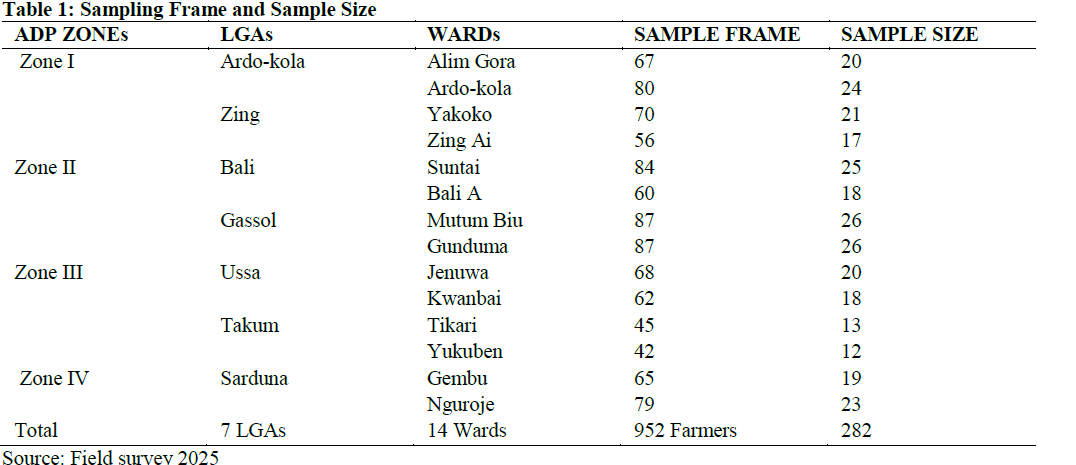
The study assessed the utilization of climate-smart agriculture among arable-crop farmers in Taraba State, Nigeria. The specific objectives were to describe the socio-economic characteristics of the respondents; and assess the extent of utilization of CSA by respondents. A multi-stage sampling technique was used to select 278 respondents from seven local government areas. Primary data were collected through structured questionnaire and analyzed using descriptive statistics and likert-type rating scales as described by Best and Kahn (2006). Results revealed that the mean age of the farmers was 42 years, indicating that most respondents were in their active and productive years. The majority (75.54%) were male, and most (86.33%) were married, with an average household size of nine persons. The mean farm size was 2.51 hectares, indicating that most respondents were smallholder farmers. A considerable proportion had secondary (33.45%) and tertiary education (30.94%), while 58.27% had access to credit and were members of cooperative societies. The findings further showed that commonly utilized CSA practices include early planting (mean=2.74), use of improved seed varieties (mean=2.65), and drought-tolerant crops (mean=2.57). However, the overall level of the utilization was moderate, indicating that although farmers are aware of CSA technologies their level of use remains suboptimal. It is therefore recommended that the government and relevant stakeholders strengthen extension services, improve access to credit, invest in rural infrastructure, and promote policies that support the utilization of climate-smart agriculture practices.
References
Adebayo, A.E. and Ojogu, E.O. (2019). Assessment of the use of climate smart agricultural practices among smallholder farmers in Ogun state. Acta Sci Agric 3(6):47–56
Agbaji, S. T. and Terngu, A. T. (2022). Socio-economic factors influencing the use of organic fertilizer among arable crop farmers in Benue State, Nigeria. Nigerian Journal of Soil and Environmental Research, 20(1), 70–78.
Alabi, A. A., Wahab, M., K. A., Busari, A. O., Adeniyi, K.M. I., Akinduro, V. O. And Akintaiwo, R.A. (2023). Factors Influencing Climate Change Adaptation Strategies Among Arable Crop Farmers in Osun State, Nigeria. Economic Engineering in Agriculture and Rural Development Vol. 23, (3), 2285-3952
Amafade, U. G., Evwierhurhoma, F. E., Abuche, O. P., Ekokogbe, O. T., Gideon, O. O., and Omosigho, N. E. (2024). Adoption Of Climate-Smart Agricultural Practices by Cassava Farmers in Delta State, Nigeria, IJARIIE 10 (3), 2395-4396
Antwi-Agyei, P., Abalo, E.M., Dougill, A.J. and Baffour-Ata, F. (2021). Motivations, enablers and barriers to the adoption of climate-smart agricultural practices by smallholder farmers: evidence from the transitional and savannah agroecological zones of Ghana. Reg Sustain 2:375–386.
Asfaw, S., McCarthy, N., Lipper, L., Arslan, A. and Cattaneo, A. (2016). What determines farmers’ adaptive capacity? Empirical evidence from Africa. Food Security, 8, 643–664. https://doi.org/10.1007/s12571-016-0586-7
Baiyegunhi, L. J. S., Akinbosoye, F., & Bello, L. O. (2022). Welfare impact of improved maize varieties adoption and crop diversification practices among smallholder maize farmers in Ogun State, Nigeria. Heliyon, 8(5), e09338. https://doi.org/10.1016/j.heliyon.2022.e093 38
Bashir, M.B., Faruk, A.U., Abdullahi, M.M and Yusuf, B. (2025). Rice Farmers’ Awareness of Climate- Smart Agriculture (CSA) Practices in Taraba State, Nigeria. Journal of Arid Agriculture, 26 (2): 16 - 23
Brede, J. M. and Sanger, H. (2022). Age and its impact on technology adoption among smallholder farmers in Nigeria. International Journal of Agricultural Economics, 7(2), 113-128.
Ekpa, D., Tiri, G. D. and Ekpa, M.O. (2021). Analysis of the Challenges of Climate-Smart Agricultural Practices among Crop Farmers in North-West, Nigeria, Journal of Agriculture and Environment, 17 (2), 7-27
Ezra, A., Adebayo, A. A. and Umar, A. S. (2020) Application of Multi-Criteria Decision Making (MCDM) Model in Agro-climatic zoning of Taraba State for Ofada rice production. FUTY Journal of the Environment 14(1): 107-120
FAO. (2019). FAO’s work on climate change. United Nations Climate Change Conference 2019. Rome. 40 pp. www.fao.org/3/ca7126en/ca7126en.pdf.
Fasoranti, O. O. and Olorunfemi, D. O. (2021). Effect of farmer characteristics on the productivity of arable crops in Ekiti State, Nigeria. Journal of Agricultural Science and Practice, 6(1), 18–28.
Henri-Ukoha, A. (2020). Assessment of the viability of climate adaptation strategies of cassava-based farmers in Southern Nigeria. Journal of Agriculture and Food Sciences. 18(1):105–117.
Idiku, F. O., Archibong, E. E., Essien, E. N., Ediene, V. F., Eremi, E. O., and Aya, C.F. (2026). Utilization of Climate-Smart agricultural practices among rural farmers in Cross River State Nigeria. Agro Bali: Agricultural Journal, (9) 1: 244–254
Izuagbe, I. R., Fadare, O. G. and Ibrahim, M. A. (2023). Impact Assessment of Flooding on Food Security: A Case Study of Koton-Karfe in Kogi Local Government Area of Kogi State, International Journal of Social Science and Humanities Research, 11 (3), 74-82. DOI: https://doi.org/10.5281/zenodo.8214313.
Jacob, M. (2021). "An Analysis of the Impacts of Climate Change on Food Security in the Albertine Rift of East Africa" (2021). International Development, Community and Environment (IDCE). 248.https://commons.clarkus.edu/idce_masters_papers/248
Keovilignavong, O. and Suhardiman, D. (2020). Linking land tenure security with food security: unpacking farm households’ perceptions and strategies in the rural uplands of Laos. Land Use Policy 90:104260.
Khatri-Chhetri, A., Pant, A. and Aggarwal, P.K. (2019). Stakeholders’ prioritization of climate-smart agriculture interventions: evaluation of a framework. Agric Syst 174:23–31.
Kilani, O. F., Gbenga, O. F., Aminu, M. I. and Roselyn, I. I. (2023). Effect of Flooding on the Nigeria Economic Growth: A Case Study of Lokoja, Kogi State, International Journal of Social Science and Humanity, 11 (2), 234-242. https://doi.org/10.5281/zenodo.7944447.
Lipper, L., Thornton, P., Campbell, B. M., Baedeker, T., Braimoh, A., Bwalya, M. and Torquebiau, E. F. (2014). Climate-smart agriculture for food security. Nature Climate Change, 4(12), 1068-1072.
Martey, E., Etwire, P.M. and Mockshell, J. (2021). Climate-smart cowpea adoption and welfare effects of comprehensive agricultural training programs. Technol Soc 64:101468.
Mupangwa, W., Nyagumbo, I., Liben, F., Chipindu, L., Craufurd, P., and Mkuhlani, S. (2021). Maize yields from rotation and intercropping systems with different legumes under conservation agriculture in contrasting agro-ecologies. Agriculture, ecosystems & environment, 306, 107170.
Musafiri, C.M., Kiboi, M. and Macharia, J. (2022). Adoption of climate-smart agricultural practices among smallholder farmers in Western Kenya: do socioeconomic, institutional, and biophysical factors matter? Heliyon 8.
Mutombo, P. and Musarandega, H. (2023). Unpacking the determinants of climate-smart agriculture adoption by smallholder farmers in Ward 10, Zvimba District, Zimbabwe. Eur J Dev Stud 3:74–84.
Muzangwa, L., Mnkeni, P. N. S., and Chiduza, C. (2017). Assessment of conservation agriculture practices by smallholder farmers in the Eastern Cape Province of South Africa. Agronomy, 7(3), 46.
National Population Census (NPC), (2006). Federal Republic of Nigeria Official Gazette, Vol. 94, Lagos. 244pp
Ngaiwi, M. E., Molua, E. L., Sonwa, D. J., Meliko, M. O., Bomdzele, E. J., Ayuk, J. E., and Latala, M. M. (2023). Do farmers’ socioeconomic status determine the adoption of conservation agriculture? Empirical evidence from Eastern and Southern Regions of Cameroon. Scientific African, 19, e01498.
Ojoko, E.A., Akinwunmi, J.A., Yusuf, S.A. and Oni, O.A. (2017). Factors influencing the level of use of climate-smart agricultural practices (CSAPs) in Sokoto State, Nigeria. J Agric Sci 62(3):315–327
Okeke, M. N. and Eze, S. O. (2023). Gender and adoption of agricultural technologies among arable crop farmers in Anambra State, Nigeria. International Journal of Agricultural Research and Food Production, 8(2), 15–25.
Okon, U. E., Ernest, I. J. and Udoh, A. N. (2024). Determinants of Use of Climate-Smart Practices Among Arable Crop Farmers in Uyo Agricultural Zone, Akwa Ibom State, Nigeria. Journal Of Agripreneurship and Sustainable Development, (7)4,2651-6144
Oluwasusi, J. O. and Ajayi, M. T. (2021). Determinants of adoption of improved maize varieties among arable crop farmers in Oyo State, Nigeria. Journal of Agricultural Extension, 25(4), 99–110.
Ouedraogo, M., Houessionon, P., Zougmore, R. And Partey, S., 2019. Uptake of climate-smart agricultural technologies and practices: Actual and potential adoption rates in the climate-smart village site of Mali. Sustainability, 11(17): 4710.
Pelemo, J. J., Ajibola, B. O., Adeyemi, O. A., Shehu, M. and Adewumi, A. (2024). Adoption of climate-smart practices among arable crop farmers in Kogi State, Nigeria. Journal of Agricultural Extension 28 (4), 110- 119
Pelemo, J. J., Olaleye, R. S., Umar, I. S., Tsado, J. H. and Mohammed, U. (2019). Analysis of Socioeconomic Benefits Derived from Cashew Production in Kogi State, Nigeria, Journal of Agricultural Economics, Extension and Social Sciences, 2 (1), 36–42.
Sam, K. O., Botchway, V. A., Karbo, N., Essegbey, G. O., Nutsukpo, D. K., and Zougmoré, R. B. (2020). Evaluating the utilization of Climate-Smart Agriculture (CSA) technologies and practices among smallholder farmers in the Lawra, Jirapa and Nandom districts of Ghana. Ghana Journal of Agricultural Science, 55(2), 122–144. https://doi.org/10.4314/gjas.v55i2.10
Thornton, P. K. and Herrero, M. (2022). Climate change adaptation in livestock systems. Annual Review of Animal Biosciences, 10(1), 437–456.DOI: 10.1146/annurev-animal-020520-115828
Yahaya, K. M. and Suleiman, R. A. (2023). Access to extension services and its impact on arable crop production in Niger State, Nigeria. African Journal of Agricultural Research, 18(5), 122–129.
Yamane, T. (1967). Statistics: An Introductory Analysis, 2nd Ed., New York: Harper and Row.
Zheng, H., Ma, W. and He, Q (2024). Climate Smart Agricultural Practices for enhanced farm Productivity, Income, Resilience, and Greenhouse Gas Mitigation: A Comprehensive review. Mitigation Adaptation Strategies Global Change, 29-28 1-38, https://doi.org/10.1007/s11027-024-10124-6.
Zikusooka, E. and Irumba, A. (2025). Climate-Smart Agriculture and Drought-Resistant Crop Varieties: A Case Study of National Agricultural Research Organization (NARO), Metropolitan Journal of Environmental and Health Research, Vol. 4 Issue 5, May - 2025, Pages: 720- 733
Zougmoré, R. B., Läderach, P., and Campbell, B. M. (2021). Transforming food systems in Africa under climate change pressure: Role of climate-smart agriculture. Sustainability, 13(8), 4305.
Zougmoré, R., Partey, S., Ouédraogo, M., Omitoyin, B., Thomas, T., Ayantunde, A., Ericksen, P., Said, M. and Jalloh, A. (2016). Toward climate-smart agriculture in West Africa: A review of climate change impacts, adaptation strategies and policy developments for the livestock, fishery and crop production sectors. Agriculture and Food Security, 5(1), 1–16. https://doi.org/10.1186/s40066-016-0075-3
Downloads
Published
Issue
Section
Categories
License
Copyright (c) 2026 Celestine Gwayem, Ibrahim Usman, Mahammad Ahmed

This work is licensed under a Creative Commons Attribution 4.0 International License.


