
In Silico Study of Selected Bambara Groundnut Bioactive Compounds on Anti-Lipogenic Protein Targets in Non-Alcoholic Fatty Liver Disease
DOI:
https://doi.org/10.33003/fjs-2026-1023-5766Keywords:
Bambara Groundnut, Molecular Docking, Isoquercitrin, Network Pharmacology, Nutraceuticals, Non-Alcoholic Fatty Liver DiseaseAbstract
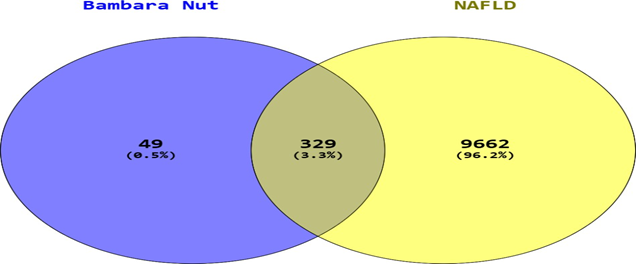
Non-alcoholic fatty liver disease (NAFLD) is characterised by excessive hepatic triglyceride accumulation independent of significant alcohol intake and is strongly associated with obesity, insulin resistance and type 2 diabetes. Bambara groundnut (Vigna subterranea) is a nutrient-dense legume rich in phenolic compounds with documented antioxidant and anti-inflammatory properties. This study employed an integrated network pharmacology and molecular docking approach to investigate the potential of selected Bambara groundnut bioactive compounds against anti-lipogenic protein targets in NAFLD. Phytochemicals were subjected to target prediction (SwissTargetPrediction), disease-gene mapping (GeneCards), consensus target identification (Venny 2.1.0), Gene Ontology and KEGG enrichment (ShinyGO), protein–protein interaction network analysis (STRING/Cytoscape) and molecular docking with MM-GBSA binding free energy calculations (Schrödinger Maestro). A total of 329 consensus genes were identified. Hub genes included EGFR, SRC, ERBB2, PIK3CA and PIK3R1. Molecular docking revealed that isoquercitrin exhibited the strongest binding affinity for EGFR (Glide score −13.520 kcal/mol; MM-GBSA ΔGbind −59.60 kcal/mol). Rutin, quercitrin, ellagic acid, myricetin and luteolin also showed favourable interactions across multiple targets. These findings suggest that Bambara groundnut flavonoids, particularly isoquercitrin and rutin, may modulate key signalling pathways involved in hepatic lipid accumulation and inflammation, supporting their potential as nutraceutical candidates for NAFLD management. Experimental validation is recommended.
References
Bu, D., Luo, H., Huo, P., Wang, Z., Zhang, S., & He, Z. (2021). KOBAS-i: Intelligent prioritization and exploratory visualization of biological functions for gene enrichment analysis. Nucleic Acids Research, 49(W1), W317–W325. https://doi.org/10.1093/nar/gkab447
Burley, S. K., Bhikadiya, C., Bi, C., Bittrich, S., Chen, L., Crichlow, G. V., ... & Zardecki, C. (2023). RCSB Protein Data Bank: Tools for visualizing and understanding biological macromolecules in 3D. Nucleic Acids Research, https://doi.org/51(D1),D488–D508
Chalasani, N., Younossi, Z., Lavine, J. E., Charlton, M., Cusi, K., Rinella, M., ... & Sanyal, A. J. (2018). The diagnosis and management of nonalcoholic fatty liver disease: Practice guidance from the American Association for the Study of Liver Diseases. Hepatology, 67(1), 328–357. https://doi.org/10.1002/hep.29367
Chiriac, S., Stanciu, C., Girleanu, I., Cojocariu, C., Sfarti, C., Singeap, A. M., ... & Trifan, A. (2021). Nonalcoholic fatty liver disease and cardiovascular diseases: The heart of the matter. Canadian Journal of Gastroenterology & Hepatology, 2021, 6696857. https://doi.org/10.1155/2021/6696857
Daina, A., Michielin, O., & Zoete, V. (2019). SwissTargetPrediction: Updated data and new features for efficient prediction of protein targets of small molecules. Nucleic Acids Research, 47(W1), W357–W364. https://doi.org/10.1093/nar/gkz382
Feyisa, Z. (2026). Non-alcoholic fatty liver disease in type 2 diabetes mellitus: Prevalence and associated factors. [Journal details as cited in original manuscript].
Gao, S. S., Sun, J. J., Wang, X., Hu, Y. Y., Feng, Q., & Gou, X. J. (2020). Research on the mechanism of Qushi Huayu decoction in the intervention of nonalcoholic fatty liver disease based on network pharmacology and molecular docking technology. BioMed Research International, 2020, 1704960. https://doi.org/10.1155/2020/1704960
Ge, S. X., Jung, D., & Yao, R. (2020). ShinyGO: A graphical gene-set enrichment tool for animals and plants. Bioinformatics, 36(8), 2628–2629. https://doi.org/10.1093/bioinformatics/btz931
Hillocks, R. J., Bennett, C., & Mponda, O. M. (2012). Bambara nut: A review of utilisation, market potential and crop improvement. African Crop Science Journal, https://doi.org/20(1),1–16
Kim, S., Chen, J., Cheng, T., Gindulyte, A., He, J., He, S., ... & Bolton, E. E. (2019). PubChem 2019 update: Improved access to chemical data. Nucleic Acids Research, https://doi.org/47(D1),D1102–D110 .
Luo, H., Lin, Y., Liu, T., Lai, F., Zhang, C., Gao, F., & Chen, Y. (2022). GeneCards: The human gene database. Nucleic Acids Research, https://doi.org/50(D1),D154–D162
Okafor, E. C., Oyeyinka, S. A., & Adeyeye, S. A. O. (2022). Phytochemical properties of Bambara groundnut (Vigna subterranea). Heliyon, 8(6), e09765. https://doi.org/10.1016/j.heliyon.2022.e09765
Poochanasri, M., Kookanok, C., Kaewput, W., Rangsin, R., Sathavarodom, N., Boonyavarakul, A., & Samakkarnthai, P. (2025). Comparison of obesity prevalence and associated factors among Thai patients with type 2 diabetes between 2014 and 2018. Diabetology & Metabolic Syndrome, 17(1), 254. https://doi.org/10.1186/s13098-025-01781-x
Powell, E. E., Wong, V. W., & Rinella, M. (2021). Non-alcoholic fatty liver disease. The Lancet, 397(10290), 2212–2224. https://doi.org/10.1016/S0140-6736(20)32511-3
Qin, Y., Qian, C., Li, W., Wang, Q., Sheng, Q., Chen, Z., ... & Geng, D. (2026). Oxidative stress: Molecular mechanisms, diseases, and therapeutic targets. MedComm, 7(2), e70600. https://doi.org/10.1002/mco2.70600
Wang, H., Cheng, W., Hu, P., Ling, T., Hu, C., Chen, Y., ... & You, Q. (2024). Integrative analysis identifies oxidative stress biomarkers in non-alcoholic fatty liver disease via machine learning and weighted gene co-expression network analysis. Frontiers in Immunology, 15, 1335112. https://doi.org/10.3389/fimmu.2024.1335112
Younossi, Z. M., Golabi, P., de Avila, L., Paik, J. M., Srishord, M., Fukui, N., & Nader, F. (2018). The global epidemiology of NAFLD and NASH in patients with type 2 diabetes: A systematic review and meta-analysis. Journal of Hepatology, https://doi.org/64(1),73–84
Zhang, X., Zhang, J., Zhou, Z., Xiong, P., Cheng, L., Ma, J., ... & Xiao, C. (2024). Integrated network pharmacology, metabolomics, and transcriptomics of Huanglian-Hongqu herb pair in non-alcoholic fatty liver disease. Journal of Ethnopharmacology, 325, 117828. https://doi.org/10.1016/j.jep.2024.117828
Downloads
Published
Issue
Section
Categories
License
Copyright (c) 2026 Oluwaseun Adewole, Okikiola Olanrewaju, Olusegun Akinola, Iseoluwani Oyejobi, Oladimeji Emmanuel, Modupe Adetayo, Samuel Adewole, Ngozi Ukangwa, Abel Fadipe

This work is licensed under a Creative Commons Attribution 4.0 International License.