
Machine Learning for Diabetes Prediction: A Systematic Review of Data Sources, Algorithms, Validation Practices and Implications for Nigeria
DOI:
https://doi.org/10.33003/Keywords:
Diabetes Mellitus, Machine Learning, Risk Prediction, Systematic Review, Model Validation, NigeriaAbstract
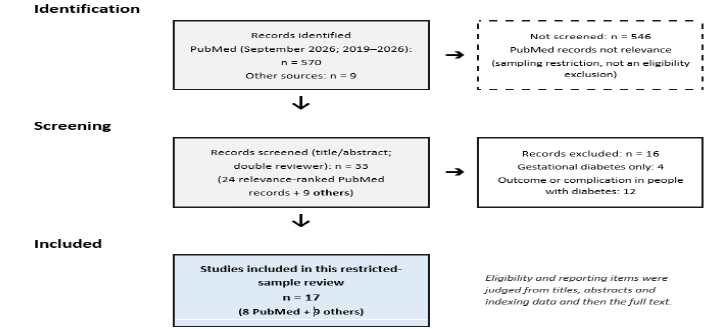
Machine learning (ML) is widely proposed for early diabetes prediction, but the reliability of reported performance is uncertain. This systematic review describes the data sources, algorithms, validation designs and reporting practices of recent ML diabetes prediction studies and draws implications for Nigeria and other low-resource settings. PubMed was searched in September 2026 for studies published between 2019 and 2026 (570 Articles). The 24 highest relevance-ranked database records and 9 records from preliminary searches were screened, and 17 primary studies were included. Data on data source, sample size, algorithms, validation, performance, 7 reporting items were extracted and synthesised narratively. Gradient boosting (12 studies), random forests (11), regression models (9) were the most frequent algorithms, and four studies used the Pima Indians Diabetes Database. Reported area under the curve ranged from 0.73 to 0.996 (median 0.85), with the highest values in large public datasets where glycaemic variables dominated predictions. Explainability was reported in 10 studies, yet only one evaluated model in an independent population, one reported calibration and one assessed fairness. One study used African data (Rwanda) and none used Nigerian data. Reported accuracy therefore, probably overstates real-world performance. Priorities include representative Nigerian datasets, leakage-free preprocessing, external validation, calibration and fairness assessment, and models that avoid diagnostic variables when early detection is the aim. Findings are limited by single-database searching and partial screening
References
Aich, A., Murshed, M. M., Hewage, S., & Mayeaux, A. (2026). A copula based supervised filter for feature selection in machine learning driven diabetes risk prediction. Scientific Reports, 16(1). https://doi.org/10.1038/s41598-026-41874-9
Bi, Y., Yuan, X., Wang, Y., Sun, C., & Tian, S. (2026). Machine-learning-based prediction model of type 2 diabetes using liver enzymes: A cross-sectional study. Frontiers in Endocrinology, 17, Article 1905144. https://doi.org/10.3389/fendo.2026.1905144
Breiman, L. (2001). Random forests. Machine Learning, 45(1), 5–32. https://doi.org/10.1023/A:1010933404324
Chawla, N. V., Bowyer, K. W., Hall, L. O., & Kegelmeyer, W. P. (2002). SMOTE: Synthetic minority over-sampling technique. Journal of Artificial Intelligence Research, 16, 321–357. https://doi.org/10.1613/jair.953
Chen, T., & Guestrin, C. (2016). XGBoost: A scalable tree boosting system. In Proceedings of the 22nd ACM SIGKDD International Conference on Knowledge Discovery and Data Mining (pp. 785–794). ACM. https://doi.org/10.1145/2939672.2939785
Christodoulou, E., Ma, J., Collins, G. S., Steyerberg, E. W., Verbakel, J. Y., & Van Calster, B. (2019). A systematic review shows no performance benefit of machine learning over logistic regression for clinical prediction models. Journal of Clinical Epidemiology, 110, 12–22. https://doi.org/10.1016/j.jclinepi.2019.02.004
Collins, G. S., Reitsma, J. B., Altman, D. G., & Moons, K. G. M. (2015). Transparent reporting of a multivariable prediction model for individual prognosis or diagnosis (TRIPOD): The TRIPOD statement. BMJ, 350, Article g7594. https://doi.org/10.1136/bmj.g7594
Dadashpour, M., Yousefi, M., Effati, S., & Hafezi, S. G. (2026). Evaluation and comparison of machine learning methods for type 2 diabetes classification and associated factors. Healthcare Informatics Research, 32(3), 214–223. https://doi.org/10.4258/hir.2026.32.3.214
Johnson, E. S., Gandhi, U., Reddy, U. S., & Mangalanathan, U. (2025). Generative AI models for type 2 diabetes mellitus risk prediction. Health Systems, 15(1), 66–89. https://doi.org/10.1080/20476965.2025.2546904
Kamkar, N., Behzadi, S., Mahdavizadeh, V., Maali Tafti, M., Mansoori, A., Poudineh, M., Esmaily, H., & Ghayour-Mobarhan, M. (2026). A machine learning-based framework for predicting type 2 diabetes mellitus using hematological indices. American Heart Journal Plus: Cardiology Research and Practice, 69, Article 100854. https://doi.org/10.1016/j.ahjo.2026.100854
Kaufman, S., Rosset, S., Perlich, C., & Stitelman, O. (2012). Leakage in data mining: Formulation, detection, and avoidance. ACM Transactions on Knowledge Discovery from Data, 6(4), Article 15. https://doi.org/10.1145/2382577.2382579
Kavakiotis, I., Tsave, O., Salifoglou, A., Maglaveras, N., Vlahavas, I., & Chouvarda, I. (2017). Machine learning and data mining methods in diabetes research. Computational and Structural Biotechnology Journal, 15, 104–116. https://doi.org/10.1016/j.csbj.2016.12.005
Khan, T. F., Saeed, M., Hussain, M., Khan, L., Khan, M. Z., Nadeem, A., & Alghamdi, T. (2026). A comparative and interpretable machine learning framework for reliable diabetes risk prediction. Scientific Reports, 16. https://doi.org/10.1038/s41598-026-61038-z
Khokhar, P. B., Gravino, C., & Palomba, F. (2024). Advances in artificial intelligence for diabetes prediction: Insights from a systematic literature review [Preprint]. arXiv.
Kiran, M., Xie, Y., Anjum, N., Ball, G., Pierscionek, B., & Russell, D. (2025). Machine learning and artificial intelligence in type 2 diabetes prediction: A comprehensive 33-year bibliometric and literature analysis. Frontiers in Digital Health, 7. https://doi.org/10.3389/fdgth.2025.1557467
Kopitar, L., Kocbek, P., Cilar, L., Sheikh, A., & Stiglic, G. (2020). Early detection of type 2 diabetes mellitus using machine learning-based prediction models. Scientific Reports, 10(1), Article 11981. https://doi.org/10.1038/s41598-020-68771-z
Lim, D., Kim, A., Lee, H., & Woo, K. (2026). Enhancing community-based nursing decision support: Machine learning models for diabetes risk prediction using home health nursing notes. Public Health Nursing, 43(4), 1043–1055. https://doi.org/10.1111/phn.70122
Lundberg, S. M., & Lee, S.-I. (2017). A unified approach to interpreting model predictions. Advances in Neural Information Processing Systems, 30, 4765–4774.
Majyambere, S., Lindgren, T., Twizere, C., & Ntakirutimana, I. (2026). Early type 2 diabetes risk prediction using explainable machine learning in a two-stage approach. Frontiers in Digital Health, 8, Article 1743619. https://doi.org/10.3389/fdgth.2026.1743619
Mohsen, F., Biswas, M. R., Ali, H., Alam, T., Househ, M., & Shah, Z. (2022). Customized and automated machine learning-based models for diabetes type 2 classification. Studies in Health Technology and Informatics, 295, 517–520. https://doi.org/10.3233/SHTI220779
Moons, K. G. M., Wolff, R. F., Riley, R. D., Whiting, P. F., Westwood, M., Collins, G. S., Reitsma, J. B., Kleijnen, J., & Mallett, S. (2019). PROBAST: A tool to assess risk of bias and applicability of prediction model studies: Explanation and elaboration. Annals of Internal Medicine, 170(1), W1–W33. https://doi.org/10.7326/M18-1377
Nanda Kishore, M., & Navaneethan, C. (2026). Quantifying the imputation paradox and XAI inconsistency in multi-source diabetes prediction: A 353,680-record leakage-free stacking ensemble with dynamic routing architecture. Frontiers in Artificial Intelligence, 9, Article 1898153. https://doi.org/10.3389/frai.2026.1898153
Nasrin, A., Asif, M. B., Naidu, R., Asif, A. H., Chohan, M. S., Khan, G. A., Arifuzzaman, M., Azad, A. K. M., & Martuza, M. A. (2026). An optimized and explainable machine learning framework for diabetes prediction using Marine Predators Algorithm and SHAP. Journal of Personalized Medicine, 16(8), Article 423. https://doi.org/10.3390/jpm16080423
Obermeyer, Z., Powers, B., Vogeli, C., & Mullainathan, S. (2019). Dissecting racial bias in an algorithm used to manage the health of populations. Science, 366(6464), 447–453. https://doi.org/10.1126/science.aax2342
Olamoyegun, M. A., Alare, K., Afolabi, S. A., Aderinto, N., & Adeyemi, T. (2024). A systematic review and meta-analysis of the prevalence and risk factors of type 2 diabetes mellitus in Nigeria. Clinical Diabetes and Endocrinology, 10(1), 1–13. https://doi.org/10.1186/s40842-024-00209-1
Page, M. J., McKenzie, J. E., Bossuyt, P. M., Boutron, I., Hoffmann, T. C., Mulrow, C. D., Shamseer, L., Tetzlaff, J. M., Akl, E. A., Brennan, S. E., Chou, R., Glanville, J., Grimshaw, J. M., Hróbjartsson, A., Lalu, M. M., Li, T., Loder, E. W., Mayo-Wilson, E., McDonald, S., . . . Moher, D. (2021). The PRISMA 2020 statement: An updated guideline for reporting systematic reviews. BMJ, 372, Article n71. https://doi.org/10.1136/bmj.n71
Ravi, R., & Olickal, J. J. (2026). Machine learning-based risk prediction models for type 2 diabetes in primary care: A scoping review. Frontiers in Public Health, 14, Article 1946070. https://doi.org/10.3389/fpubh.2026.1946070
Riley, R. D., Ensor, J., Snell, K. I. E., Harrell, F. E., Martin, G. P., Reitsma, J. B., Moons, K. G. M., Collins, G., & van Smeden, M. (2020). Calculating the sample size required for developing a clinical prediction model. BMJ, 368, Article m441. https://doi.org/10.1136/bmj.m441
Rudin, C. (2019). Stop explaining black box machine learning models for high stakes decisions and use interpretable models instead. Nature Machine Intelligence, 1(5), 206–215. https://doi.org/10.1038/s42256-019-0048-x
Salas-Ramos, B. M., Garcia-Calvillo, I., Navarro-Acosta, J. A., & Mendoza-Frías, G. I. (2026). Predicting individuals at risk of diabetes using machine learning. Cureus, 18(5), Article e109761. https://doi.org/10.7759/cureus.109761
Shin, J., Kim, J., Lee, C., Yoon, J. Y., Kim, S., Song, S., & Kim, H.-S. (2022). Development of various diabetes prediction models using machine learning techniques. Diabetes & Metabolism Journal, 46(4), 650–657. https://doi.org/10.4093/dmj.2021.0115
Shobha, T., Pradeep, S., Patil, S., Subramanya, J., & Mitra, G. B. S. (2026). A data-driven machine learning model for effective diabetes diagnosis. Scientific Reports, 16(1). https://doi.org/10.1038/s41598-026-63505-z
Smith, J. W., Everhart, J. E., Dickson, W. C., Knowler, W. C., & Johannes, R. S. (1988). Using the ADAP learning algorithm to forecast the onset of diabetes mellitus. In Proceedings of the Annual Symposium on Computer Application in Medical Care (pp. 261–265).
Teruna, M. M. S., Razak, T. R., Yasin, S. M., Ali, A. A. R., Salleh, M. M. M., Yusoff, M. Z. M., Khebir, M. H. A., Rameli, N. A. C., Sallehhudin, M. I. M., Asraff, M. S. M., & Isa, M. R. (2026). Artificial intelligence driven prognostic models for predicting diabetic retinopathy risk in type 2 diabetes mellitus: A systematic review. The Medical Journal of Malaysia, 81(5), 759–768.
Uloko, A. E., Musa, B. M., Ramalan, M. A., Gezawa, I. D., Puepet, F. H., Uloko, A. T., Borodo, M. M., & Sada, K. B. (2018). Prevalence and risk factors for diabetes mellitus in Nigeria: A systematic review and meta-analysis. Diabetes Therapy, 9(3), 1307–1316. https://doi.org/10.1007/s13300-018-0441-1
Van Calster, B., McLernon, D. J., van Smeden, M., Wynants, L., & Steyerberg, E. W. (2019). Calibration: The Achilles heel of predictive analytics. BMC Medicine, 17, Article 230. https://doi.org/10.1186/s12916-019-1466-7
Vickers, A. J., & Elkin, E. B. (2006). Decision curve analysis: A novel method for evaluating prediction models. Medical Decision Making, 26(6), 565–574. https://doi.org/10.1177/0272989X06295361
Wang, Y., Wang, C., & Wang, J. (2026). Prediction models for progression from prediabetes to diabetes: A systematic review and meta-analysis. Frontiers in Endocrinology, 17, Article 1888466. https://doi.org/10.3389/fendo.2026.1888466
Xiao, H., Xi, Q., Zeng, P., Hao, J., He, Q., Wang, X., & Zhang, C. (2026). An XGBoost-based model for detecting undiagnosed type 2 diabetes using routine physical and lifestyle data from a multi-center Chinese population. Frontiers in Medicine, 13, Article 1798509. https://doi.org/10.3389/fmed.2026.1798509
Yata, V. K., Jena, S., Indracanti, M., Chitta, S., & Kolliputi, N. (2026). Adversarial debiasing for age-equitable diabetes prediction: Performance-fairness trade-offs and partition dependency in machine learning. Frontiers in Digital Health, 8, Article 1816806. https://doi.org/10.3389/fdgth.2026.1816806
Downloads
Published
Issue
Section
Categories
License
Copyright (c) 2026 Alhaji Abdullahi Gwani, Siok Kun Sek, Waziri Usman

This work is licensed under a Creative Commons Attribution 4.0 International License.