
Biomass-Derived Hydrogen Donor and Equilibrated Zeolite Assisted Upgrading of Extra Heavy Bitumen: Reactor Response, Viscosity Reduction, and Compositional Shift
DOI:
https://doi.org/10.33003/fjs-2026-1021-5826Keywords:
Bitumen Upgrading, Hydrogen Donor, Biomass, Rice Husk, Zeolite Catalyst, API GravityAbstract
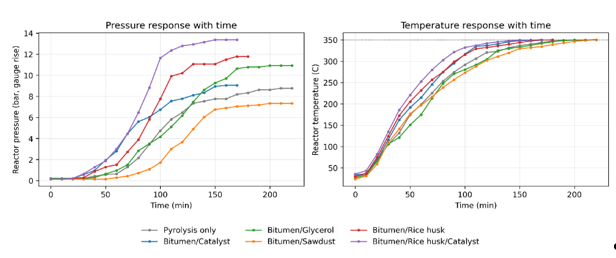
Nigerian bitumen sourced from Agbabu, Ondo State, is classified as an extra heavy oil, with an API gravity of 8.6° and a viscosity of 32000 mPa s at 40°C, properties that render it unsuitable for pipeline transportation or direct refinery feedstock without prior upgrading. This study evaluated hydrogen addition upgrading of the bitumen using three renewable biomass derived hydrogen donors, glycerol, sawdust, and rice husk, assessed individually and with rice husk further combined with an equilibrated zeolite catalyst, benchmarked against pyrolysis alone and catalytic upgrading without a hydrogen donor. Runs were performed in a high pressure batch reactor pressurized with 10 bar nitrogen and heated to 350°C, with pressure and temperature recorded at 10 min intervals. Upgraded liquid products were characterized for viscosity, density, and API gravity, and analyzed by Fourier transform infrared (FTIR) and gas chromatography mass spectrometry (GCMS). Viscosity decreased from 32000 mPa s in the raw feedstock to between 1900 and 2700 mPa s across the upgrading routes, a reduction of 90.6 to 94.1%, while API gravity rose from 8.6° to between 24.3° and 28.9°. The combination of rice husk and catalyst produced the most favorable outcomes, yielding the greatest viscosity reduction and highest API gravity; this ranking was consistent across all routes, with sawdust the least effective additive. Reactor pressure rise, indicative of gas evolution, was likewise greatest for the rice husk and combined runs. These findings establish rice husk as a cost effective, promising renewable hydrogen donor for bitumen upgrading, particularly with zeolite catalysis.
References
References
Bannerjee, D. K. (2012). Oil Sands, Heavy Oil, and Bitumen: From Recovery to Refinery (1st ed.). Tulsa, Oklahoma: PennWell Corporation.
Behrendt, F., Neubauer, Y., Oevermann, M., Wilmes, B., and Zobel, N. (2008). Direct liquefaction of biomass. Chemical Engineering and Technology, 31(5), 667 to 677.
Bejjenki, A. (2015). Performance of bituminous mixes with modified binders. SSRG International Journal of Civil Engineering, 2(3), 1 to 2.
Bilkadi, Z. (2018, March 7). Bitumen, a history. Saudi Aramco World. Retrieved from http://www.saudiaramcoworld.com/issue/198406/bitumen..a.history.html
Blasi, C. D. (2009). Combustion and gasification rates of lignocellulosic chars. Progress in Energy and Combustion Science, 35(2), 121 to 140.
Cornelius, C. D., and Voelker, A. E. L. (1984). Classification of natural bitumen: a physical and chemical approach.
Dayton, D. (2002). A Review of the Literature on Catalytic Biomass Tar Destruction (NREL Report TP-510-32815). Golden, Colorado: National Renewable Energy Laboratory.
Demirbas, A. (2001). Biomass resources facilities and biomass conversion processing for fuels and chemicals. Energy Conversion and Management, 42(11), 1357 to 1378.
Diebold, J. P., and Bridgwater, A. V. (1997). Overview of fast pyrolysis of biomass for the production of liquid fuels. In A. V. Bridgwater and D. G. B. Boocock (Eds.), Developments in Thermochemical Biomass Conversion (pp. 5 to 27). London: Blackie Academic and Professional.
Gary, J. H., Handwerk, G. E., and Kaiser, M. J. (2007). Petroleum Refining (3rd ed.). Boca Raton: CRC Press.
Gray, M. R. (2015). Upgrading Oilsands Bitumen and Heavy Oil. Edmonton: University of Alberta Press.
Klass, D. L. (1998). Biomass for Renewable Energy, Fuels, and Chemicals. San Diego: Academic Press.
Milos, C. (2015). Bitumen in Nigeria: Weighing the True Costs of Extraction. Abuja: Heinrich Boell Foundation Nigeria.
Oblad, A. (1997). The Extraction of Bitumen from Western Oil Sands (Vol. 1).
Quaak, P., Knoef, H. A. M., and Stassen, H. (1999). Energy from Biomass: A Review of Combustion and Gasification Technologies (Technical Paper No. 422). Washington, DC: The World Bank, Energy Series.
Santos, R. G., Loh, W., Bannwart, A. C., and Trevisan, O. V. (2014). An overview of heavy oil properties and its recovery and transportation methods. Brazilian Journal of Chemical Engineering, 31(3), 571 to 590.
Speight, J. G. (2006). Handbook of Petroleum Analysis (2nd ed.). Hoboken, New Jersey: John Wiley and Sons.
Speight, J. G. (2011). Heavy and Extra Heavy Oil Upgrading Technologies. Oxford: Gulf Professional Publishing.
Yusuf, A., Al-Hajri, R. S., Al-Waheibi, Y. M., and Jibril, B. Y. (2016). In situ upgrading of Omani heavy oil with catalyst and hydrogen donor. Journal of Analytical and Applied Pyrolysis, 121, 102 to 112.
Downloads
Published
Issue
Section
Categories
License
Copyright (c) 2026 Abdulwasiu Abdurrahman, Fadimatu N. Dabai, Muhammad Ibrahim Idris

This work is licensed under a Creative Commons Attribution 4.0 International License.


