
Nasal Carriage of Staphylococcus Aureus and Methicillin-Resistant S. Aureus among Female University Employees in Ila-Orangun, Nigeria
DOI:
https://doi.org/10.33003/fjs-2026-1022-5827Keywords:
Staphylococcus aureus, MRSA, Nasal Colonization, Antimicrobial Resistance, Occupational Health, Tertiary Institution Workers, Multidrug ResistanceAbstract
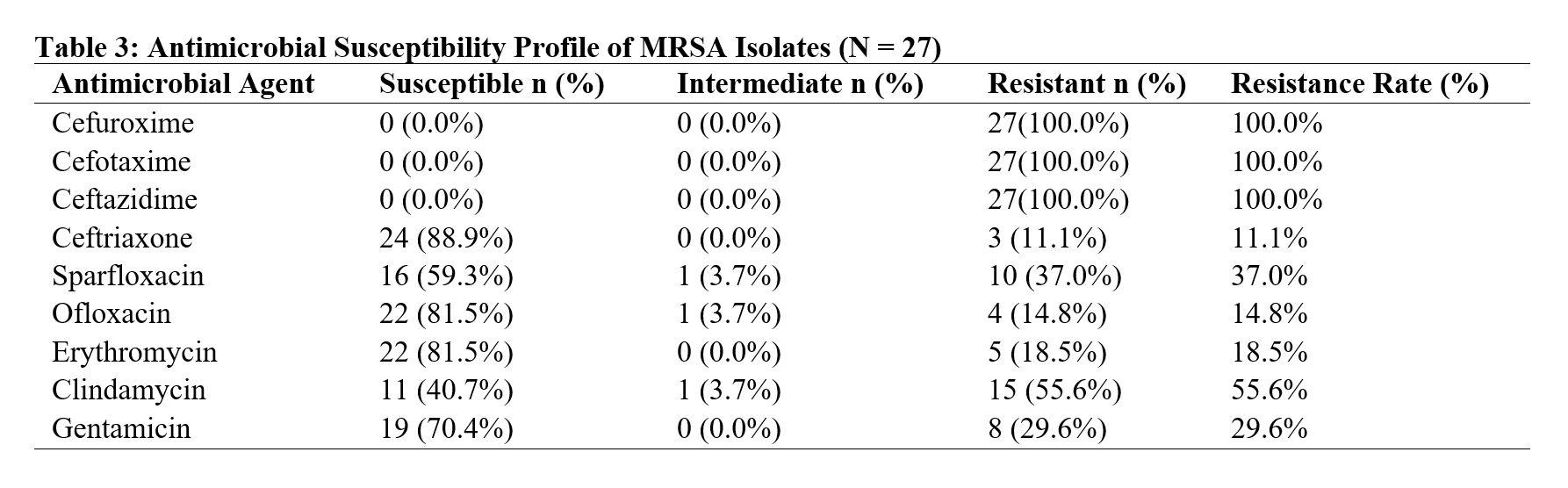
Staphylococcus aureus, including methicillin-resistant S. aureus (MRSA), represents a significant public health concern due to escalating antimicrobial resistance and potential for community transmission. A cross-sectional study was conducted among 127 workers at a tertiary institution. Participants comprised married women (n = 69) and single women (n = 58). Nasal swab specimens were collected using sterile techniques and processed using standard microbiological methods. S. aureus identification was performed through Gram staining, catalase testing, and coagulase testing. Antimicrobial susceptibility testing was conducted using the Kirby-Bauer method for disk diffusion. Colonization rates showed a non-significant trend toward difference by marital status, with married women demonstrating higher but non-statistically-significant prevalence (56.5%) compared to single women (39.7%, χ² = 3.58, p = 0.058). S. aureus was identified in 62 (48.8%) participants and 27 of 62 (43.5%) were methicillin-resistant, with comparable proportions between married (41.0%) and single women (47.8%). Antimicrobial resistance analysis revealed alarmingly high resistance rates to third-generation cephalosporins: cefuroxime (93.5%), cefotaxime (93.5%), and ceftazidime (90.3%). MRSA isolates showed high resistance rates to clindamycin (55.6%), sparfloxacin (37.0%), and gentamicin (29.6%). Conversely, relatively preserved susceptibility was observed for ceftriaxone (88.9%), ofloxacin (81.5%), and erythromycin (81.5%). This study reveals a high prevalence of S. aureus and MRSA nasal colonization among tertiary institution workers in a single cross-sectional survey, with high resistance rates to beta-lactam antibiotics. These findings highlight the need for targeted infection prevention and surveillance measures in non-healthcare occupational settings.
References
Abdullahi, I. N., Lari, A. R., Ramazanzadeh, R., Ranjbar, R., and Farshadzadeh, Z. (2022). Colonization and antibiotic resistance of nasal Staphylococcus aureus among healthcare workers in southwestern Iran: Occurrence of OS-MRSA. Journal of Advanced Biomedical Sciences, 12(4). https://doi.org/10.18502/jabs.v12i4.11440
Baroja, M. L., Eguiguren-Jiménez, L., Esparza, G., Zurita, J., and Paz-Y-Miño, A. (2021). Methicillin-resistant Staphylococcus aureus nasal colonization among health care workers of a tertiary hospital in Ecuador and associated risk factors. Infection and Drug Resistance, 14, 3385–3394. https://doi.org/10.2147/IDR.S326148
Baron, E. J. (2015). Specimen Collection, Transport, and Processing: Bacteriology. In Manual of Clinical Microbiology (eds J.H. Jorgensen, K.C. Carroll, G. Funke, M.A. Pfaller, M.L. Landry, S.S. Richter, D.W. Warnock, K.C. Carroll, G. Funke, K.A. Bernard, J.S. Dumler, M.B. Miller, C.A. Petti and P.A.R. Vandamme). https://doi.org/10.1128/9781555817381.ch18
Bawankar, P., Lahiri, K. K., Singh, M. M., and Shastri, J. (2025). Uncovering the silent public health threat: Nasal carriers of linezolid-resistant, vancomycin-intermediate and mupirocin-resistant MRSA among healthcare workers in a tertiary care hospital in Central India. GMS Hygiene and Infection Control, 20, Doc05. https://doi.org/10.3205/dgkh000547
Beshiru, A., and Uwhuba, K. E. (2023). Molecular identification and antibiogram of methicillin-resistant Staphylococcus aureus from wounds of both in-and out-patients at University of Benin Teaching Hospital (UBTH), Benin City, Nigeria. FUDMA Journal of Sciences, 7(3), 323-331
Giri, S., Pant, N. D., Lekhak, B., Chaudhary, R., and Raut, M. (2021). Nasal carriage of methicillin-resistant Staphylococcus aureus among healthcare workers in a tertiary care hospital, Kathmandu, Nepal. International Journal of Microbiology, 2021, 8825746. https://doi.org/10.1155/2021/8825746
Ibrahim, M., Woldeamanuel, Y., Kahsay, A. G., Teklehaimanot, T., Tuem, K. B., and Gebreyes, W. A. (2024). Antimicrobial resistance profile of Staphylococcus aureus isolated from patients, healthcare workers, and the environment in a tertiary hospital in Addis Ababa, Ethiopia. PLoS ONE, 19(8), e0308615. https://doi.org/10.1371/journal.pone.0308615
Ishore, K., Joshi, P., and Chaudhary, B. L. (2022). Prevalence of staphylococcal nasal carriage among health care worker working in intensive and critical care units of a tertiary care hospital. Journal of Medical Sciences and Health, 8(1), 46–51. https://doi.org/10.46347/jmsh.2022.v8i1.8
Karunarathna, N. D., Kottahachchi, J., Jayaweera, J. A. A. S., Gunasekara, C. P., and Kottahachchi, D. U. (2020). Association of Staphylococcus aureus nasal colonisation and mobile phone contamination in a Sri Lankan hospital. Ceylon Medical Journal, 65(4), 97–102. https://doi.org/10.4038/CMJ.V65I4.9285
Mitiku, E., Amsalu, A., Tadesse, S., and Awoke, T. (2023). Nasal carriage rate of Staphylococcus aureus, its associated factors, and antimicrobial susceptibility pattern among health care workers in public hospitals, Harar, Eastern Ethiopia. Infection and Drug Resistance, 16, 595–607. https://doi.org/10.2147/IDR.S396570
Moazen, M., Saki, M., Jafari, A., Khoshnood, S., and Emami, M. (2023). Characterization of Staphylococcus aureus nasal carriage among healthcare providers in an intensive care unit: Insights into antibiotic resistance profiles and virulence gene distribution. Archives of Clinical Infectious Diseases, 18(3), e137545. https://doi.org/10.5812/archcid-137545
Mohamoud, Y. A., Abdi, A. M., Mohamud, S. A., and Osman, M. O. (2023). Carriage rate and antimicrobial resistance profile of Staphylococcus aureus among healthcare workers at Edna Adan University Hospital. International Archives of Medical Microbiology, 2(1), 020. https://doi.org/10.23937/2643-4008/1710020
Nocera, F. P., Ferrara, G., Scandura, E., Ambrosio, M., Fiorito, F., and De Martino, L. (2021). A preliminary study on antimicrobial susceptibility of Staphylococcus spp. and Enterococcus spp. grown on mannitol salt agar in European wild boar (Sus scrofa) hunted in campania region—Italy. Animals, 12(1), 85.
Premanand, R., Shashidhar, V., Bandekar, N., Rao, S., and Gopalkrishna, B. K. (2023). Prevalence of mupirocin and methicillin-resistant Staphylococcus aureus in nasal carriage among healthcare workers in an intensive care unit and post-decolonization screening outcomes at a tertiary care hospital: A prospective study. Cureus, 15(10), e46435. https://doi.org/10.7759/cureus.46435
Qian, Y., Zeng, T., Wang, H., Xu, M., Chen, J., Hu, N., ... Liu, Y. (2020). Safety management of nasopharyngeal specimen collection from suspected cases of coronavirus disease 2019. International Journal of Nursing Sciences, 7(2), 153-156.
Ribeiro, L. F. (2021). MRSA colonization in healthcare professionals: A systematic review. International Journal of Infection Control, 9(1). https://doi.org/10.5935/2674-7960.v9-0001-en
Rohmah, M. K., Saputra, M. R., Masriani, M., Rahmawati, W., and Sulistiawati, S. (2023). Identification of risk factors for Nasal Carriage of Staphylococcus aureus and Methicillin-Resistant Staphylococcus aureus and vancomycin-resistant Staphylococcus aureus in health workers at a tertiary hospital, Indonesia. Open Access Macedonian Journal of Medical Sciences, 11(B), 134–139. https://doi.org/10.3889/oamjms.2023.11441
Saenhom, N., Kansan, R., Chopjitt, P., Boueroy, P., Hatrongjit, R., and Kerdsin, A. (2022). Evaluation of in-house cefoxitin screening broth to determine methicillin-resistant staphylococci. Heliyon, 8(2).
Salam, M. A., Al-Amin, M. Y., Pawar, J. S., Akhter, N., and Lucy, I. B. (2023). Conventional methods and future trends in antimicrobial susceptibility testing. Saudi Journal of Biological Sciences, 30(3), 103582.
Shih, C. J., Chen, Y. C., Chang, S. C., Chu, C. C., Wang, N. C., and Lee, C. C. (2021). High prevalence nasal carriage of methicillin-resistant Staphylococcus aureus among long term care facility healthcare workers in relation to patient contact. Infection Prevention in Practice, 3(2), 100117. https://doi.org/10.1016/J.INFPIP.2021.100117
Subba, P., Pradhan, A., Chettri, M. K., Chettri, P., Rai, M., and Bhutia, K. D. (2025). Methicillin-resistant Staphylococcus aureus (MRSA) carriage among the critical care personnel in a tertiary care hospital in Sikkim: An observational study. Indian Journal of Medical Research, 161(1), 112–118. https://doi.org/10.25259/ijmr_1224_2024
Downloads
Published
Issue
Section
Categories
License
Copyright (c) 2026 Muritala Issa Bale, AbdulHafiz Ishowo, Onipede Gbemisola Olufunke, Rabiu Akeem Ganiyu, Oyinkansola Suliat Fadiji, Yusuf Usman

This work is licensed under a Creative Commons Attribution 4.0 International License.


