
Comparative In Vitro Antioxidant and Antidiabetic Activities of Piliostigma reticulatum Stem Bark Extract: Implications for the Management of Oxidative Stress and Diabetes Mellitus
DOI:
https://doi.org/10.33003/fjs-2026-1021-5932Keywords:
Piliostigma Reticulatum, Antioxidants, DPPH, ABTS, FRAP, Diabetes Mellitus, Oxidative StressAbstract
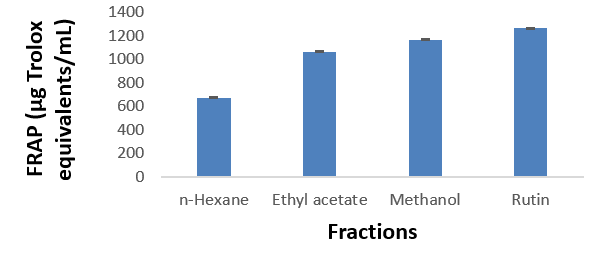
Medicinal plants rich in natural antioxidants have attracted considerable interest because of their ability to neutralize free radicals and protect biological systems against oxidative damage. Piliostigma reticulatum is widely used in African traditional medicine for managing diabetes and inflammatory disorders; however, comparative information on the antioxidant and antidiabetic activities of its solvent fractions remains limited. This study evaluated the antioxidant and antidiabetic potential of P. reticulatum stem bark solvent fractions using in vitro antioxidant and carbohydrate-hydrolyzing enzyme inhibition assays. Antioxidant activity was assessed using DPPH and ABTS radical-scavenging assays, while ferric reducing antioxidant power (FRAP) evaluated reducing capacity. α-Amylase and α-glucosidase inhibitory activities were also determined. The methanol fraction exhibited the strongest DPPH scavenging activity (IC₅₀ = 1.353 ± 1.239 µg/mL), followed by ethyl acetate (1.717 ± 1.382 µg/mL) and n-hexane (14.023 ± 5.716 µg/mL). Similarly, methanol showed superior ABTS activity (47.420 ± 8.594 µg/mL) and FRAP capacity (1166.0 ± 2.646 trelox equivalent), compared with ethyl acetate and n-hexane fractions. Ethyl acetate demonstrated the strongest α-amylase (IC₅₀ = 9.007 ± 2.431 µg/mL) and α-glucosidase (IC₅₀ = 0.0010 ± 0.0000 µg/mL) inhibitory activities. Overall, P. reticulatum stem bark exhibited solvent-dependent antioxidant and enzyme inhibitory activities, with methanol showing superior antioxidant activity and ethyl acetate demonstrating stronger enzyme inhibition. These findings highlight P. reticulatum as a promising source of bioactive compounds with potential applications in diabetes management.
References
Sani A.A, A.K. Dalla Dalla, S.B. Idris, N. Suleiman, & A.H. Jibril. (2024). Antioxidants and vitamins content of methanol extract of Piliostigma reticulatum leaves. Journal of Agriculture and Environment, 20(1), 141–149. https://doi.org/10.4314/jagrenv.v20i1.14
Alqahtani, A. S., Hidayathulla, S., Rehman, M. T., ElGamal, A. A., Al-Massarani, S., Razmovski-Naumovski, V., Alqahtani, M. S., El Dib, R. A., & AlAjmi, M. F. (2019). Alpha-Amylase and Alpha-Glucosidase Enzyme Inhibition and Antioxidant Potential of 3-Oxolupenal and Katononic Acid Isolated from Nuxia oppositifolia. Biomolecules, 10(1), 61. https://doi.org/10.3390/biom10010061
Azzahra, V. O., Mardiana, S., Suharyadi, S., Sianipar, R. J., & Ramadhan, D. S. (2025). Effect of Solvent Polarity on Extraction Yield, Phytochemical Composition, and Antioxidant Activity of Curcuma xanthorrhiza Roxb. And Moringa oleifera Lam. Biology, Medicine, & Natural Product Chemistry, 14(2), 1273–1284. https://doi.org/10.14421/biomedich.2025.142.1273-1284
Benzie, I. F. F., & Strain, J. J. (1996). The Ferric Reducing Ability of Plasma (FRAP) as a Measure of “Antioxidant Power”: The FRAP Assay. Analytical Biochemistry, 239(1), 70–76. https://doi.org/10.1006/abio.1996.0292
Dirir, A. M., Daou, M., Yousef, A. F., & Yousef, L. F. (2022). A review of alpha-glucosidase inhibitors from plants as potential candidates for the treatment of type-2 diabetes. Phytochemistry Reviews, 21(4), 1049–1079. https://doi.org/10.1007/s11101-021-09773-1
Febriyanti, R. M., Indradi, R. B., Maisyarah, I. T., Iskandar, Y., Susanti, R. D., & Lestari, D. (2025). Alpha-amylase and Alpha-glucosidase enzymes inhibition and antioxidant potential of selected medicinal plants used as anti-diabetes by Sundanese community in West Java, Indonesia. BMC Complementary Medicine and Therapies, 25(1), 426. https://doi.org/10.1186/s12906-025-05144-x
Forman, H. J., & Zhang, H. (2021). Targeting oxidative stress in disease: Promise and limitations of antioxidant therapy. Nature Reviews Drug Discovery, 20(8), 652–652. https://doi.org/10.1038/s41573-021-00267-5
Hashim, N. A., Mahmod, N. H., Lema, A. A., Ho, L.-H., & Khandaker, M. M. (2024). Effects of Extraction Solvents and Drying Techniques on Antioxidant Content and Radical Scavenging Activity of Roselle (Hibiscus sabdariffa) Calyx. Sarhad Journal of Agriculture, 40(s1). https://doi.org/10.17582/journal.sja/2024/40/s1.110.121
Ighodaro, O. M. (2018). Molecular pathways associated with oxidative stress in diabetes mellitus. Biomedicine & Pharmacotherapy, 108, 656–662. https://doi.org/10.1016/j.biopha.2018.09.058
Kafi, S. K., Abdalla, F. M., & Eljack, M. S. (2018). Evaluation of Antimicrobial Activity of a Sudanese Herbal Plant (Piliostigma reticulatum). Sudan Journal of Medical Sciences, 13(4). https://doi.org/10.18502/sjms.v13i4.3599
Kumari, K., Adhikari, P., Pandey, A., Samant, S. S., Lal, M., & Pande, V. (2024). Influence of Solvent Polarity on Phytochemicals, Antioxidants, and Antimicrobial Properties of Delphinium denudatum: A Medicinal Herb from Sainj Valley, Himachal Pradesh, India. Bioactivities, 2(1), 30–40. https://doi.org/10.47352/bioactivities.2963-654X.214
Lam, T.-P., Tran, N.-V. N., Pham, L.-H. D., Lai, N. V.-T., Dang, B.-T. N., Truong, N.-L. N., Nguyen-Vo, S.-K., Hoang, T.-L., Mai, T. T., & Tran, T.-D. (2024). Flavonoids as dual-target inhibitors against α-glucosidase and α-amylase: A systematic review of in vitro studies. Natural Products and Bioprospecting, 14(1), 4. https://doi.org/10.1007/s13659-023-00424-w
Ling, B., Shao, L., Jiang, H., & Wu, S. (2024). Wide pH, Adaptable High Internal Phase Pickering Emulsion Stabilized by a Crude Polysaccharide from Thesium chinense Turcz. Molecules, 29(18), 4312. https://doi.org/10.3390/molecules29184312
Mareček, V., Mikyška, A., Hampel, D., Čejka, P., Neuwirthová, J., Malachová, A., & Cerkal, R. (2017). ABTS and DPPH methods as a tool for studying antioxidant capacity of spring barley and malt. Journal of Cereal Science, 73, 40–45. https://doi.org/10.1016/j.jcs.2016.11.004
Nguyen, T. T., Tsai, C.-K., & Horng, J.-J. (2022). Sustainable Recovery of Valuable Nanoporous Materials from High-Chlorine MSWI Fly Ash by Ultrasound with Organic Acids. Molecules, 27(7), 2289. https://doi.org/10.3390/molecules27072289
Ouor, P. O., Othieno, C. O., Robinson, J. M., & Baker, D. M. (1991). Response of tea quality parameters to time of year and nitrogen fertiliser. Journal of the Science of Food and Agriculture, 55(1), 1–11. https://doi.org/10.1002/jsfa.2740550102
Sun, H., Saeedi, P., Karuranga, S., Pinkepank, M., Ogurtsova, K., Duncan, B. B., Stein, C., Basit, A., Chan, J. C. N., Mbanya, J. C., Pavkov, M. E., Ramachandaran, A., Wild, S. H., James, S., Herman, W. H., Zhang, P., Bommer, C., Kuo, S., Boyko, E. J., & Magliano, D. J. (2022). IDF Diabetes Atlas: Global, regional and country-level diabetes prevalence estimates for 2021 and projections for 2045. Diabetes Research and Clinical Practice, 183, 109119. https://doi.org/10.1016/j.diabres.2021.109119
Sun, W., & Shahrajabian, M. H. (2023). Therapeutic Potential of Phenolic Compounds in Medicinal Plants-Natural Health Products for Human Health. Molecules, 28(4), 1845. https://doi.org/10.3390/molecules28041845
Wado, T. E., Suleman, S., & Mohammed, T. (2022). Antimicrobial Evaluation of Sequentially extracted Leaf of Vernonia auriculifera Hiern (Rejicho). BMC Complementary Medicine and Therapies, 22(1), 219. https://doi.org/10.1186/s12906-022-03690-2
Xiang, Z., Liu, L., Xu, Z., Kong, Q., Feng, S., Chen, T., Zhou, L., Yang, H., Xiao, Y., & Ding, C. (2024). Solvent Effectson the Phenolic Compounds and AntioxidantActivity Associated with Camellia polyodonta FlowerExtracts. ACS Omega, 9(25), 27192–27203. https://doi.org/10.1021/acsomega.4c01321
Downloads
Published
Issue
Section
Categories
License
Copyright (c) 2026 Muhammad Atiku Kano, Alfa Tijjani Imam, Haruna Tsoho Bala

This work is licensed under a Creative Commons Attribution 4.0 International License.


