
Assessment of Radiological Indices and Heavy Metals in Well Water Around Lapite Dumpsite, Ibadan, Southwestern Nigeria
DOI:
https://doi.org/10.33003/fjs-2026-1019-5936Keywords:
Groundwater, Lapite dumpsite, Natural radionuclides, Heavy metals, Annual Effective Dose Equivalent (AEDE), Excess Lifetime Cancer Risk (ELCR), Hazard indexAbstract
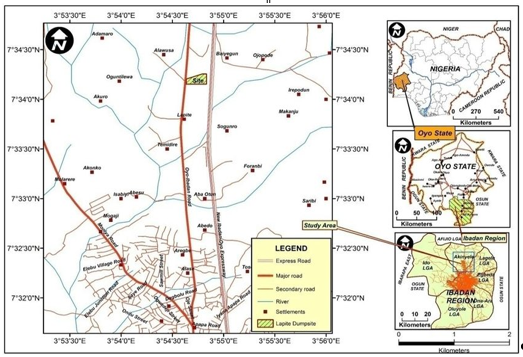
Municipal solid-waste dumpsites can generate leachate containing heavy metals and naturally occurring radionuclides, which may migrate into groundwater and pose potential health risks to communities relying on well water for domestic purposes. Lapite dumpsite, Ibadan, is surrounded by communities that depend substantially on well water, while limited information exists on the combined radiological and heavy-metal quality of the well water. This study therefore assessed the radiological indices and heavy-metal concentrations in well water around Lapite dumpsite, determined the activity concentrations of U-238, Th-232 and K-40, quantified Cd, Pb, Fe, Cu and Zn, and evaluated associated radiological, carcinogenic and non-carcinogenic health risks. Forty well-water samples were collected from selected locations around the dumpsite, including a control sample. Samples were filtered and analysed for radionuclides using a gamma-ray spectrometer coupled with NaI(Tl) detector, while heavy metals concentration were determined using atomic absorption spectrophotometry. Descriptive statistics, radiological indices, chronic daily intake, hazard quotient, hazard index, lifetime average daily dose and cancer risk were evaluated. K-40, U-238 and Th-232 recorded mean activities of 45.00 ± 17.47, 4.49 ± 2.20 and 2.28 ± 1.20 Bq/L, respectively. Mean AEDE and ELCR were 1.50 ± 0.59 mSv/y and 0.0053 ± 0.0020, respectively, AEDE indicating elevated radiological exposure while ELCR fall below ICRP nominal cancer risk coefficient of 5.5 × 10⁻² Sv-1. The combined non-carcinogenic risk of the investigated heavy metals remained below unity.
References
Ajibola, T. B., Orosun, M. M., Ehinlafa, O. E., Sharafudeen, F. A., Salawu, B. N., Ige, S. O., and Akoshile, C. O. (2022). Radiological hazards associated with 238U, 232Th, and 40K in some selected packaged drinking water in Ilorin and Ogbomoso, Nigeria. Journal of Environmental Pollution, 8(1), 117–131.
Akintola, O. O., Adeyemi, G. O., Bodede, A. I., Adekoya, O. O., and Babatunde, K. O. (2021). Hydrochemical assessment of groundwater around Lapite dumpsite for irrigation water quality in Ibadan, Southwestern Nigeria. Journal of Bioresource Management, 8(2), 98–108. https://doi.org/10.35691/JBM.1202.0184
Ariyo, S. O., Adeyemi, G. O., and Akintola, O. O. (2018). Assessment of heavy metal status in groundwater around a dumpsite in Ibadan, South-Western Nigeria. Journal of Science Research, 17(1).
Dimowo, B. O., Gbadebo, A. M., Taiwo, A. M., Sojinu, O. S., and Dimowo, M. O. (2025). Carcinogenic and non-carcinogenic health risk assessment of heavy metals in water from selected oil pollution-prone communities in the Niger Delta region. Journal of Trace Elements and Minerals, 14, Article 100266. https://doi.org/10.1016/j.jtemin.2025.100266
Emmanuel, U. C., Chukwudi, M. I., Monday, S. S., and Anthony, A. I. (2022). Human health risk assessment of heavy metals in drinking water sources in three senatorial districts of Anambra State, Nigeria. Toxicology Reports, 9, 869–875. https://doi.org/10.1016/j.toxrep.2022.04.011
Igbudu, O., Ogan, A. C., and Amakiri, A. R. C. (2025). Assessment of radiological hazards associated with 40K, 232Th and 232U in water samples from New Calabar River, Rivers State, Nigeria. FNAS Journal of Applied and Physical Sciences, 2(2), 95–107.
Ojaniyi, O. F., Okoye, P. A. C., and Omokpariola, D. O. (2021). Heavy metals analysis and health risk assessment of three fish species, surface water and sediment samples in Ogbaru Axis of River Niger, Anambra State, Nigeria. Asian Journal of Applied Chemistry Research, 9(1), 64–81. https://doi.org/10.9734/ajacr/2021/v9i130205
Saber, A. A., Al-Mashhadany, M. F. M., Hamid, A., Gabrieli, J., Tockner, K., Alsaif, S. S., ... and Bhat, S. U. (2024). Carcinogenic and non-carcinogenic health risk evaluation of heavy metals in water sources of the Nubian Sandstone Aquifer in the El-Farafra Oasis (Egypt). Water, 16(12), 1649.
Smart, M. O., Okumodi, B. O., Ibiyeye, D. E., Roberts, A. E., Olunloyo, O. O., Adeoye, A. S., and Ibironke, O. H. (2024). Concentration and Ecological Risk Assessments of Potentially Toxic Elements in Soils around Lapite Dump Site, Akinyele Local Government Area, Ibadan, Nigeria. Journal of Applied Sciences and Environmental Management, 28(1), 19-25.
Tamilarasi, A., Sathish, V., and Chandrasekaran, A. (2023). Assessment of gamma dose and annual effective dose rate for commonly used fertilizer samples in agriculture field with a statistical approach. Radiation protection dosimetry, 199(2), 95-106.
Vetrimurugan, E., Brindha, K., Elango, L., and Ndwandwe, O. M. (2017). Human exposure risk to heavy metals through groundwater used for drinking in an intensively irrigated river delta. Applied Water Science, 7, 3267–3280. https://doi.org/10.1007/s13201-016-0472-6
World Health Organization. (2022). Guidelines for Drinking-water Quality: Fourth Edition Incorporating the First and Second Addenda. World Health Organization.
Downloads
Published
Issue
Section
Categories
License
Copyright (c) 2026 Emmanuel Oni, Bamise James, Oluwakemi T. Oni, Michael Adegunlola, Paul Ayanlola, Oluwaseun Oloyede, Olaoluwa P. Oyero, Muritadoh Kolawole

This work is licensed under a Creative Commons Attribution 4.0 International License.


