
Physicochemical, Elemental, Morphological, and Microbiological Properties of WUPA Sewage Sludge: Implications for Potential Soil Remediation
DOI:
https://doi.org/10.33003/fjs-2026-1019-5955Keywords:
sewage sudge, WUPA, soil remediation, heavy metals, microbiologyAbstract
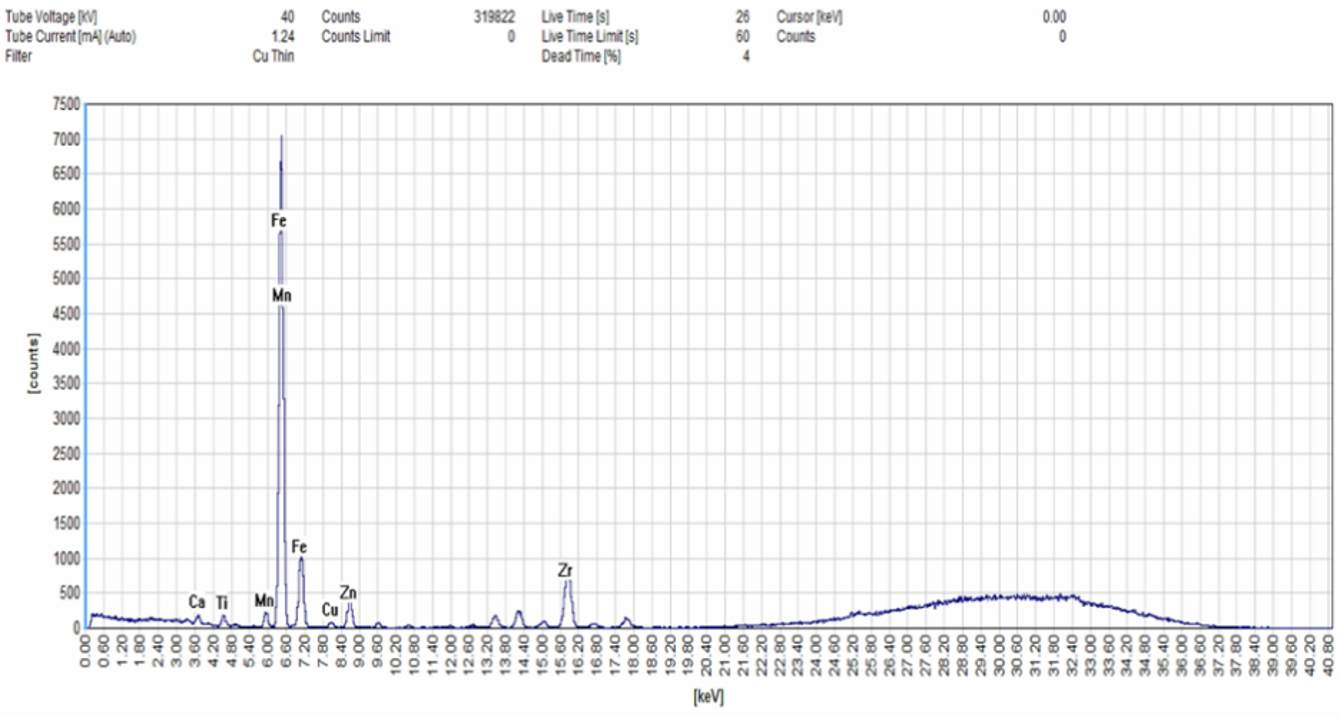
Sustainable management of sewage sludge is a persistent environmental challenge, particularly in rapidly developing areas. This study explores the physicochemical, mineralogical, and microbiological properties of raw sewage sludge from the WUPA Wastewater Treatment Plant, Abuja, Nigeria, to establish the quality of the raw sludge prior to conditioning and to evaluate its suitability for use in soil remediation. Analytical techniques employed comprise Energy Dispersive X-ray Fluorescence (EDXRF) for elemental composition SiO2 has concentration of 67.50wt% as the highest and SeO2 with lowest concentration of 0.00040wt%, Scanning Electron Microscopy (SEM) for morphological analysis result show that carbon (79.00 wt.%, 84.55 atomic%) and oxygen (18.14 wt.%), Fourier Transform Infrared Spectroscopy (FTIR) for functional group identification indicate 3698 to 3265cm-1 assigned to O–H stretching of alcohol and hydroxyl compounds, the band at 1543cm-1 is associated with aliphatic nitro compounds, of medium intensity. The analyzed wastewater sludge had a pH of 6.96 which falls within the optimal range of 6.5-7.0 for plant nutrient availability, indicating it is suitable for agricultural application without pH correction, low salinity, and high organic matter content. Heavy metals such as zinc and copper were within permissible limits of 2.00Mg/l & 0.5Mg/l for liquid sludge. SEM micrographs revealed a heterogeneous, porous structure conducive to soil aeration, while FTIR spectra revealed typical absorption bands of humus substances, including hydroxyl, amide, carboxyl, and aliphatic groups consistent with the presence of humus, which plays an important role in nutrient retention, soil aggregation, and organic matter stability. Microbiological analysis identified potential pathogens, underscoring the need...
References
Abuja Waste Water Treatment Plant (2003), “Description of the operation of the control system,”JN.985-4427 October 2003-PN.4907, SCC Nig Ltd.
Alonso, J.M., Abreu, A.H.M., Andreoli, C.V. et al. “Chemical characteristics and valuation of sewage sludge from four different wastewater treatment plants”. Environ Monit Assess 196, 34 (2024). https://doi.org/10.1007/s10661-023-12211-8
Archis A, Jerry A.N. (2025) “Sludge treatment and disposal in wastewater treatment” (2025) Britannica encyclopedia/websource. 21st June 2025. https://www.britannica.com. Accessed 14th July 2025
Anyakora N.V, Ajinomoh C.S., Ahmed. A.S.,Mohammed-Dabo, J.A. Ejeh S.P, Abba H., Okoro J. (2022) “Modelling of sludge drying parameters in a Paved Drying Bed” International journal of Engineering and Computer science. ISSN:2319-7242. https://doi.org/10.18535/ijecs/v11i03.
Anna T, Kinga W. and Wojciech M. (2019), ‘Wolf Digestion Procedure and Determination of Heavy Metals in Sewage Sludge an Analytical Problem’ Sustainability 2019, 11, 1753; https://doi.org/10.3390/su11061753
Beckhoff B. Kanngießer, N. Langhoff R. Wedell H. Wolff (2006), Handbook of Practical X-Ray Fluorescence Analysis’ ISBN-13 978-3-540-28603-5 Springer Berlin Heidelberg New York.
Bingdi C., Tao Z., Weijun H., Dongsheng W. (2021) “Enhanced Technology Based for
sewage sludge deep watering: A review.” Water Research Volume 89, Februuary, 2021,116650. https://doi.org/10.1016/j.watres2020.116650
Ben H., H., Debuigne, A., Kleinjan, H., Toye, D., & Léonard, A. (2024). “Enhancing Sewage Sludge Stabilization, Pathogen Removal, and Biomass Production through Indigenous Microalgae Promoting Growth: A Sustainable Approach for Sewage Sludge Treatment” Recycling, 9(5), 97. https://doi.org/10.3390/recycling9050097
Bot A., and Benites J. (2005) “The Importance of Soil Organic Matter” Food and Agriculture Organization of the United Nations Rome FAO Publications, Available: www.fao.org [26th Oct.2025].
El Yaacoubi, C., Bensaddik, M., Bensitel, N., Azar, F.-Z., Dimane, F., El Hammoudani, Y., & El Kasmi, A. (2026). “Sustainable Wastewater Sludge Valorization: A Critical Review of Life Cycle Assessment and Techno-Economic Studies.” Resources, 15(8), 99. https://doi.org/10.3390/resources15080099
EPA (2020); ‘Environmental Regulations and Technology, Control of Pathogens and Vector Attraction in Sewage Sludge. United States Environmental Protection Agency.
Lamastra L., Suciu N.A., & Trevian M. (2018) “Sewage sludge for sustainable agriculture: contaminants, contents and potential use as fertilizer. Chemical and Biological Technologies in agriculture 5, Article number 10 (2018). https://doi.org/10.1186/s40538-018-0122-3
Magdalene M. (2024), “Properties of organic matter in compost based on sewage sludge.” Journal of ecological engineering, 25(7),70-81 https://doi.org/10.12911/22998993/187964 ISSN 2299-8993
Nandiyanto, A.B.D.,Dani A.B., Ragadhitta R.& Oktiani R. (2019). “How to Read and Interpret FTIR Spectroscope of Organic Material” Indonesian journal of Science and Technology Vol 4, DOI: http://dx.doi.org/10.17509/ijost.v4i1.15806 | p- ISSN 2528-1410 e- ISSN 2527-8045.
Ojo O. Ogwueleka T.C, Evuti A.M. (2023)” Study on the application of bio solids from WUPA Sewage Treatment Plant in soil remediation” University Abuja, Faculty of Engineering.
Priyanka S., Vibha M., Dwivedi M. K. and Tiwari M. K. (2022) ‘Elemental Investigation of Sewage Sludge Samples Using Synchrotron Radiation Based Xrf Spectrometry’ Dickensian Journal volume 22.
Qrenawi, L.I. and Rabah, F.K.J. (2021) “Sludge management in water treatment plants: literature review.” International. Journal of Environment and Waste Management, Vol. 27, No 1, pp.93-Ana27 (1):93. https://doi.org/10.1504/IJEWM.2021.111909.
Rahim M, Lise A, Hatice Y, A. Evren T, Bariş Ç. (2024), “Sustainable heavy metal removal from sewage sludge: A review of bioleaching and other emerging technologies”, Science of The Total Environment, Volume 955,2024,177020, ISSN 0048-9697,
Standards for the use or disposal of sewage sludge (2025) Title 40-Protection of Environment. Chapter 1- Environmental Protection Agency. Subchapter 0-Sewage Sludge. Up- to- date as of 9/16/2025.
Tytła, M.; Widziewicz, K.; Zielewicz, E. (2016) “Heavy metals and their chemical specification in sewage sludge at different stages of processing”. Environ. Technol. 37, 899–908.
Cecconet & Capodaglio A, G, (2022).:” Sewage Sludge Biorefinery for Circular Economy” Sustainability 2022,14(22),14841; https://doi.org/10.3390/SUI42214841 MDPI Resources.
Zhuo L, Fang L, Lingzhi He, Siqi W, Yi Wu, Zhuqi C (2024) “Physical conditioning methods for sludge deep dewatering” A critical review. Journal of Environmental Management, volume 360, June 2024,121207. https://doi.org/10.1016/j.jenvman.2024.121207
Downloads
Published
Issue
Section
Categories
License
Copyright (c) 2026 Ijeoma Chiamaka Nwokorie, Mohammed Evuti Abdulahi, Nkolika Victoria Anyakora, Isah Abdulkarim Bala, Daniel Apeh Egyegbola

This work is licensed under a Creative Commons Attribution 4.0 International License.


