
Assessment of Abundance and Richness of Urban Bird Species in Green and Non-Green Areas in Gombe Metropolis, Gombe State, Nigeria
DOI:
https://doi.org/10.33003/fjs-2026-1024-5985Keywords:
Urban birds, Habitat, Gombe metropolisAbstract
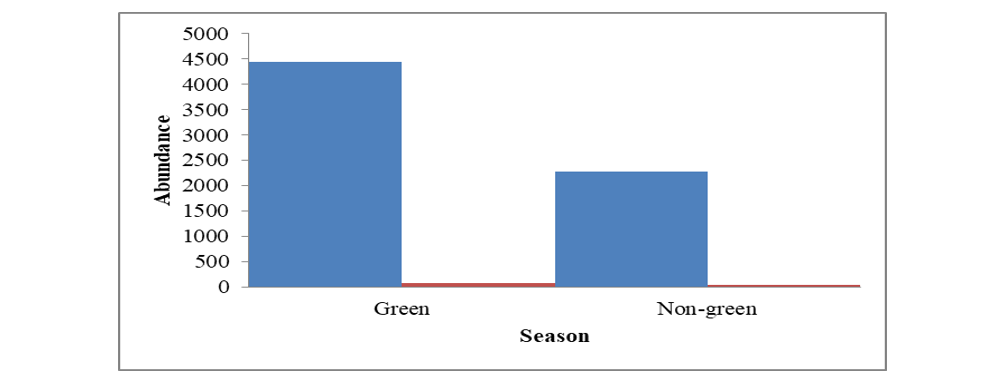
Urbanization is one of the major forms of land-use change affecting biodiversity and ecosystem functioning. This study assessed the abundance and richness of urban bird species in green and non-green areas of Gombe Metropolis, Gombe State, Nigeria. A random sampling design was employed, with the study area stratified into green and non-green habitats. Birds were surveyed using the fixed-cardinal point count method, with sampling points established approximately 100 m apart. Each observation lasted 15 minutes within a 50 m radius and was conducted during morning and afternoon/evening periods. Bird identification was done based on standard field guides ABC Bird of Africa field guide (2020) and binocular for visual and auditory identification. A total of 6,713 individual birds belonging to 60 species, 44 genera, 27 families and 16 orders were recorded. Laughing Dove (Spilopelia senegalensis) was the most abundant species with 1,577 individuals, The feeding-guild composition was dominated by granivores, which accounted for 20 species (33.3%), followed by insectivores and omnivores with 11 species each (18.3%). Morning observations recorded 3,532 individuals representing 60 species, whereas afternoon/evening observations recorded 3,181 individuals representing 58 species. Seasonal variation was also evident, with the wet-season sampling period recording 5,885 individuals and 60 species compared with 828 individuals and 42 species during the dry-season sampling period. Green areas supported 4,437 individuals (66.1%), while non-green areas supported 2,276 individuals (33.9%). However green areas play a critical role in maintaining bird diversity.
References
Abdulrasheed, I., Musa, A., & Hassan, L. (2022). Urban bird assemblages in Kano metropolis, Nigeria. Biodiversity International Journal, 6(2), 101–110
Adeleke, A., Ogunleye, O., & Sadiq, R. (2023). Urban bird diversity in Ilorin metropolis, Nigeria. Nigerian Journal of Zoology, 37(1), 88–97.
Aronson, M. F. J., Lepczyk, C. A., Evans, K. L., Goddard, M. A., Lerman, S. B., & MacIvor, J. S. (2020). Biodiversity in the city: Key challenges for urban green space management. Frontiers in Ecology and the Environment, 18(4), 189–196.
Aronson, M. F. J., Lepczyk, C. A., Evans, K. L., Goddard, M. A., Lerman, S. B., & MacIvor, J. S. (2023). Urban biodiversity and the future of cities. Annual Review of Environment and Resources, 48, 205–232.
Awoyemi, O., Adeyemi, B., & Lawal, K. (2024). Urbanization and avian functional diversity in Nigerian cities. Urban Ecosystems, 27(2), 389–402.
Ayuk, E. N., Danjuma, A., & Haruna, M. (2025). Bird species diversity along the Old Gongola River, northeastern Nigeria. African Ornithology, 96(1), 15–32.
Bashir , B. S., Salisu, M., & Saadu, A. M., (2021). Species Diversity of Bird of Prey in Hadejia Nguru Wetlands. Nigeria. FUDMA journal of sciences (FJS) Vol. 5 No. 4, pp 260-267.
Basile, M., Balestrieri, R., Posillico, M., Altea, T., De Cinti, B., & Matteucci, G. (2021). What do we know about birds as indicators of environmental quality? A review. Ecological Indicators, 123, 107324.
Beninde, J., Veith, M., & Hochkirch, A. (2015). Biodiversity in cities needs space: A meta-analysis of factors determining intra-urban biodiversity variation. Ecology Letters, 18(6), 581–592.
Bibby, C. J., Burgess, N. D., Hill, D. A., & Mustoe, S. (2000). Bird census techniques (2nd ed.). Academic Press.
Blake, J. G., & Loiselle, B. A. (2018). Bird communities and rainfall-driven productivity in tropical ecosystems. Ecology Letters, 21(5), 745–758.
Borrow, N., & Demey, R. (2023). Birds of Western Africa (2nd ed.). Christopher Helm.
Borrow, N., & Demey, R. (2023). Birds of Western Africa (2nd ed.). Christopher Helm.
Callaghan, C. T., Major, R. E., Lyons, M. B., Martin, J. M., Kingsford, R. T., & Cornwell, W. K. (2021). Urbanization alters the functional diversity of bird communities worldwide. Nature Communications, 12, 1–10.
Callaghan, C. T., Ozeroff, I., Major, R. E., & Cornwell, W. K. (2023). Urban environments reshape global bird communities and their ecological functions. Global Ecology and Biogeography, 32(6), 1024–1037.
Chace, J. F., & Walsh, J. J. (2006). Urban effects on native avifauna: A review. Landscape and Urban Planning, 74(1), 46–69.
Danmallam, B. A., Ngila, P. M., Iniunam, I. A., Kuria, A., Tende, T., Ngugi, S., Njoroge, P., Jackson, C., Okoth, B., Ottosson, U., Chaskda, A. A., & Trevelyan, R. (2024). Ecological consequences of urbanization in Afrotropical bird communities: Present and future prospects. Frontiers in Conservation Science, 5, 1503408. https://doi.org/10.3389/fcosc.2024.1503408
Ibrahim, A., & Okeke, C. (2024). Bird diversity and habitat use in Zaria urban landscape. Savanna Journal of Biological Sciences, 5(2), 120–131
Johnson, P., Ouattara, B., & Sawadogo, M. (2023). Seasonal dynamics of urban birds in Ouagadougou, Burkina Faso. Sahelian Ecology Reports, 11(2), 67–80
Lu, X., Jia, Y., & Wang, Y. (2024). The effect of landscape composition, complexity, and heterogeneity on bird richness: A systematic review and meta-analysis on a global scale. Landscape Ecology, 39, 132. https://doi.org/10.1007/s10980-024-01933-w
McCloy, M. W. D., et al. (2024). Promoting urban ecological resilience through the lens of avian biodiversity. Frontiers in Ecology and Evolution, 12, 1302002. https://doi.org/10.3389/fevo.2024.1302002
McClure, C. J. W., Ware, H. E., Carlisle, J., Kaltenecker, G., & Barber, J. R. (2020). An experimental investigation into the effects of traffic noise on distributions of birds. Conservation Biology, 34(1), 203–212
Mühlbauer, M., Weisser, W. W., Apfelbeck, B., Müller, N., & Meyer, S. T. (2025). Bird guilds need different features on city squares. Basic and Applied Ecology, 83, 23–35. https://doi.org/10.1016/j.baae.2024.12.003
Musa, A., & Hassan, L. (2021). Urban bird communities in Abuja, Nigeria. Nigerian Journal of Ecology, 20(1), 34–42.
Newbold, T., et al. (2020). Global effects of land use on biodiversity differ among functional groups. Nature Ecology & Evolution, 4(3), 384–392.
Onyekwelu, J., & Akinyemi, O. (2024). Feeding guild distribution of birds in southwestern Nigeria cities. Tropical Ecology, 65(1), 78–89.
Rega-Brodsky, C. C., & MacGregor-Fors, I. (2024). Birds in an urban world: Community patterns across cities. In C. H. Nilon & M. F. J. Aronson (Eds.), Routledge handbook of urban biodiversity (pp. 247–261). Routledge. https://doi.org/10.4324/9781003016120-20
Sanusi, R., & Bassey, E. (2022). Seasonal variation of bird communities in Calabar, Nigeria. Nigerian Journal of Ornithology, 10(2), 90–102
Şekercioğlu, Ç. H., Wenny, D. G., & Whelan, C. J. (2019). Why Birds Matter: Avian Ecological Function and Ecosystem Services. University of Chicago Press
Sullivan, B. L., Wood, C. L., Iliff, M. J., Bonney, R., Fink, D., & Kelling, S. (2024). Seasonal dynamics of bird populations revealed through long-term monitoring. Biological Conservation, 298, 110743. Bregman, T. P., Lees, A. C., MacGregor, H. E. A., Darski, B., de Moura, N. G., Aleixo, A., Barlow, J., & Tobias, J. A. (2019). Climate and habitat jointly shape global patterns of avian functional diversity. Ecology Letters, 22(12), 1924–1935.
Wang, X., Li, Y., Zhang, H., Chen, S., & Liu, J. (2024). Insectivorous birds are more sensitive to urban greenspace changes in Guangzhou City, China. Urban Forestry & Urban Greening, 94, 128243. https://doi.org/10.1016/j.ufug.2024.128243
Downloads
Published
Issue
Section
Categories
License
Copyright (c) 2026 Joel Patrick Solomon, Nsor Charles Ayuk, Aako Oyanji Ann

This work is licensed under a Creative Commons Attribution 4.0 International License.


