
Measles-Specific IgG Antibody Levels and Associated Demographic and Vaccination Factors Among Children in Diyala Governorate, Iraq: A Cross-Sectional Study
DOI:
https://doi.org/10.33003/fjs-2026-1022-5999Keywords:
Measles, IgG Antibody, ELISA, Vaccination, Children, Immunity, Diyala, IraqAbstract
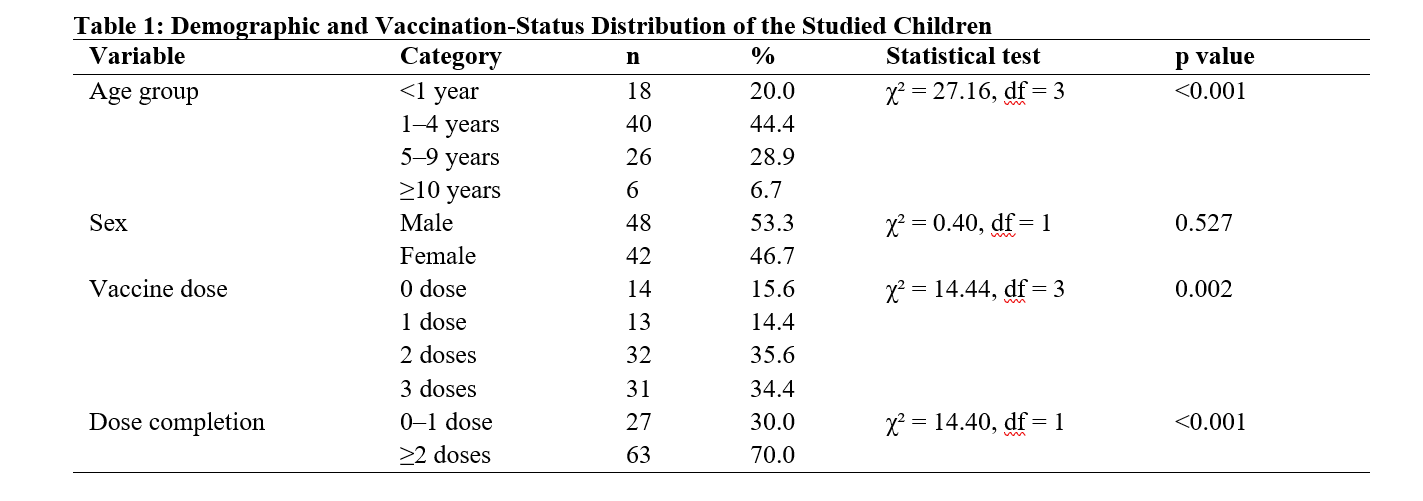
Measles is a significant cause of death in children, despite the availability of safe and cost-effective measles vaccines. Monitoring measles-specific IgG antibody levels is essential for evaluating vaccine-induced immunity and identifying factors associated with protective immune responses. This study was aimed to assess of measles IgG antibody levels and identify associated factors affecting measles immunity among children in Diyala Governorate / Iraq. A cross-sectional study was conducted between October 1, 2025, and April 30, 2026. Ninety children aged 1–14 years who had received at least one dose of a measles-containing vaccine were enrolled from primary health care centres in Diyala Governorate. Venous blood samples were collected, and serum anti-measles IgG antibody concentrations were determined using the enzyme-linked immunosorbent assay (ELISA). Demographic characteristics and vaccination history were obtained through a structured questionnaire. Statistical analysis was performed using SPSS version 29, with statistical significance set at P < 0.05 Among the 90 enrolled children, 53.3% were males and 46.7% were females. Female children showed significantly higher measles IgG antibody concentrations than males (64.74 ± 58.91 vs. 46.60 ± 46.55 ng/L; P = 0.006). No significant differences in measles IgG antibody concentrations were observed according to vaccination status (65.77 ± 73.29 vs. 50.48 ± 41.64 ng/L; P = 0.682) or age groups (P = 0.341). Furthermore, a weak positive correlation was found between measles IgG antibody concentration and the number of vaccine doses; however, this correlation was not statistically significant (r = 0.070, P = 0.512).
References
Cheedarla, N., & Hanna, L. E. (2019). Functional and protective role of neutralizing antibodies (NAbs) against viral infections. In Recent developments in applied microbiology and biochemistry (pp. 83-93). DOI: https://doi.org/10.1016/B978-0-12-816328-3.00007-6
Di Pietrantonj, C., Rivetti, A., Marchione, P., Debalini, M. G., & Demicheli, V. (2020). Vaccines for measles, mumps, rubella, and varicella in children. Cochrane Database of Systematic Reviews(4). doi: https://doi.org/10.1002/14651858.cd004407.pub5
Feiler, M. O., Salerno, M., Pei, X., & Colicino, E. (2026). Racial and ethnic differences in the association between pediatric phthalate exposures and antibody response to vaccination from NHANES 2015-2016. Environmental Research, 305, 124973. DOI: https://doi.org/10.1016/j.envres.2026.124973
Galipeau, Y., Greig, M., Liu, G., Driedger, M., & Langlois, M.-A. (2020). Humoral responses and serological assays in SARS-CoV-2 infections. Frontiers in immunology, 11, 610688. DOI: https://doi.org/10.3389/fimmu.2020.610688
Hall, E., Control, C. f. D., & Prevention. (2021). Epidemiology and prevention of vaccine-preventable diseases. US Department of Health and Human Services, Centers for Disease Control .DOI: https://stacks.cdc.gov/view/cdc/252997
Haralambieva, I. H., Salk, H. M., Lambert, N. D., Ovsyannikova, I. G., Kennedy, R. B., Warner, N. D., Pankratz, V. S., & Poland, G. A. (2014). Associations between race, sex and immune response variations to rubella vaccination in two independent cohorts. Vaccine, 32(17), 1946-1953. DOI: https://doi.org/10.1016/j.vaccine.2014.01.090
Jalal, M. A., Halboot, K. M., Lami, S. A., Gumar, E. A., Al-Delphi, M. H. K., Lami, F., & Taher, T. M. J. (2025). Epidemiological trends and clinical characteristics of measles in Iraq (2023–2024): a retrospective cross-sectional study. BMC infectious diseases, 25(1), 487. DOI: https://doi.org/10.1186/s12879-025-10904-8
Jasem, J., Marof, K., Nawar, A., & Islam, K. M. (2012). Epidemiological analysis of measles and evaluation of measles surveillance system performance in Iraq, 2005–2010. International Journal of Infectious Diseases, 16(3), e166-e171. DOI: https://doi.org/10.1016/j.ijid.2011.11.00
Kontio, M., Palmu, A. A., Syrjänen, R. K., Lahdenkari, M., Ruokokoski, E., Davidkin, I., Vaarala, O., & Melin, M. (2016). Similar antibody levels in 3-year-old children vaccinated against measles, mumps, and rubella at the age of 12 months or 18 months. The Journal of infectious diseases, 213(12), 2005-2013.
Lin, L.-T., & Richardson, C. D. (2016). The host cell receptors for measles virus and their interaction with the viral hemagglutinin (H) protein. Viruses, 8(9), 250.
Misin, A., Antonello, R. M., Di Bella, S., Campisciano, G., Zanotta, N., Giacobbe, D. R., Comar, M., & Luzzati, R. (2020). Measles: an overview of a re-emerging disease in children and immunocompromised patients. Microorganisms, 8(2), 276.
Moss, W. J., & Griffin, D. E. (2024). What’s going on with measles? Journal of virology, 98(8), e00758-00724.
Muñoz-Valle, J. F., Macedo-Ojeda, G., Turrubiates-Hernández, F. J., Hernández-Bello, J., García-Arellano, S., Hernández-Ramírez, C. O., Baños-Hernández, C. J., Coronado-Carrillo, P. M., Lona-Reyes, J. C., & Viera-Segura, O. (2026). Decreasing Antibody Titers and the Slow Decay of Measles Immunity in Mexico’s Current Epidemiological Landscape. Vaccines, 14(3), 234.
Organization, W. H. (2019). Strategic plan for measles and rubella elimination in WHO South-East Asia Region: 2020–2024. World Health Organization. Regional Office for South-East Asia.
Patel, M. K., Goodson, J. L., Alexander Jr, J. P., Kretsinger, K., Sodha, S. V., Steulet, C., Gacic-Dobo, M., Rota, P. A., McFarland, J., & Menning, L. (2020). Progress toward regional measles elimination—worldwide, 2000–2019. MMWR. Morbidity and Mortality Weekly Report, 69.
Quach, H. Q., Chen, J., Monroe, J. M., Ratishvili, T., Warner, N. D., Grill, D. E., Haralambieva, I. H., Ovsyannikova, I. G., Poland, G. A., & Kennedy, R. B. (2023). The influence of sex, body mass index, and age on cellular and humoral immune responses against measles after a third dose of measles-mumps-rubella vaccine. The Journal of infectious diseases, 227(1), 141-150.
Quach, H. Q., Jones, S. P., Joseph, I., Powell, A. J., Ovsyannikova, I. G., Warner, N. D., Grill, D. E., Johnson, J. B., Sasi, R. V., & Ajithakumari, A. M. (2025). Low Measles Seropositivity in Vaccinated Children. JAMA Network Open, 8(8), e2529409.
Quach, H. Q., Ratishvili, T., Haralambieva, I. H., Ovsyannikova, I. G., Poland, G. A., & Kennedy, R. B. (2026). Sex-based differences in mumps immunity after a third dose of measles-mumps-rubella vaccine. Vaccine, 79, 128480.
Sasaki, H., Fukunaga, T., Asano, A., Suzuki, Y., Nakanishi, Y., Kondo, J., Ishikawa, H., & Shibata, N. (2019). A survey of vaccine-induced measles IgG antibody titer to verify temporal changes in response to measles vaccination in young adults. Vaccines, 7(3), 118.
Slight-Webb, S., Thomas, K., Smith, M., Wagner, C. A., Macwana, S., Bylinska, A., Donato, M., Dvorak, M., Chang, S. E., & Kuo, A. (2023). Ancestry-based differences in the immune phenotype are associated with lupus activity. JCI insight, 8(16), e169584.
Umlauf, B. J., Haralambieva, I. H., Ovsyannikova, I. G., Kennedy, R. B., Pankratz, V. S., Jacobson, R. M., & Poland, G. A. (2012). Associations between demographic variables and multiple measles-specific innate and cell-mediated immune responses after measles vaccination. Viral immunology, 25(1), 29-36.
Voigt, E. A., Ovsyannikova, I. G., Haralambieva, I. H., Kennedy, R. B., Larrabee, B. R., Schaid, D. J., & Poland, G. A. (2016). Genetically defined race, but not sex, is associated with higher humoral and cellular immune responses to measles vaccination. Vaccine, 34(41), 4913-4919.
Wang, Q., Wang, W., Winter, A. K., Zhan, Z., Ajelli, M., Trentini, F., Wang, L., Li, F., Yang, J., & Xiang, X. (2023). Long-term measles antibody profiles following different vaccine schedules in China, a longitudinal study. Nature communications, 14(1), 1746.
Wodi, A. P. (2021). Advisory Committee on Immunization Practices recommended immunization schedule for children and adolescents aged 18 years or younger—United States, 2021. MMWR. Morbidity and Mortality Weekly Report, 70.
Zimmermann, P., & Curtis, N. (2019). Factors that influence the immune response to vaccination. Clinical microbiology reviews, 32(2), https://doi.org/10.1128/cmr.00084-00018
Downloads
Published
Issue
Section
Categories
License
Copyright (c) 2026 Ragda Ayad Taha Mohammad

This work is licensed under a Creative Commons Attribution 4.0 International License.


