
Modelling Loss and Allocated Loss Adjustment Expenses using Modified Bivariate Conditional Lomax Distribution with a Power-Link Fuction
DOI:
https://doi.org/10.33003/fjs-2026-1024-6011Keywords:
Bivariate Lomax distribution, Power-link function, Conditional specification, Heavy-tailed data, Maximum likelihood estimationAbstract
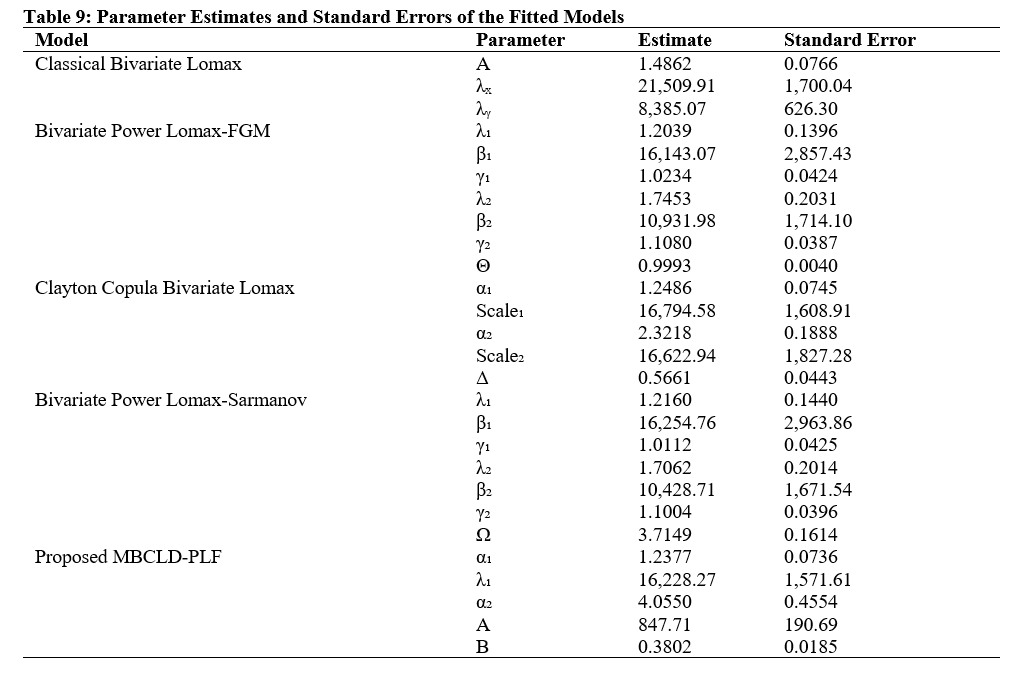
This study developed a Modified Bivariate Conditional Lomax Distribution using Power-Link Function (MBCLD-PLF) in which the scale parameter is linked to the conditioning variable through a power function. The model was proposed to provide a simple but flexible way of describing dependence between two positive heavy-tailed variables. Instead of introducing dependence mainly through a copula, the proposed model allows the conditional scale parameter to change directly with the value of the first variable. A Monte Carlo simulation with 1,000 replications at each sample size of 50, 100, 150, 300, 500 and 1,000 was used to examine the finite-sample behaviour of the maximum likelihood estimators. The results showed that estimation generally improved as the sample size increased, with lower bias, mean squared error and root mean squared error, while the confidence-interval coverage probabilities remained close to the nominal 95% level. Numerical optimisation converged successfully across the simulation settings, although boundary estimates were more frequent at the smallest sample size. The model was also fitted to the Loss–ALAE insurance dataset containing 1,500 paired observations. Its performance was compared with the Classical Bivariate Lomax, Bivariate Power Lomax–FGM, Clayton Copula Bivariate Lomax and Bivariate Power Lomax–Sarmanov models. The proposed model recorded the highest maximised log-likelihood and the lowest AIC, BIC, CAIC and HQIC. However, the Clayton and Sarmanov models produced a smaller Kolmogorov–Smirnov, Anderson–Darling and Cramér–von Mises Rosenblatt-residual statistics. The findings therefore support MBCLD-PLF as a competitive conditional alternative with strong likelihood-based performance for heavy tailed data.
References
Abd Elgawad, M. A., Alawady, M. A., Barakat, H. M., Mansour, G. M., Husseiny, I. A., Alyami, S. A., Hashem, A. F., & Mohamed, M. O. (2025). Bivariate power Lomax Sarmanov distribution: Statistical properties, reliability measures, and parameter estimation. Alexandria Engineering Journal, 113, 593–610. https://doi.org/10.1016/j.aej.2024.10.074
Arnold, B. C., & Strauss, D. J. (1991). Bivariate distributions with conditionals in prescribed exponential families. Journal of the Royal Statistical Society Series B: Statistical Methodology, 53(2), 365-375.
Arnold, B. C., & Sarabia, J. M. (2022). Conditional specification of statistical models: classical models, new developments and challenges. Journal of Multivariate Analysis, 188, 104801.
Arnold, B. C., Castillo, E., & Sarabia, J. M. (1999). Conditional specification. In Conditionally Specified Distributions (pp. 1-6). New York, NY: Springer New York.
Arnold, B. C., & Strauss, D. (1988). Bivariate distributions with conditionals in prescribed exponential families. Journal of the Royal Statistical Society: Series B, 50(3), 540–544.
Baba, L. Y., Bawa, M. U., & Rashid, B. (2025). Derivation of the Sine Exponentiated Lomax Distribution for Modelling Right Skewed and Heavy Tailed Data. FUDMA Journal of Sciences, 9(12), 859-874. https://doi.org/10.33003/fjs-2025-0912-4495
Beirlant, J., Goegebeur, Y., Segers, J., & Teugels, J. L. (2006). Statistics of extremes: theory and applications. John Wiley & Sons.
Bourguignon, M., Gallardo, D. I., & Gómez, H. J. (2022). A Note on Pareto-type distributions parameterized by its mean and precision parameters. Mathematics, 10(3), 528.
Clayton, D. G. (1978). A model for association in bivariate life tables and its application in epidemiological studies of familial tendency in chronic disease incidence. Biometrika, 65(1), 141–151. https://doi.org/10.1093/biomet/65.1.141
Embrechts, P., Klüppelberg, C., & Mikosch, T. (1997). Modelling extremal events for insurance and finance. Springer.
Fayomi, A., Refaey, R. M., AL-Dayian, G. R., EL-Helbawy, A. A., Mahmoud, A. A. M., & Abd Elaal, M. (2024). Bivariate Lomax distribution based on Clayton copula: Estimation and prediction. Journal of Statistics Applications & Probability, 13(4), 1321–1337. https://doi.org/10.18576/jsap/130415
Helu, A., & Samawi, H. (2022). Inference on P(X < Y) in bivariate Lomax model based on progressive type II censoring. PLOS ONE, 17(5), e0267981.
Lomax, K. S. (1954). Business failures: Another example of the analysis of failure data. Journal of the American Statistical Association, 49(268), 847–852. https://doi.org/10.1080/01621459.1954.10501239
Qura, M. E., Fayomi, A., Kilai, M., & Almetwally, E. M. (2023). Bivariate power Lomax distribution with medical applications. PLOS ONE, 18(3), e0282581. https://doi.org/10.1371/journal.pone.0282581
Ríos‐Ocampo, J., & Gary, M. S. (2022). Using analytical equations to represent nonlinear relationships. System Dynamics Review, 38(4), 354-370.
Downloads
Published
Issue
Section
Categories
License
Copyright (c) 2026 Samuel Omeiza Audu, Dolapo Abidemi Shobanke, Oluwamayowa Opeyimika Olajide

This work is licensed under a Creative Commons Attribution 4.0 International License.


