
Design and Optimization of a Miniaturized Stub-Based Branch-Line Coupler at 900 MHz for GSM Applications
DOI:
https://doi.org/10.33003/fjs-2026-1019-6012Keywords:
Branch Line Coupler, Coupler, Defected Ground Structure (DGS), Global System for Mobile (GSM), MiniaturizedAbstract
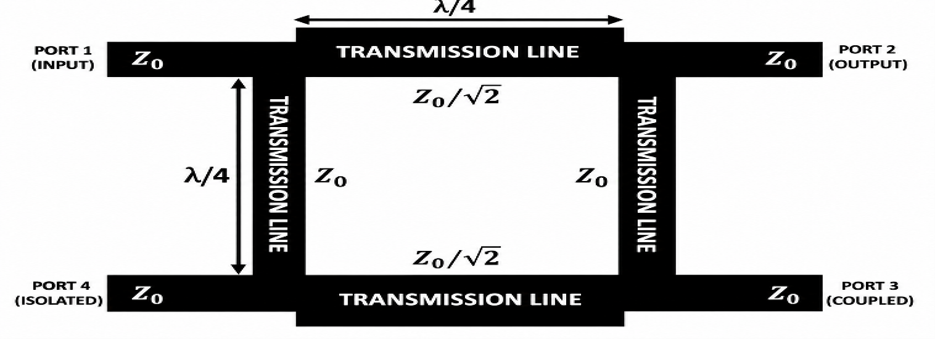
The branch-line coupler (BLC) is a four-port passive component widely used in wireless and microwave systems to divide or combine power equally with a 90° phase difference between its output ports. Because each branch of a conventional BLC is a quarter-wavelength long, the circuit becomes bulky at low frequencies such as the 900 MHz GSM band. This study presents the design and optimization of a miniaturised stub-based BLC operating at 900 MHz. We first designed a conventional coupler with 50 Ω ports on a Rogers RT5880 substrate (εr = 2.2, h = 0.78 mm) and simulated it in CST Studio Suite. Each quarter-wavelength branch was then replaced by an equivalent compact section loaded with stubs, and the stub dimensions were optimized by a parametric sweep to recover bandwidth. The conventional coupler gave a return loss (S11) and isolation (S41) of about -32 dB at 0.92 GHz, through and coupled transmission (S21, S31) of about -3.1 dB at 900 MHz and a -10 dB bandwidth of 379 MHz. The stub-loaded coupler reduced the circuit area by 50.2% (from 9109.9 mm² to 4536.6 mm²), with S11 and S41 reaching about -48.6 dB, S21 and S31 of about -2.9 dB and -3.4 dB at 900 MHz (0.5 dB amplitude imbalance) and a bandwidth of 307 MHz. After optimization, the bandwidth increased to 420 MHz (0.715-1.135 GHz) with S11 and S41 better than −18 dB at 900 MHz, but the amplitude imbalance between S21 and S31 rose to about 3.1 dB. These simulation ...
References
Bekasiewicz, A., & Koziel, S. (2018). Novel structure and design of enhanced-bandwidth hybrid quadrature patch coupler. Microwave and Optical Technology Letters, 60(12), 3073–3076. https://doi.org/10.1002/mop.31426
Chaudhary, M. A., Roshani, S., & Roshani, S. (2023). An ultra-compact microstrip branch line coupler with wide stopband using LCL filter and meandered stubs for microwave applications. Processes, 11(5), 1582. https://doi.org/10.3390/pr11051582
Du, R. N., Weng, Z. B., & Zhang, C. (2018). A miniaturized filtering 3-dB branch-line hybrid coupler with wide suppression band. Progress in Electromagnetics Research Letters, 73, 83–89. https://doi.org/10.2528/PIERL17111406
Idris, I. S., Abdullahi, K., Ya’u Muhammad, A., & Sa’ad, B. M. (2026). Novel champagne glass-shaped microstrip patch antenna for UWB 3.5 GHz lower 5G applications. International Journal of Sciences and Innovation Engineering, 3. https://doi.org/10.70849/ijsci-03032640224
Idris, I. S., & Fakandu, U. M. (2023). Design and optimization of 2.4 GHz microstrip patch antenna for WLAN and S-band wireless applications. International Journal of Scientific Research in Science, Engineering and Technology, 420. https://doi.org/10.32628/IJSRSET232534
Jutru, M. S., & Vijay. (2020). A study of compact branch line coupler. In Intelligent systems and computer technology (Advances in Parallel Computing, Vol. 37). IOS Press. https://doi.org/10.3233/APC200193
Kulkarni, M., Cheeran, A. N., Ray, K. P., & Kakatkar, S. S. (2019). Novel compact implementation of rat-race hybrid coupler using coaxial cable for VHF applications. Proceedings of the 2019 TEQIP-III Sponsored International Conference on Microwave Integrated Circuits, Photonics and Wireless Networks (IMICPW), 69–71. https://doi.org/10.1109/IMICPW.2019.8933215
Kumar, K. V. P., & Alazemi, A. J. (2021). A flexible miniaturized wideband branch-line coupler using shunt open-stubs and meandering technique. IEEE Access, 9, 158241–158246. https://doi.org/10.1109/ACCESS.2021.3131291
Kumar, M., Islam, S. K. N., Sen, G., Parui, S. K., & Das, S. (2018). Design of miniaturized 10 dB wideband branch line coupler using dual feed and T-shape transmission lines. Radioengineering, 27(1), 207–213. https://doi.org/10.13164/re.2018.0207
Lalbakhsh, A., Mohamadpour, G., Roshani, S., Ami, M., Roshani, S., Sayem, A. S. M., Alibakhshikenari, M., & Koziel, S. (2021). Design of a compact planar transmission line for miniaturized rat-race coupler with harmonics suppression. IEEE Access, 9, 129207–129217. https://doi.org/10.1109/ACCESS.2021.3112237
Letavin, D. (2018). Miniature microstrip branch line coupler with folded artificial transmission lines. AEUE - International Journal of Electronics and Communications. https://doi.org/10.1016/j.aeue.2018.11.016
Naderi, M., & Abbasi, H. (2017). Design of compact microstrip branch line coupler using semi-circular and rectangular resonators with wide range suppressed harmonics. AEUE - International Journal of Electronics and Communications. https://doi.org/10.1016/j.aeue.2017.11.031
Niu, Z., Zhang, B., Ji, D., et al. (2019). A novel 3-dB waveguide hybrid coupler for terahertz operation. IEEE Microwave and Wireless Components Letters, 29(4), 273–275. https://doi.org/10.1109/LMWC.2019.2899760
Roshani, S., Yahya, S. I., Roshani, S., Farahmand, A. H., & Hemmati, S. (2022). Design of a modified compact coupler with unwanted harmonics suppression for L-band applications. Electronics, 11(11), 1747. https://doi.org/10.3390/electronics11111747
Roshani, S., Yahya, S. I., Roshani, S., & Rostami, M. (2022). Design and fabrication of a compact branch-line coupler using resonators with wide harmonics suppression band. Electronics, 11(5), 793. https://doi.org/10.3390/electronics11050793
Sardi, A., Zbitou, J., Errkik, A., & Latrach, M. (2018). Design and fabrication of the novel miniaturized microstrip coupler 3dB using stepped impedance resonators for the ISM applications. Telkomnika (Telecommunication Computing Electronics and Control), 16(4), 1560–1567. https://doi.org/10.12928/TELKOMNIKA.v16i4.9230
Selga, J., Coromina, J., Vélez, P., Fernández-Prieto, A., Bonache, J., & Martín, F. (2019). Miniaturised and harmonic-suppressed rat-race couplers based on slow-wave transmission lines. IET Microwaves, Antennas & Propagation, 13(9), 1293–1299. https://doi.org/10.1049/iet-map.2018.5379
Sun, R. (2019). Analysis and design of wideband 90° microstrip hybrid coupler. IEEE Access, 7, 186409–186416. https://doi.org/10.1109/ACCESS.2019.2957122
Tayebi, A., & Zarifi, D. (2020). On the miniaturization of microstrip ring-hybrid couplers using Gielis supershapes. IETE Journal of Research. https://doi.org/10.1080/03772063.2020.1859955
Wang, W., Zheng, Y., & Wu, Y. (2019). Miniaturized single-ended-to-balanced arbitrary four-section coupled-line coupler with inherent impedance matching. IEEE Transactions on Circuits and Systems II: Express Briefs. https://doi.org/10.1109/TCSII.2019.2960870
Wang, Y., Zhang, X. Y., Liu, F. X., Quan, C. H., & Lee, J. C. (2018). A miniaturized rat-race coupler with ultra-wideband harmonic suppression. Microwave and Optical Technology Letters, 60(8), 1960–1963. https://doi.org/10.1002/mop.31283
Downloads
Published
Issue
Section
Categories
License
Copyright (c) 2026 Idris Saadu Idris, Umar Shehu, Abubakar Ya’u Muhammed, Bashir M. Saad, Suleiman Aliyu Babale, Nasir Farouk, Adamu Halilu Jabire, Munzala Ahmed Abana

This work is licensed under a Creative Commons Attribution 4.0 International License.


