
Ethanol Leaf Extract of Baphia longipedicellata Ameliorates Metronidazole-Induced Oxidative Stress and Cytoarchitectural Alterations in the Hypothalamic-Pituitary Axis of Male Wistar Rats
DOI:
https://doi.org/10.33003/fjs-2026-1019-6015Keywords:
Baphia longipedicellata, Metronidazole, Hypothalamic-Pituitary Axis, Oxidative StressAbstract
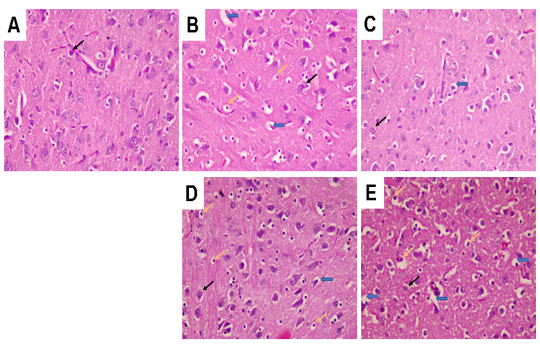
The hypothalamic–pituitary axis regulates reproduction, and its oxidative-stress vulnerability is key to reproductive toxicity from drugs. Metronidazole (MTZ) has been associated with adverse effects on this axis, potentially impairing male fertility. This study investigated the protective effects of ethanol leaf extract of Baphia longipedicellata (ELEBL) against metronidazole-induced oxidative stress and cytoarchitectural alterations in the hypothalamic-pituitary axis of male Wistar rats. Twenty-five adult male Wistar rats (190-210g) were divided into five groups (n=5). Group A received distilled water (10 mL/kg). Group B received MTZ (500 mg/kg) for 14 days. Groups C and D received MTZ followed by ELEBL at 200 mg/kg and 400 mg/kg respectively for 54 days. Group E received MTZ with a 54-day withdrawal period. After treatment, hypothalamic-pituitary tissues were harvested and evaluated for oxidative stress biomarkers (superoxide dismutase (SOD), catalase (CAT), glutathione (GSH), and malondialdehyde (MDA). Histoarchitecture was assessed using Hematoxylin and Eosin (H&E) and Cresyl Fast Violet staining. MTZ administration significantly depleted SOD, CAT, and GSH while elevating MDA levels compared with controls (p<0.0001). ELEBL at both doses significantly restored antioxidant enzyme activities and reduced MDA to near-control values (p<0.05), with the 400 mg/kg dose demonstrating superior efficacy. Histological examination revealed that MTZ caused severe neuronal degeneration, vacuolation and pyknosis in the hypothalamus, along with marked degeneration of acidophils and basophils in the pituitary gland. ELEBL-treated groups showed near-normal architecture with preserved Nissl substance and well-distributed pituitary cell populations. These findings demonstrate that ELEBL attenuates metronidazole-induced oxidative stress and preserves hypothalamic-pituitary cytoarchitecture.
References
Ajayi, A. F., Oluwole, D. T., Akhigbe, R. E., Hamed, M. A., & Ajayi, L. O. (2023). Proton pump dysfunction and upregulation of caspase-3 activity via oxidative-sensitive signaling mediate rohypnol-induced testicular toxicity. Andrologia. https://api.semanticscholar.org/CorpusID:258096592
Ajibade, A. J., & Ayanlade, I. J. (2021). Evaluation of chronic administration of metronidazole on the morphological and biochemical parameters on the cerebral cortex of adult Wistar rats. Journal of Applied Life Sciences International, 24(4), 31–43. https://doi.org/10.9734/jalsi/2021/v24i430232
Akano, O. P., Olatinwo, G., Hamed, M. A., Oluwole, D. T., Jegede, A. J., Ajayi, A. F. (2026). Glutathione as a Potential Neuroprotectant Against MDMA-Induced Oxidative Stress, Neuroinflammation, and Apoptosis in the Rat Brain. Neurochemical Research, 51: 151. https://doi.org/10.1007/s11064-026-04764-0
Anapathy, M. K., & Tadi, P. (2023). Anatomy, head and neck, pituitary gland. In StatPearls. StatPearls Publishing. https://www.ncbi.nlm.nih.gov/books/NBK551529/
Anwar, S., Sarwar, T., Khan, A. A., & Rahmani, A. H. (2025). Therapeutic applications and mechanisms of superoxide dismutase (SOD) in different pathogenesis. Biomolecules, 15(8), 1130. https://doi.org/10.3390/biom15081130
Azouz, A. A., Ali, A. M., Shaalan, M., Rashad, M. M., Bakeer, M. R., Issa, M. Y., Kadasah, S. F., Alrefaei, A. F., & Azouz, R. A. (2026). Protective effects of Olea europaea L. leaves and Equisetum arvense L. extracts against testicular toxicity induced by metronidazole through reducing oxidative stress and regulating NBN, INSL-3, STAR, HSD-3β, and CYP11A1 signaling pathways. Toxics, 14(1), 42. https://doi.org/10.3390/toxics14010042
Bakeer, M. R., Rashad, M. M., Azouz, A. A., Azouz, R. A., Alrefaei, A. F., Kadasah, S. F., Shaalan, M., Ali, A. M., Issa, M. Y., & El-Samanoudy, S. I. (2025). Molecular, physiological, and histopathological insights into the protective role of Equisetum arvense and Olea europaea extracts against metronidazole-induced pancreatic toxicity. Life, 15(12), 1907. https://doi.org/10.3390/life15121907
Bhati, M., Thakre, S., & Anjankar, A. (2023). Nissl granules, axonal regeneration, and regenerative therapeutics: A comprehensive review. Cureus, 15(10), e47872. https://doi.org/10.7759/cureus.47872
Chen, T. H., Wang, H. C., Chang, C. J., & Lee, S. Y. (2024). Mitochondrial glutathione in cellular redox homeostasis and disease manifestation. International Journal of Molecular Sciences, 25(2), 1314. https://doi.org/10.3390/ijms25021314
Chen, Y. S., Tian, H. X., Rong, D. C., Wang, L., Chen, S., Zeng, J., Xu, H., Mei, J., Wang, L. Y., Liou, Y. L., & Zhou, H. H. (2025). ROS homeostasis in cell fate, pathophysiology, and therapeutic interventions. Molecular Biomedicine, 6(1), 89. https://doi.org/10.1186/s43556-025-00338-8
Chukwudi, H. C., & Ezeabara, C. A. (2018). Phytochemical screening and in vitro antimicrobial activities of Mimosa invisa Mart. leaves and stems. Bioscience Horizons, 11, hzy019. https://doi.org/10.1093/biohorizons/hzy019
Clavijo, R. I., & Hsiao, W. (2018). Update on male reproductive endocrinology. Translational Andrology and Urology, 7(Suppl 3), S367–S372. https://doi.org/10.21037/tau.2018.03.25
Cordiano, R., Di Gioacchino, M., Mangifesta, R., Panzera, C., Gangemi, S., & Minciullo, P. L. (2023). Malondialdehyde as a potential oxidative stress marker for allergy-oriented diseases: An update. Molecules, 28(16), 5979. https://doi.org/10.3390/molecules28165979
Dangani, H. A., Salihu, A. S., & Maigoro, A. L. (2026). Comparative phytochemical screening, antioxidant, and antidiabetic activities of selected medicinal plant leaves extracts. Discover Chemistry, 3, 232. https://doi.org/10.1007/s44371-026-00696-4
Dash, U. C., Bhol, N. K., Swain, S. K., Samal, R. R., Nayak, P. K., Raina, V., Panda, S. K., Kerry, R. G., Duttaroy, A. K., & Jena, A. B. (2025). Oxidative stress and inflammation in the pathogenesis of neurological disorders: Mechanisms and implications. Acta Pharmaceutica Sinica B, 15(1), 15–34. https://doi.org/10.1016/j.apsb.2024.10.004
El-Nahas, A. F., & El-Ashmawy, I. M. (2004). Reproductive and cytogenetic toxicity of metronidazole in male mice. Basic & Clinical Pharmacology & Toxicology, 94, 226–231. https://doi.org/10.1111/j.1742-7843.2004.pto940505.x
Fatmawati, A., Bachri, M. S., & Nurani, L. H. (2019). Combination effects of Moringa oleifera leaf ethanol extract and Andrographis paniculata herb on blood glucose levels and pancreas histopathology of diabetic rats induced by streptozotocin. Traditional Medicine Journal, 24(2), 85–90. https://doi.org/10.22146/mot.39401
Garcia-Llorens, G., El Ouardi, M., & Valls-Belles, V. (2025). Oxidative stress fundamentals: Unraveling the pathophysiological role of redox imbalance in non-communicable diseases. Applied Sciences, 15(18), 10191. https://doi.org/10.3390/app151810191
Hamed, M. A., Akhigbe, R. E., Ekundina, V. O., & Oluwole, D. T. (2025). Promethazine induces testicular and epididymal toxicity via the upregulation of xanthine oxidase/uric acid-mediated oxidative stress signaling. Comparative Clinical Pathology, 34(2), 215–230. https://doi.org/10.1007/s00580-025-03647-0
Ibitoye, S. F., Lawal, S. O., Alonigbeja, A. A., & Adebayo, O. A. (2023). Phytochemical screening, antioxidant and antimicrobial activities of methanol extract from Baphia longipedicellata (De Wild.) leaf. Biochemistry & Analytical Biochemistry, 12, 482.
Intharuksa, A., Kuljarusnont, S., Sasaki, Y., & Tungmunnithum, D. (2024). Flavonoids and other polyphenols: Bioactive molecules from traditional medicine recipes/medicinal plants and their potential for phytopharmaceutical and medical application. Molecules, 29(23), 5760. https://doi.org/10.3390/molecules29235760
Jomova, K., Alomar, S. Y., Alwasel, S. H., Nepovimova, E., Kuca, K., & Valko, M. (2024). Several lines of antioxidant defense against oxidative stress: Antioxidant enzymes, nanomaterials with multiple enzyme-mimicking activities, and low-molecular-weight antioxidants. Archives of Toxicology, 98(5), 1323–1367. https://doi.org/10.1007/s00204-024-03696-4
Knudsen, E., Tadje, J., Coggins, C., & Venketaraman, V. (2026). Glutathione and neurodegenerative diseases: Immunopharmacological implications. Frontiers in Pharmacology, 16, 1737199. https://doi.org/10.3389/fphar.2025.1737199
Kong, X., Wang, X., Xia, Q., et al. (2025). Unveiling the nexus between environmental exposures and testicular damages: Revelations from autophagy and oxidative stress imbalance. Cell Death Discovery, 11, 258. https://doi.org/10.1038/s41420-025-02543-4
Liu, J., Han, X., Zhang, T., Tian, K., Li, Z., & Luo, F. (2023). Reactive oxygen species (ROS) scavenging biomaterials for anti-inflammatory diseases: From mechanism to therapy. Journal of Hematology & Oncology, 16(1), 116. https://doi.org/10.1186/s13045-023-01512-7
Ma, Y., Fan, X., Han, J., Cheng, Y., Zhao, J., Fang, W., & Gao, L. (2025). Critical illness and sex hormones: Response and impact of the hypothalamic-pituitary-gonadal axis. Therapeutic Advances in Endocrinology and Metabolism, 16, 20420188251328192. https://doi.org/10.1177/20420188251328192
Nadia Ahmad, S., Nasir, M., & Raees Ahmad, K. (2026). Histopathological impact of exogenous chemicals on the pituitary gland and neuroprotective role of natural plant extracts (NPEs). In The Pituitary in Focus – Integrated Approaches to Etiology, Pathophysiology, and Complication Management. IntechOpen. https://doi.org/10.5772/intechopen.1011154
O’Donnell, L., & Smith, L. B. (2026). Endocrinology of the testis and spermatogenesis. In K. R. Feingold, R. A. Adler, S. F. Ahmed, et al. (Eds.), Endotext. MDText.com, Inc. https://www.ncbi.nlm.nih.gov/books/NBK279031/
Odetayo, A. F., Akhigbe, R. E., Bassey, G. E., Hamed, M. A., & Olayaki, L. A. (2024). Impact of stress on male fertility: Role of gonadotropin inhibitory hormone. Frontiers in Endocrinology, 14, 1329564. https://doi.org/10.3389/fendo.2023.1329564
Ogbonye, E., Ejimofor, O., Ogbodo, E., Ezeugwunne, I., & Madukwe, D. (2020). The effect of metronidazole on the histology of the cerebellum and pituitary gland in female Wistar rats. IP Indian Journal of Neurosciences, 6(1), 67–72. https://doi.org/10.18231/j.ijn.2020.013
Oladoja, F. A., Awodele, O., Oreagba, I. A., Irokosu, E. S., Oyinloye, E. O., & Murtala, A. A. (2024). Anti-inflammatory activity and molecular docking studies of the hydromethanolic leaf extract of Baphia longipedicellata Brumitt in rats. Pharmacological Research – Modern Chinese Medicine, 13, 100512. https://doi.org/10.1016/j.prmcm.2024.100512
Oladoja, F. A., Awodele, O., Oreagba, I. A., Irokosu, E. S., Oyinloye, E. O., Murtala, A. A., Ganiyu-Abideen, N. A., & Pender, G. C. (2025). Baphia longipedicellata exhibits antidiabetic, antioxidant, and hepatoprotective activities: In vitro and in vivo studies. RPS Pharmacy and Pharmacology Reports, 4(3), rqaf010. https://doi.org/10.1093/rpsppr/rqaf010
Pasternak, M., Hussein, N., Piedra, V., Malla, S., Karthikeyan, C., Amawi, H., Rajak, H., Ashby, C. R., Jr., Babu, R. J., & Tiwari, A. K. (2026). Vacuolization as a novel approach to cancer therapy. Journal of Biochemical and Molecular Toxicology, 40(6), e70912. https://doi.org/10.1002/jbt.70912
Qin, Y., Qian, C., Li, W., Wang, Q., Sheng, Q., Chen, Z., Zhang, W., Li, W., Ge, G., Yan, Z., & Geng, D. (2026). Oxidative stress: Molecular mechanisms, diseases, and therapeutic targets. MedComm, 7(2), e70600. https://doi.org/10.1002/mco2.70600
Rasheed, Z. (2024). Therapeutic potentials of catalase: Mechanisms, applications, and future perspectives. International Journal of Health Sciences, 18(2), 1–6.
Roepke, T. A., & Sadlier, N. C. (2021). Reproductive toxicology: Impact of endocrine disruptors on neurons expressing GnRH or kisspeptin and pituitary gonadotropins. Reproduction, 162(5), F131–F145. https://doi.org/10.1530/REP-20-0612
Sharma, A., Jayasena, C. N., & Dhillo, W. S. (2022). Regulation of the hypothalamic-pituitary-testicular axis: Pathophysiology of hypogonadism. Endocrinology and Metabolism Clinics of North America, 51(1), 29–45. https://doi.org/10.1016/j.ecl.2021.11.010
Sisli, H. B., Hayal, T. B., Şenkal, S., Kuratlı, B., Sağraç, D., Seçkin, S., Özpolat, M., Şahin, F., Yılmaz, B., & Doğan, A. (2022). Apelin receptor signaling protects GT1-7 GnRH neurons against oxidative stress in vitro. Cellular and Molecular Neurobiology, 42, 753–775. https://doi.org/10.1007/s10571-020-00968-2
Vyas, R., Kesari, K. K., Slama, P., Roychoudhury, S., & Sisodia, R. (2022). Differential activity of antioxidants in testicular tissues following administration of Chlorophytum borivilianum in gamma-irradiated Swiss albino mice. Frontiers in Pharmacology, 12, 774444. https://doi.org/10.3389/fphar.2021.774444
Weir, C. B., & Le, J. K. (2023). Metronidazole. In StatPearls. StatPearls Publishing. https://www.ncbi.nlm.nih.gov/books/NBK539728
Yang, Y., Wang, Q., Wang, Z., Wang, Y., Liu, B., Zhang, Y., Mao, X., & Sun, H. (2025). The role of fatty acids in neurodegenerative diseases: Mechanistic insights and therapeutic strategies. Journal of Lipid Research, 66(12), 100944. https://doi.org/10.1016/j.jlr.2025.100944
Yeh, Y. M., Huang, P. J., Wu, Y. L., Chen, C. H., Chen, P. Y., Hsu, Y. T., & Cheng, W. H. (2026). Mitomycin C potentiates metronidazole activity in resistant Trichomonas vaginalis through suppression of thioredoxin reductase. International Journal for Parasitology: Drugs and Drug Resistance, 31, 100661. https://doi.org/10.1016/j.ijpddr.2026.100661
Downloads
Published
Issue
Section
Categories
License
Copyright (c) 2026 Albert Abiodun Ogunlade, Ifabunmi Oduyemi Osonuga, Oyedayo Phillips Akano, Olaniyi Azeez Soetan, Eunice Oluwabunmi Ojo-Adebayo, God’sFavour Oluwanifemi Odukoya, Farouk Adedeji Oladoja

This work is licensed under a Creative Commons Attribution 4.0 International License.


