
Response Surface Optimization of Coconut-Shell Aggregate Concrete for Compressive Strength and Water Absorption
DOI:
https://doi.org/10.33003/fjs-2026-1024-6051Keywords:
Coconut Shell Aggregate, Concrete, Compressive Strength, Water Absorption, Central Composite Design, Response Surface MethodologyAbstract
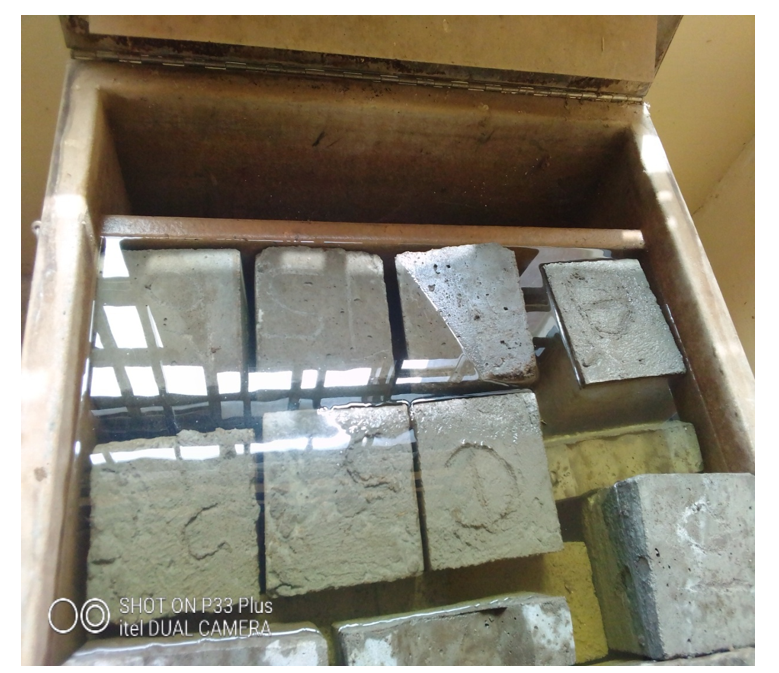
Coconut shell (CS) is an abundant agricultural residue that has been proposed as a partial substitute for coarse aggregate in concrete. This study used a central composite design (CCD) within response surface methodology (RSM) to examine how CS replacement ratio (5–25 %), CS particle size (3.35–14 mm) and curing age (7–35 days) affect the compressive strength and water absorption of concrete (cement: sand: coarse aggregate = 1: 1.5: 3 by absolute volume; water/cement ratio 0.5). Twenty experimental runs (one 150 mm cube per run, including five centre-point replicates) and one control cube without CS were produced. Measured compressive strength of the CS concretes ranged from 16.23 to 20.21 N/mm2 (control: 24.36 N/mm2) and water absorption from 1.5 to 3.9 %. The quadratic models were significant for both responses (p < 0.0001; R2 = 0.980 and 0.958), although the lack-of-fit test for compressive strength was borderline (p = 0.051). Numerical optimisation (maximise strength, minimise absorption) predicted 20.46 N/mm2 and 1.50 % at 5.27 % replacement, 3.42 mm particle size and 9.2 days of curing; the desirability of 1.000 is a model output that reflects the chosen goal limits and is not evidence of performance. Two confirmation specimens made at these settings gave 18.98 and 19.10 N/mm2 (mean 19.04 N/mm2) and 1.95 and 1.98 % (mean 1.97 %).
References
American Concrete Institute. (2023). Guide for structural lightweight-aggregate concrete (ACI 213R-14, reapproved 2023; designated ACI PRC-213-14(23)).
ASTM International. (2019). Standard test method for determining density of structural lightweight concrete (ASTM C567/C567M-19).
ASTM International. (2021). Standard test method for density, absorption, and voids in hardened concrete (ASTM C642-21).
ASTM International. (2023a). Standard specification for lightweight aggregates for structural concrete (ASTM C330/C330M-23).
ASTM International. (2023b). Standard test method for bulk density (“unit weight”) and voids in aggregate (ASTM C29/C29M-23).
ASTM International. (2025a). Standard test method for relative density (specific gravity) and absorption of coarse aggregate (ASTM C127-25).
ASTM International. (2025b). Standard test method for relative density (specific gravity) and absorption of fine aggregate (ASTM C128-25).
Boakye, K. A., Tarantsev, D., Ahmed, M., & Bainge, G. (2025). Sustainable concrete solutions: Evaluating the structural performance of coconut shells as coarse aggregate substitute. Structural Concrete. https://doi.org/10.1002/suco.202401159
British Standards Institution. (2020). Testing concrete: Method for determination of water absorption (BS 1881-122:2011+A1:2020).
British Standards Institution. (2022). Tests for mechanical and physical properties of aggregates: Part 6. Determination of particle density and water absorption (BS EN 1097-6:2022).
de Bortoli, A. (2025). Understanding the environmental impacts of virgin aggregates: Critical literature review and primary comprehensive life cycle assessments [Preprint]. arXiv. https://arxiv.org/abs/2501.10457
Dwarampudi, M., & Venkateshwari, B. (2024). Performance of lightweight concrete with different aggregates: A comprehensive review. Discover Civil Engineering, 1, Article 46. https://doi.org/10.1007/s44290-024-00015-9
Gunasekaran, K., Kumar, P. S., & Lakshmipathy, M. (2011). Mechanical and bond properties of coconut shell concrete. Construction and Building Materials, 25(1), 92–98.
Kumar, D., & Pawar, S. J. (2022). Compressive behaviour of green concrete partially reinforced with dry coconut shell aggregates as a replacement of coarse aggregates. AMC Indian Journal of Civil Engineering, 5(1), 7–15.
Liman, A. Z., Adagba, T., & Umar, H. A. (2021). Effect of crushed doum palm shell as partial replacement of coarse aggregate in concrete. FUDMA Journal of Sciences, 4(4), 1–9. https://doi.org/10.33003/fjs-2020-0404-456
Natarajan, K. S., Ramalingasekar, D., Palanisamy, S., & Ashokan, M. (2022). Effect on mechanical properties of lightweight sustainable concrete with the use of waste coconut shell as replacement for coarse aggregate. Environmental Science and Pollution Research, 29, 39421–39426. https://doi.org/10.1007/s11356-022-18905-9
Oppon, J. A., Adinyira, E., & Agyekum, K. (2025). A bibliometric review of agricultural waste as coarse aggregates in sustainable concrete. Discover Civil Engineering, 2, Article 127. https://doi.org/10.1007/s44290-025-00286-w
Osei, D. Y. (2013). Experimental assessment on coconut shells as aggregate in concrete. International Journal of Engineering Science Invention, 2(5), 7–11.
Pordesari, A. J., Shafigh, P., Ünal, M. T., & Ibrahim, Z. (2025). Mechanical properties of coconut shell lightweight aggregate concrete: A comprehensive review. Advances in Civil Engineering, 2025, Article 7816362.
Pratiwi, N., Lakawa, I., Sulaiman, S., & Hujiyanto, H. (2022). Testing the compressive strength of concrete with the addition of coconut shell waste. Sultra Civil Engineering Journal, 3(2), 61–70. https://doi.org/10.54297/sciej.v3i2.350
Downloads
Published
Issue
Section
Categories
License
Copyright (c) 2026 Moses Oloche Oglekwu, Paul Abuh Omale, Usman Abdulgafar, Mustapha Tola Abdulquadri, Dorcas Yakubu Kantiok

This work is licensed under a Creative Commons Attribution 4.0 International License.


