
Heavy Metal Concentrations and Associated Health Risks in Edible Vegetables Sold in Selected Market in Alimosho, Lagos State, Nigeria
DOI:
https://doi.org/10.33003/fjs-2026-1021-6056Keywords:
heavy metals, bio accumulation, atomic absorption spectroscopy, estimate daily ingestion, hazard indexAbstract
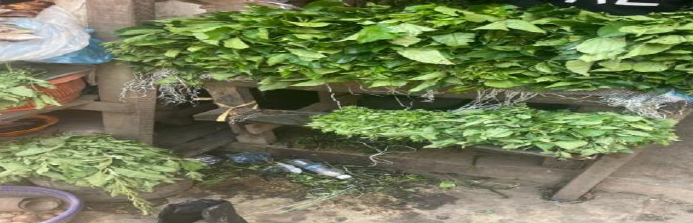
The concentrations of cadmium (Cd), lead (Pb), and zinc (Zn) in fluted pumpkin (Telfairia occidentalis), locally known as ugwu, and okra (Abelmoschus esculentus), from a selected local market in Alimosho Local Government Area, Lagos State, Nigeria was evaluated. The samples were analysed using Atomic Absorption Spectroscopy (AAS), and toxicological data were converted to a fresh weight baseline to accurately evaluate human health risks. Human health risk exposure was appraised for the local adult cohort using the Estimated Daily Intake (EDI), Hazard Quotient (HQ), Hazard Index (HI), and Lifetime Carcinogenic Risk (CR) indices based on standard regional ingestion rates (65 g/day for ugwu; 50 g/day for okra) and an average adult body weight of 60 kg. The analytical results revealed dry weight concentrations of 0.01 ± 0.01 mg/kg Cd, 0.05 ± 0.01 mg/kg Pb, and 54.11 ± 1.48 mg/kg Zn in ugwu, and 0.03 ± 0.02 mg/kg Cd, 0.15 ± 0.02 mg/kg Pb, and 11.07 ± 0.07 mg/kg Zn in okra. Based on regional moisture benchmarks, all heavy metal contents fell safely below the maximum permissible limits formalized by the FAO/WHO. Hazard Index was 0.0302 for ugwu and 0.0096 for okra; which are substantially below 1.0, the dietary intake of these crops poses no chronic non-carcinogenic health hazards to consumers. Furthermore, the lifetime incremental carcinogenic risk metrics for Pb in both vegetables (<10-7) and Cd in ugwu 5.76 x 10⁻⁷ were classified as toxicologically negligible.
References
Adeyeye, E. I. (2019). Heavy metal contamination of agricultural soils and vegetables in Lagos,
Nigeria: A review. Environmental Monitoring and Assessment, 191(5), 1–12.
Adepoju-Bello, A. A. (2020). Heavy metal levels in vegetables from Lagos markets. Journal of
Environmental Chemistry and Ecotoxicology, 12(2), 45–54.
Akinola, M. O. (2019). Heavy metal bioaccumulation in roadside vegetables. Nigerian Journal
of Environmental Sciences, 13(1), 23–34.
Akinola, M. O., Ojo, O. A., & Adegbite, A. A. (2021). Assessment of heavy metal levels in
vegetables from major markets in Lagos, Nigeria. Journal of Environmental Chemistry and Ecotoxicology, 13(2), 45–53.
Alloway, B. J. (2013). Heavy metals in soils: Trace metals and metalloids in soils and their
bioavailability (3rd ed.). Springer.
Bawa, U. (2023). Heavy metals in food crops irrigated with pesticide-contaminated water and
associated health risks in Kaduna State, Nigeria. Cogent Food & Agriculture, 9(1), Article 2191889. https://doi.org/10.1080/23311932.2023.2191889
Danladi, S. Y., Saminu, M. Y., & Yahaya, A. A. (2025). Pollution level of heavy metals in
vegetables produced through irrigation farming in Jigawa State, Nigeria. FUDMA Journal of Sciences, 9(2), 186–192.
Eze, P. N. (2022). Health risk assessment of heavy metals in vegetables in Port Harcourt.
Environmental Monitoring and Assessment, 194, 155.
Food and Agriculture Organization/World Health Organization. (2011). Codex Alimentarius
Commission: Joint FAO/WHO food standards programme—Contaminants in foods. FAO.
Jaishankar, M., Tseten, T., Anbalagan, N., Mathew, B. B., & Beeregowda, K. N. (2014).
Toxicity, mechanism and health effects of some heavy metals. Interdisciplinary Toxicology, 7(2), 60–72.
Ogundele, D. T., & Adejumo, A. O. (2020). Impact of traffic emissions on heavy metal accumulation in leafy vegetables grown along major roads in Lagos. Nigerian Journal of Environmental Sciences, 8(3), 112–120.
Okereke, C. J. (2023). Heavy metals and dietary risk assessment in Kano markets. African Journal of Environmental Science and Technology, 17(4), 210–222.
Oladele, E.O., Adewumi, O.O., Yahaya, T. (2019) Response of Bambara groundnut (Vigna
subterranean L.) and Maize (Zea mays L.) to heavy metal stress. Beni-Suef Univ J Basic Appl Sci 8, 19 (2019). https://doi.org/10.1186/s43088-019-0024-x
Olowu, R. A., Ayejuyo, O. O., & Adewuyi, G. O. (2020). Heavy metals in soils and vegetables
from urban agricultural sites in Lagos, Nigeria. International Journal of Environmental Science and Technology, 17(4), 2145–2156.
Orisakwe, O. E. (2019). Blood lead levels in Nigerian urban residents. Environmental Research, 174, 147–153.
Sharma, R. K., Agrawal, M., & Marshall, F. (2018). Heavy metals in vegetables: A review of
unbound and bound forms and their health risks. Environmental Reviews, 26(2), 123–139.
Tchounwou, P. B., Yedjou, C. G., Patlolla, A. K., & Sutton, D. J. (2012). Heavy metal toxicity
and the environment. In A. Luch (Ed.), Molecular, clinical and environmental toxicology
(pp. 133–164). Springer.
World Health Organization. (2017). Guidelines for drinking-water quality (4th ed., incorporating the 1st addendum). WHO.
Yahaya, T. O., Isah, A. T., Obaroh, I., Abdulrahman, S., Bello, S. A., & Inuwa, F. G. (2025).
Heavy Metals in River Jega Northwestern Nigeria: Ecological and Human Health Risk Assessment. Aswan University Journal of Environmental Studies, 6(4), 364-376
Downloads
Published
Issue
Section
Categories
License
Copyright (c) 2026 Esther O Oladele, Olusoji Adewumi, Daniel Achem, Victoria Nwokoma

This work is licensed under a Creative Commons Attribution 4.0 International License.


