
Mathematical Model of Canine Rabies Transmission Dynamics with Combined Pre and Post Exposure Vaccination
DOI:
https://doi.org/10.33003/fjs-2026-1022-6070Keywords:
Effective Reproduction Number, Local Stability Analysis, Sensitivity AnalysisAbstract
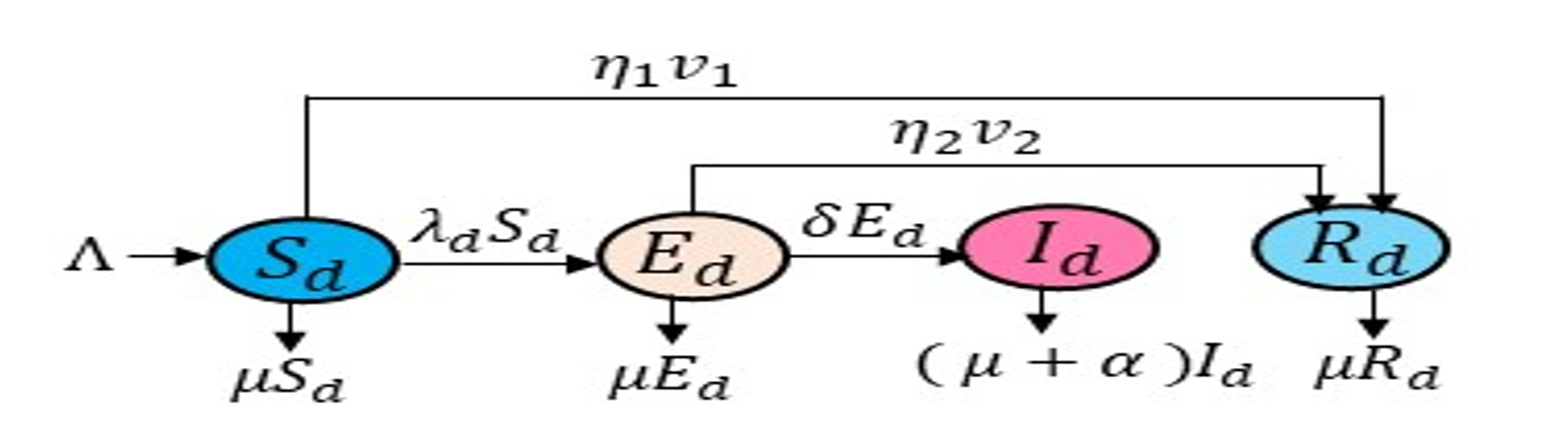
Canine rabies remains an important public health concern, and mathematical modeling provides a useful framework for understanding its transmission dynamics and evaluating vaccination strategies. This study develops a deterministic mathematical model for canine rabies transmission incorporating pre- and post-exposure vaccination. The positivity and boundedness of the model solutions are established, the rabies-free equilibrium is determined, and the effective reproduction number is derived. The rabies-free equilibrium is shown to be locally asymptotically stable whenever and unstable whenever The condition for the existence of an endemic equilibrium is established, and sensitivity analysis indicates that increases with the transmission contact rate , whereas increasing the disease-induced death rate reduces Numerical simulations are conducted to examine the effects of pre- and post-exposure vaccine effectiveness on rabies transmission dynamics. The results show that increasing the effectiveness of both vaccination strategies reduces rabies transmission and increases the number of protected dogs. However, pre-exposure vaccination has a greater effect on the protected dog population than post-exposure vaccination.
References
Abubakar, A., Andrawus, J., Ibrahim, K. G., Yusuf, A., Maiwa, S. I., & Bitrus, K. (2025). Assessing the impact of booster vaccine and isolation in controlling the spread of pertussis: A mathematical modeling approach. FUDMA Journal of Sciences (FJS), 9(8), 392-405.
Bako, D., Odo, C. E., Oluwafemi, T. J., & Oladejo, J. K. (2025). Semi-analytic solution of a mathematical model of disease dynamics in schools using the Homotopy Perturbation Method. FUDMA Journal of Sciences (FJS), 9(4), 44-49.
Centers for Disease Control and Prevention. (2025, July 16). Information for veterinarians. https://www.cdc.gov/rabies/hcp/veterinarians/
Cleaveland, S., Kaare, M., Knobel, D., & Laurenson, M. K. (2006). Canine vaccination: Providing broader benefits for disease control. Veterinary Microbiology, 117(1), 43-50. https://doi.org/10.1016/j.vetmic.2006.04.009
Cleaveland, S., Kaare, M., Tiringa, P., Mlengeya, T., & Barrat, J. (2003). A dog rabies vaccination campaign in rural Africa: Impact on the incidence of dog rabies and human dog-bite injuries. Vaccine, 21(17-18), 1965-1973.
https://doi.org/10.1016/S0264-410X(02)00778-8
Hampson, K., Coudeville, L., Lembo, T., Sambo, M., Kieffer, A., Attlan, M., Barrat, J., Blanton, J. D., Briggs, D. J., Cleaveland, S., Costa, P., Freuling, C. M., Hiby, E., Knopf, L., Leanes, F., Meslin, F.-X., Metlin, A., Miranda, M. E., Müller, T., ... Dushoff, J. (2015). Estimating the global burden of endemic canine rabies. PLoS Neglected Tropical Diseases, 9(4), 1-20.
Islam, M. M., Biswas, M. H. A., & Islam, M. H. (2026). Evaluating pre- and post-exposure vaccination for rabies control in dog populations using mathematical modeling. Abstract and Applied Analysis, 2026(1), 1-18. https://doi.org/10.1155/aaa/7714251
Layan, M., Dellicour, S., Baele, G., Cauchemez, S., & Bourhy, H. (2021). Mathematical modelling and phylodynamics for the study of dog rabies dynamics and control: A scoping review. PLOS Neglected Tropical Diseases, 15(5), 1-24. https://doi.org/10.1371/journal.pntd.0009449
Van Den Driessche, P., & Watmough, J. (2002). Reproduction numbers and sub-threshold endemic equilibria for compartmental models of disease transmission. Mathematical Biosciences, 180(1-2), 29-48. https://doi.org/10.1016/S0025-5564(02)00108-6
World Health Organization. (2024). Rabies. https://www.who.int/news-room/fact-sheets/detail/rabies
World Health Organization. (2024). Veterinary vaccines. https://www.who.int/teams/control-of-neglected-tropical-diseases/rabies/vaccinations-and-immunization/veterinary-vaccines
Downloads
Published
Issue
Section
Categories
License
Copyright (c) 2026 Yakubu Gambo, Hassan Muhammad, Sulaiman Aliyu Yayangida, Nata'ala Bako

This work is licensed under a Creative Commons Attribution 4.0 International License.


