
AI-SEHOS: A Solar-Powered, Energy-Aware Digital Learning Framework for Nomadic Communities in Northern Nigeria
DOI:
https://doi.org/10.33003/fjs-2026-1021-6089Keywords:
solar energy management, battery energy storage, reinforcement learning, LSTM forecasting, nomadic education, off-grid digital learning, Northern NigeriaAbstract
Nomadic and pastoralist communities in Northern Nigeria are poorly served by digital-education strategies because electricity is absent, households are seasonally mobile and ICT infrastructure is weak. This concept paper specifies AI-SEHOS (AI-driven Solar Energy Harvesting, Optimisation and Storage), a four-layer framework (Data, Energy, AI Decision and Educational Service) that treats instructional demand and mobility as explicit terms in energy dispatch and load allocation. The specification uses twenty-five numbered equations adapted from established photovoltaic, forecasting, battery-estimation and reinforcement-learning work. The components were exercised on a documented synthetic generator with chronological splits, repeated runs and stated baselines; the code is supplied. On synthetic data only, long short-term memory (LSTM) and gradient-boosting forecasters reduced one-hour-ahead test RMSE by about 4–6% relative to smart persistence (nRMSE 2.52% and 2.56% of capacity versus 2.67%) and were statistically indistinguishable; the gain disappeared under a simpler generator. A tabular Q-learning dispatch policy matched, but did not beat, the best rule-based controller on 30 held-out traces. Criticality-aware allocation raised server availability during school hours from 81% to 98% and reduced weighted unmet load by about 34% under fixed reference weights, at the cost of more lighting shortfall; the allocation depended only on weight rank. These results illustrate mechanisms; they are not evidence of field performance. The paper contributes a specification, a reproducible test bed, a field-validation protocol with pre-stated hypotheses and an explicit account of what remains unestablished.
References
Aderinoye, R. A., Ojokheta, K. O., & Olojede, A. A. (2007). Integrating mobile learning into nomadic education programmes in Nigeria: Issues and perspectives. The International Review of Research in Open and Distributed Learning, 8(2). https://doi.org/10.19173/irrodl.v8i2.347
Alabdullah, M. H., & Abido, M. A. (2022). Microgrid energy management using deep Q-network reinforcement learning. Alexandria Engineering Journal, 61(11), 9069–9078. https://doi.org/10.1016/j.aej.2022.02.042
Alfredo, R., Echeverria, V., Jin, Y., Yan, L., Swiecki, Z., Gasevic, D., & Martinez-Maldonado, R. (2024). Human-centred learning analytics and AI in education: A systematic literature review. Computers and Education: Artificial Intelligence, 6, Article 100215. https://doi.org/10.1016/j.caeai.2024.100215
Ali, M. H., Zakaria, M., & El-Tawab, S. (2025). A comprehensive study of recent maximum power point tracking techniques for photovoltaic systems. Scientific Reports, 15, Article 14269. https://doi.org/10.1038/s41598-025-96247-5
Carabajal, A. T., Orsot, A., Moudio, M. P. E., Haggai, T., Okonkwo, C. J., Jarrard, G. T., III, & Selby, N. S. (2024). Social and economic impact analysis of solar mini-grids in rural Africa: A cohort study from Kenya and Nigeria. Environmental Research: Infrastructure and Sustainability, 4(2), Article 025005. https://doi.org/10.1088/2634-4505/ad4ffb
Chen, T., & Guestrin, C. (2016). XGBoost: A scalable tree boosting system. In Proceedings of the 22nd ACM SIGKDD International Conference on Knowledge Discovery and Data Mining (pp. 785–794). ACM. https://doi.org/10.1145/2939672.2939785
Davis, F. D. (1989). Perceived usefulness, perceived ease of use, and user acceptance of information technology. MIS Quarterly, 13(3), 319–340. https://doi.org/10.2307/249008
Ejiyi, C. J., Cai, D., Thomas, D., Obiora, S., Osei-Mensah, E., Acen, C., Eze, F. O., Sam, F., Zhang, Q., & Bamisile, O. O. (2025). Comprehensive review of artificial intelligence applications in renewable energy systems: Current implementations and emerging trends. Journal of Big Data, 12, Article 169. https://doi.org/10.1186/s40537-025-01178-7
Federal Republic of Nigeria. (2023). Nigeria Data Protection Act 2023.
Gers, F. A., Schmidhuber, J., & Cummins, F. (2000). Learning to forget: Continual prediction with LSTM. Neural Computation, 12(10), 2451–2471. https://doi.org/10.1162/089976600300015015
Hevner, A. R., March, S. T., Park, J., & Ram, S. (2004). Design science in information systems research. MIS Quarterly, 28(1), 75–105. https://doi.org/10.2307/25148625
Hochreiter, S., & Schmidhuber, J. (1997). Long short-term memory. Neural Computation, 9(8), 1735–1780. https://doi.org/10.1162/neco.1997.9.8.1735
Hu, L., Hu, R., Ma, Z., & Jiang, W. (2022). State of charge estimation and evaluation of lithium battery using Kalman filter algorithms. Materials, 15(24), Article 8744. https://doi.org/10.3390/ma15248744
Hyndman, R. J., & Koehler, A. B. (2006). Another look at measures of forecast accuracy. International Journal of Forecasting, 22(4), 679–688. https://doi.org/10.1016/j.ijforecast.2006.03.001
Inman, R. H., Pedro, H. T. C., & Coimbra, C. F. M. (2013). Solar forecasting methods for renewable energy integration. Progress in Energy and Combustion Science, 39(6), 535–576. https://doi.org/10.1016/j.pecs.2013.06.002
Julier, S. J., & Uhlmann, J. K. (2004). Unscented filtering and nonlinear estimation. Proceedings of the IEEE, 92(3), 401–422. https://doi.org/10.1109/JPROC.2003.823141
Kalman, R. E. (1960). A new approach to linear filtering and prediction problems. Journal of Basic Engineering, 82(1), 35–45. https://doi.org/10.1115/1.3662552
Khouili, O., Hanine, M., Louzazni, M., Lopez Flores, M. A., Garcia Villena, E., & Ashraf, I. (2025). Evaluating the impact of deep learning approaches on solar and photovoltaic power forecasting: A systematic review. Energy Strategy Reviews, 59, Article 101735. https://doi.org/10.1016/j.esr.2025.101735
Lillicrap, T. P., Hunt, J. J., Pritzel, A., Heess, N., Erez, T., Tassa, Y., Silver, D., & Wierstra, D. (2016). Continuous control with deep reinforcement learning. In International Conference on Learning Representations (ICLR 2016). https://arxiv.org/abs/1509.02971
Mnih, V., Kavukcuoglu, K., Silver, D., Rusu, A. A., Veness, J., Bellemare, M. G., et al. (2015). Human-level control through deep reinforcement learning. Nature, 518(7540), 529–533. https://doi.org/10.1038/nature14236
Mohammadi, P., Darabi, R., Shamaghdari, S., & Siano, P. (2024). Comparative analysis of control strategies for microgrid energy management with a focus on reinforcement learning. IEEE Access, 12, 171368–171395. https://doi.org/10.1109/ACCESS.2024.3495032
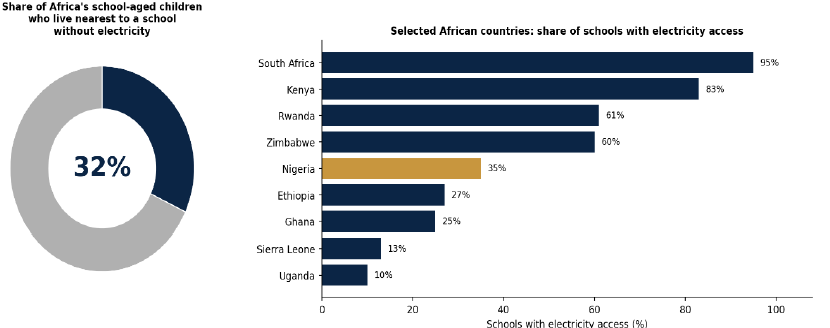
Moner-Girona, M., Kakoulaki, G., Falchetta, G., Weiss, D. J., et al. (2025). Empowering quality education through sustainable and equitable electricity access in African schools. Joule, 9(1), Article 101804. https://doi.org/10.1016/j.joule.2024.12.005 [complete author list to be inserted from the published record]
NASA. (n.d.). Prediction of Worldwide Energy Resources (POWER) data access viewer. https://power.larc.nasa.gov/
Olaniran, S. O. (2018). Almajiri education: Policy and practice to meet the learning needs of the nomadic population in Nigeria. International Review of Education, 64(1), 111–126. https://doi.org/10.1007/s11159-018-9705-2
Peffers, K., Tuunanen, T., Rothenberger, M. A., & Chatterjee, S. (2007). A design science research methodology for information systems research. Journal of Management Information Systems, 24(3), 45–77. https://doi.org/10.2753/MIS0742-1222240302
Plett, G. L. (2004). Extended Kalman filtering for battery management systems of LiPB-based HEV battery packs: Part 1. Background. Journal of Power Sources, 134(2), 252–261. https://doi.org/10.1016/j.jpowsour.2004.02.031
Rogers, E. M. (2003). Diffusion of innovations (5th ed.). Free Press.
Skoplaki, E., & Palyvos, J. A. (2009). On the temperature dependence of photovoltaic module electrical performance: A review of efficiency/power correlations. Solar Energy, 83(5), 614–624. https://doi.org/10.1016/j.solener.2008.10.008
Song, Z., Fang, K., Sun, X., Liang, Y., Lin, W., Xu, C., Huang, G., & Yu, F. (2021). An effective method to accurately extract the parameters of single diode model of solar cells. Nanomaterials, 11(10), Article 2615. https://doi.org/10.3390/nano11102615
Ukoba, K., Olatunji, K. O., Adeoye, E., Jen, T.-C., & Madyira, D. M. (2024). Optimizing renewable energy systems through artificial intelligence: Review and future prospects. Energy & Environment, 35(7), 3833–3879. https://doi.org/10.1177/0958305X241256293
Umar, S. I., & Maaji, S. M. (2025). From sacred education to street exploitation: The Almajiri crisis in Nigeria as a nexus of public health failures, legal paralysis, and global security risks. Philosophy, Ethics, and Humanities in Medicine, 20(1), Article 23. https://doi.org/10.1186/s13010-025-00191-1
Watkins, C. J. C. H., & Dayan, P. (1992). Q-learning. Machine Learning, 8(3–4), 279–292. https://doi.org/10.1007/BF00992698
World Bank Group. (n.d.). Global Solar Atlas. https://globalsolaratlas.info/
Yang, D., Kleissl, J., Gueymard, C. A., Pedro, H. T. C., & Coimbra, C. F. M. (2018). History and trends in solar irradiance and PV power forecasting: A preliminary assessment and review using text mining. Solar Energy, 168, 60–101. https://doi.org/10.1016/j.solener.2017.11.023
Downloads
Published
Issue
Section
Categories
License
Copyright (c) 2026 Gregory Onwodi, Enoch Jacob Dodo, Grace Egenti, Yayock Amos Takai

This work is licensed under a Creative Commons Attribution 4.0 International License.


