
Isolation and Phenotypic Characterization of Culturable Bacteria Associated with Spoiled Onion Bulbs (Allium cepa L.) Sold in Selected Markets of Dutse Metropolis, Jigawa State, Nigeria
DOI:
https://doi.org/10.33003/fjs-2026-1022-6097Keywords:
Onion, Allium cepa, Spoilage, Bacteria, Dutse, Jigawa StateAbstract
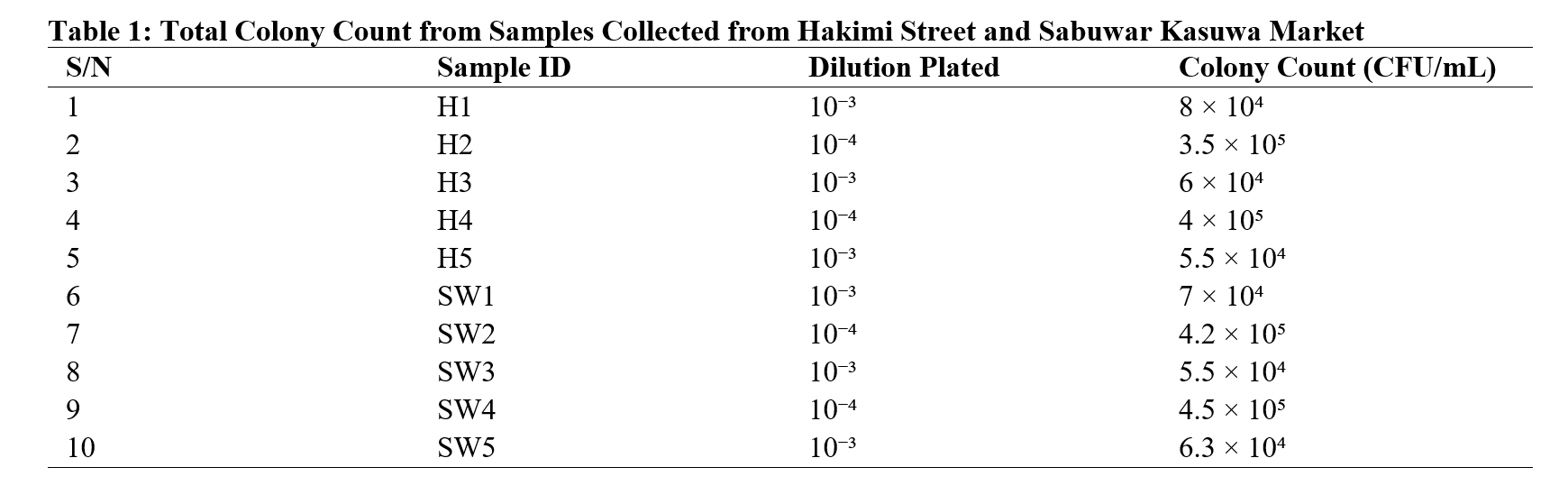
Spoilage of onion bulbs causes economic losses and may pose health risks, and bacterial contamination is one of its main contributors. This study isolated and characterised culturable bacteria associated with spoiled onion bulbs sold in Dutse metropolis, Jigawa State, Nigeria. Ten spoiled onion samples (five each from Hakimi Street and Sabuwar Kasuwa markets) were aseptically prepared, serially diluted, and plated on nutrient agar. Isolates were characterised by colony morphology, Gram staining, microscopy, and biochemical tests. Colony counts ranged from 5.5 × 10⁴ CFU/mL (H5) to 4 × 10⁵ CFU/mL (H4) among Hakimi Street samples and from 5.5 × 10⁴ CFU/mL (SW3) to 4.5 × 10⁵ CFU/mL (SW4) among Sabuwar Kasuwa samples. Phenotypic characteristics indicated Staphylococcus spp. (30%), Micrococcus spp. (30%), Escherichia coli (20%), and Klebsiella spp. (20%). All isolates were catalase positive; the Staphylococcus isolates were coagulase positive, whereas E. coli, Micrococcus spp., and Klebsiella spp. were coagulase negative. Because identification relied on phenotypic characteristics only, the isolates are presumptive, and their occurrence indicates association with spoiled onions rather than proof that they caused the spoilage. Further studies using molecular identification and pathogenicity tests are recommended to establish species-level identities and the organisms responsible for spoilage.
References
Adebami, G. E., Maloma, M. R., Olaleye, E. D., Isinkaye, O. E., Joshua, O. C. and Opere, B. O. (2026). Isolation and antibiotic susceptibility patterns of airborne bacteria from the in-patient and out-patient sections of selected primary health care centers. FUDMA Journal of Sciences, 10(20): 283-291. DOI: https://doi.org/10.33003/fjs-2026-1020-5574.
Aminu, F. Ali, M. (2017). Isolation and identification of microorganisms associated with spoilage of cabbage (Brassica oleracea) in Sabon-Gari market Kano Nigeria. International Journal of Advanced Academic Research, 3: 1-8.
Bartholomew, J.W. & Mittwer, T. (1952). The Gram stain. Bacteriological Reviews, 16(1): 1-29. DOI: 10.1128/br.16.1.1-29.1952.
Brady, C., Cleenwerck, I., Venter, S., Coutinho, T. and Vos, P. D. (2013). Taxonomic evaluation of the genus Enterobacter based on multilocus sequence analysis (MLSA). Systematic and Applied Microbiology, 36(5): 309-319. DOI: 10.1016/j.syapm.2013.03.005.
Carr, E. A., Bonasera, J. M., Zaid, A. M., Lorbeer, J. W. and Beer, S. V. (2010). First report of bulb disease of onion caused by Pantoea ananatis in New York. Plant Disease, 94(7): 916.
Cheesbrough, M. (2006). District laboratory practice in tropical countries. 2nd ed. USA: Cambridge University Press; Pp. 1–442.
Dada, E. O. and Olusola-Makinde, O. O. (2015). Microbial and parasitic contamination on vegetables collected from retailers in main market, Akure, Nigeria. American Journal of Microbiological Research, 3(3): 112-117.
Darlington, P., Eruteya, O. C. and Akomah-Abadaike, O. N. (2024). Occurrence of virulence genes of Staphylococcus aureus and Escherichia coli in vended foods in selected motor-parks in Obio/Akpor, Rivers State. FUDMA Journal of Sciences, 8(2): 5-14. DOI: https://doi.org/10.33003/fjs-2024-0802-2326.
Doyle, M. P. and Erickson, M. C. (2008). Summer meeting 2007 – the problems with fresh produce: an overview. Journal of Applied Microbiology, 105: 317-330. https://doi.org/10.1111/j.1365-2672.2008.03746.x.
Erin, S. (2010). Influence of pre-harvest factor on post-harvest quality. Journal of Biochemistry, 2: 133-145.
Food and Agricultural Organization (FAO) (2012). World onion production. Food and Agriculture Organization of the United Nations. http://faostat.fao.org.
Getenesh, N., Ali, M. and Temesgen, M. (2015). Effect of curing and top removal time on quality and shelf life of onions (Allium cepa L.). Global Journal of Science Frontier Research, 15: 27-36.
Habtamu, G.M. (2017). Onion (Allium cepa L.) yield improvement progress in Ethiopia: A review. International Journal of Agriculture and Bioscience, 6(5): 265-271.
Humann, J. L., Wildung, M., Cheng, C.-H., Lee, T., Stewart, J. E., Drew, J. C., Triplett, E. W., Main, D. and Schroeder, B. K. (2011). Complete genome of the onion pathogen Enterobacter cloacae EcWSU1. Standards in Genomic Sciences, 5(3): 279-286. https://doi.org/10.4056/sigs.2174950.
Ibemologi, A. and Tolulope, A. (2022). Isolation and identification of bacteria from exposed and sliced Allium cepa (onions). Journal of Microbiology & Experimentation, 10(6): 224-227. https://doi.org/10.15406/jmen.2022.10.00377.
Krishna, K. P. and Sarita, P. (2016). Enterobacter spp.: An emerging nosocomial infection. International Journal of Applied Research, 2(11): 532-538.
Kughur, P.G., Iornenge, G.M. and Ityonongu, B.E. (2015). Effects of postharvest losses on selected onion, fruit and vegetables among small scale farmers in Gboko Local Government area in Benue state, Nigeria. International Journal Innovation and Scientific Research, 19(1): 201-208.
Liu, S., Tang, Y., Wang, D., Lin, N. and Zhou, J. (2016). Identification and characterization of a new Enterobacter onion bulb decay caused by Lelliottia amnigena in China. Journal of Applied Microbiology, 2: 1-7.
Mohamed, H., Abd-Alla, Shymaa R., Bashandy, Stefan R. and Sylvia, S. (2011). First report of soft rot of onion bulbs in storage caused by Pseudomonas aeruginosa in Egypt. Journal of Plant Interactions, 6: 229-238.
National Onion Association (2017). Seasons, Colors, Flavors, and Sizes of Onion. Available: https://www.onions-usa.org/all-about-onions/colors-flavor availability and sizes-of-onions.
Olani, N., Fikre, M. (2010). Onion Seed Production Techniques: A manual for extension agents and seed producers. Master printing press PLC, Asella, Ethiopia.
Orpin, J.B., Yusuf, Z., Mzungu, I. (2017). Investigation of microorganism associated with the spoilage of onions. Moj Biol Med, 2(4): 280-285.
Pfeufer, E., Hoepting, C. and Gugino, B. (2015). Identification of the most important factors driving bacterial bulb rot of onion in New York and Pennsylvania and implications for management. Empire Expo Conference Proceedings, New York.
Phillips, K., Zaidan, F., Elizondo, O. R. and Lowe, K. L. (2012). Phenotypic characterization and 16S rDNA identification of culturable non-obligate halophilic bacterial communities from a hypersaline lake, La Sal del Rey, in extreme South Texas (USA). Aquatic Biosystems, 8: 5. https://doi.org/10.1186/2046-9063-8-5.
Resch, M., Zell, C., Rosentein, R., Albrecht, T., Hertel, C. and Gotz, F. (2008). Characterization of toxin production of coagulase negative Staphylococcus isolated from food and starter cultures. International Journal of Food Microbiology, 127(3): 246-251.
Rewas, S. (2015). Food Spoilage: Microorganisms and their prevention. Department of Botany and Microbiology, HNB Garhwal Central University, Srinagar, Uttarakhand, India. Asia Journal of Plant Science and Research, 5(4): 47-56.
Roopa, V. M., Suvarna, V. C. and Natesh, N. (2014). Antimicrobial activity of plant extracts against post-harvest spoilage of onions. International Journal of Current Microbiology and Applied Science, 3(5): 388-394.
Samuel, O., Ifeanyi, O. (2015). Fungi associated with the deterioration postharvest onion bulbs sold in some market of Awka, Nigeria. Journal of Bioengineering and Bioscience, 3(5): 90-94.
Schroeder, B. K., Humann, J. L. and Toit, L. J. D. (2012). Effects of postharvest onion curing parameters on the development of sour skin and slippery skin in storage. Plant Disease, 96(10): 1548-1555.
Thairu, Y., Nasir, I. A. and Usman, Y. (2014). Laboratory perspective of gram staining and its significance in investigations of infectious diseases. Sub-Saharan African Journal of Medicine, 1: 168-74.
Downloads
Published
Issue
Section
Categories
License
Copyright (c) 2026 Mahmud Ahmed, Hassan Bashir Mukhtar

This work is licensed under a Creative Commons Attribution 4.0 International License.


