
Distribution and Interactions of Soil Nutrients and Organic Carbon at University of Calabar Campus, Nigeria
DOI:
https://doi.org/10.33003/fjs-2026-1022-6126Keywords:
soil depth, soil fertility, nutrient cycling, nutrient dynamics, tropical urban soilsAbstract
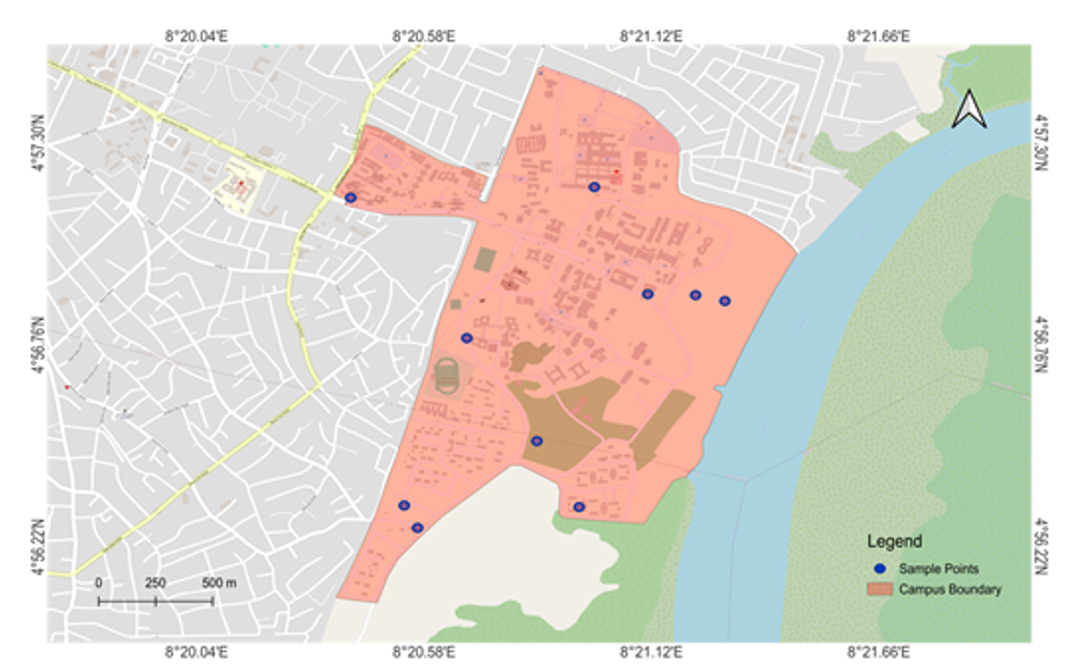
Plant biodiversity depends fundamentally on soil nutrient availability. However, nutrient dynamics within university campuses remain poorly studied, and less attention has been given to soil health, plant biodiversity, and the ecosystem services supported by campus soils. This study evaluated the influence of soil depth on the distribution, relationships, and multivariate interactions of soil nutrients and organic carbon across the University of Calabar campus, Nigeria. Ten randomly selected sampling locations were established using QGIS, and composite soil samples were collected from four depth intervals (0–15, 15–30, 30–60, and 60–100 cm). Soil organic carbon, nitrogen, phosphorus, potassium, calcium, magnesium, silicon, and sulfur were determined using standard laboratory procedures. Data were analyzed using Pearson correlation, one-way ANOVA, principal component analysis, and multiple linear regression. Significant positive correlations were observed between nitrogen and phosphorus (r = 0.78, p = 0.0027), phosphorus and silicon (r = 0.72, p = 0.0082), and calcium and potassium (r = 0.62, p = 0.0331), whereas phosphorus and magnesium were negatively correlated (r = –0.65, p = 0.0227). Soil depth had no significant effect on organic carbon or nutrient concentrations (p > 0.05). The regression analysis showed that the measured nutrients did not significantly predict organic carbon. These findings indicate relatively homogeneous soil conditions within the campus and provide a baseline for future studies on nutrient dynamics and distribution within the University of Calabar campus and similar landscapes
References
Abdel-Fattah, M. K., Mohamed, E., Wagdi, E. M., Shahin, S. A., Aldosari, A., Lasaponara, R., & Alnaimy, M. A. (2021). Quantitative Evaluation of Soil Quality Using Principal Component Analysis: The Case Study of El-Fayoum Depression Egypt. Sustainability. https://doi.org/10.3390/su13041824
Abrar, M. M., Waqas, M. A., Mehmood, K., Fan, R., Zhou, B., Ma, X., Nan, S., Du, J., & Xu, M. (2025). Organic carbon and nitrogen accrual evidenced by the underpinning protection mechanisms in soil profile following contrasting 35-year fertilization regimes. Journal of Environmental Management, 376, 124482. https://doi.org/10.1016/j.jenvman.2025.124482
Alvarez, R. (2025). Increasing soil organic carbon by applying farm-made organic fertilizers as a function of soil depth: A global synthesis. The Science of the Total Environment, 991, 179933. https://doi.org/10.1016/j.scitotenv.2025.179933
Awuh, M. E., Officha, M. C., Okolie, A. O., & Enete, I. C. (2018). Land-use/land-cover dynamics in Calabar Metropolis using a combined approach of remote sensing and GIS. Journal of Geographic Information System, 10(04), 398–414. https://doi.org/10.4236/jgis.2018.104021
Bashir, O., Bangroo, S. A., Shafai, S. S., Senesi, N., Kader, S., & Alamri, S. (2024). Geostatistical modeling approach for studying total soil nitrogen and phosphorus under various land uses of North-Western Himalayas. Ecological Informatics, 80, 102520. https://doi.org/10.1016/j.ecoinf.2024.102520
Bray, R. H., & Kurtz, L. T. (1945). Determination of total, organic, and available forms of phosphorus in soils. Soil Science, 59(1), 39–46. https://doi.org/10.1097/00010694-194501000-00006
Bremner, J. M. (1965). Total nitrogen. In Agronomy monograph/Agronomy (pp. 1149–1178). https://doi.org/10.2134/agronmonogr9.2.c32
Colding, J., & Barthel, S. (2017). The role of university campuses in reconnecting humans to the biosphere. Sustainability, 9(12), 2349. https://doi.org/10.3390/su9122349
Dai, L., Ge, J., Wang, L., Zhang, Q., Liang, T., Bolan, N., Lischeid, G., & Rinklebe, J. (2022). Influence of soil properties, topography, and land cover on soil organic carbon and total nitrogen concentration: A case study in Qinghai-Tibet plateau based on random forest regression and structural equation modeling.. The Science of the total environment, 153440. https://doi.org/10.1016/j.scitotenv.2022.153440
De Freitas Aurivan, S., Edson, A. P., Adélia, A. a. P., De O Soares Maria, G., Humberson, R. S., & Cristian, D. P. P. (2017). Interaction between potassium (K) and calcium (Ca) on the severity of Yellow Sigatoka in banana plants. African Journal of Agricultural Research, 12(16), 1353–1361. https://doi.org/10.5897/ajar2017.12279
Dertli, H. I., Hayes, D. M., & Zorn, T. (2024). Effects of multicollinearity and data granularity on regression models of stream temperature. Journal of Hydrology. https://doi.org/10.1016/j.jhydrol.2024.131572
Elliott, C. L., & Snyder, G. H. (1991). Autoclave-induced digestion for the colorimetric determination of silicon in rice straw. Journal of Agricultural and Food Chemistry, 39(6), 1118–1119. https://doi.org/10.1021/jf00006a024
Ellur, R., Ankappa, A. M., Dharumarajan, S., Puttavenkategowda, T., Nanjundegowda, T. M., Sannegowda, P. S., Mishra, A. P., Đurin, B., & Dogančić, D. (2024). Soil Quality Assessment and Its Spatial Variability in an Intensively Cultivated Area in India. Land. https://doi.org/10.3390/land13070970
Gao, J., Jansen, B., Cerli, C., Helmus, R., Mikutta, R., Dultz, S., Guggenberger, G., & Kalbitz, K. (2017). Competition and surface conditioning alter the adsorption of phenolic and amino acids on soil minerals. European Journal of Soil Science, 68(5), 667–677. https://doi.org/10.1111/ejss.12459
Genta, C., Favaro, S., Sonetti, G., Fracastoro, G. V., & Lombardi, P. (2021). Quantitative assessment of environmental impacts at the urban scale: the ecological footprint of a university campus. Environment Development and Sustainability, 24(4), 5826–5845. https://doi.org/10.1007/s10668-021-01686-5
Gerke, J. (2022). The central role of soil organic matter in soil fertility and carbon storage. Soil Systems, 6(2), 33. https://doi.org/10.3390/soilsystems6020033
Hengl, T., Leenaars, J. G. B., Shepherd, K. D., Walsh, M. G., Heuvelink, G. B. M., Mamo, T., Tilahun, H., Berkhout, E., Cooper, M., Fegraus, E., Wheeler, I., & Kwabena, N. A. (2017). Soil nutrient maps of Sub-Saharan Africa: assessment of soil nutrient content at 250 m spatial resolution using machine learning. Nutrient Cycling in Agroecosystems, 109(1), 77–102. https://doi.org/10.1007/s10705-017-9870-x
Hu, Y., Deng, Q., Kätterer, T., Olesen, J. E., Ying, S. C., Ochoa‐Hueso, R., Mueller, C. W., Weintraub, M. N., & Chen, J. (2024). Depth‐dependent responses of soil organic carbon under nitrogen deposition. Global Change Biology, 30(3), e17247. https://doi.org/10.1111/gcb.17247
John, K., Isong, I. A., Kebonye, N. M., Ayito, E. O., Agyeman, P. C., & Afu, S. M. (2020). Using Machine Learning Algorithms to Estimate Soil Organic Carbon Variability with Environmental Variables and Soil Nutrient Indicators in an Alluvial Soil. Land, 9(12), 487. https://doi.org/10.3390/land9120487
Kabato, W., Hailegnaw, N., Mutum, L., & Molnar, Z. (2025). Managing soil health for climate resilience and crop productivity in a changing environment. The Science of the Total Environment, 1000, 180460. https://doi.org/10.1016/j.scitotenv.2025.180460
Kilmer, V. J., & Nearpass, D. C. (1960). The determination of available sulfur in soils. Soil Science Society of America Journal, 24(5), 337–340. https://doi.org/10.2136/sssaj1960.03615995002400050011x
Kotze, D. J., Ghosh, S., Hui, N., Jumpponen, A., Lee, B. P. Y., Lu, C., Lum, S., Pouyat, R., Szlavecz, K., Wardle, D. A., Yesilonis, I., Zheng, B., & Setälä, H. (2021). Urbanization minimizes the effects of plant traits on soil provisioned ecosystem services across climatic regions. Global Change Biology, 27(17), 4139–4153. https://doi.org/10.1111/gcb.15717
Krüger, N., Finn, D. R., & Don, A. (2023). Soil depth gradients of organic carbon-13 – A review on drivers and processes. Plant and Soil, 495(1–2), 113–136. https://doi.org/10.1007/s11104-023-06328-5
Kyriazos, T., & Poga, M. (2023). Dealing with Multicollinearity in Factor Analysis: The Problem, Detections, and Solutions. Open Journal of Statistics. https://doi.org/10.4236/ojs.2023.133020
Li, J., Nie, M., Powell, J. R., Bissett, A., & Pendall, E. (2020). Soil physico-chemical properties are critical for predicting carbon storage and nutrient availability across Australia. Environmental Research Letters, 15(9), 094088. https://doi.org/10.1088/1748-9326/ab9f7e
Liang, Y., Liao, M., Fang, Z., Guo, J., Xie, X., & Xu, C. (2021). How silicon fertilizer improves nitrogen and phosphorus nutrient availability in paddy soil? Journal of Zhejiang University SCIENCE B, 22(7), 521–532. https://doi.org/10.1631/jzus.b2000708
Luo, T., He, Z., Xia, D., Xu, Y., Xia, L., Guo, T., Xu, W., & Fang, J. (2025). Relationship between soil organic carbon fractions and microbial nutrient limitations among different woodlands in the western karst region of Hubei. Environmental Technology & Innovation, 38, 104074. https://doi.org/10.1016/j.eti.2025.104074
Macci, C., Vannucchi, F., Scartazza, A., Masciandaro, G., Doni, S., & Peruzzi, E. (2025). Soil–Plant Indicators for assessing nutrient cycling and ecosystem functionality in urban forestry. Urban Science, 9(3), 82. https://doi.org/10.3390/urbansci9030082
Müller, C. R., Six, J., Njiru, D. M., Vanlauwe, B., & Van De Broek, M. (2025). Depth effects of long-term organic residue application on soil organic carbon stocks in central Kenya. Biogeosciences, 22(12), 2733–2747. https://doi.org/10.5194/bg-22-2733-2025
Mwendwa, S. M., Mbuvi, J. P., Kironchi, G., & Gachene, C. K. (2022). Assessing spatial variability of selected soil properties in Upper Kabete Campus coffee farm, University of Nairobi, Kenya. Heliyon, 8(8), e10190. https://doi.org/10.1016/j.heliyon.2022.e10190
Neu, S., Schaller, J., & Dudel, E. G. (2017). Silicon availability modifies nutrient use efficiency and content, C:N:P stoichiometry, and productivity of winter wheat (Triticum aestivum L.). Scientific Reports, 7(1), 40829. https://doi.org/10.1038/srep40829
Oliveira, M. C., & Proença, J. (2025). Sustainable Campus Operations in Higher Education Institutions: A Systematic Literature review. Sustainability, 17(2), 607. https://doi.org/10.3390/su17020607
Omokaro, G. O., Abiola, K. A., Bakare, A., Airueghian, E., & Michael, I. (2024). Forms and Distribution of Phosphorus along A Toposequence at the University of Benin, Nigeria. American Journal of Geospatial Technology, 3(1), 1–8. https://doi.org/10.54536/ajgt.v3i1.2591
Ononyume, M. O., & Edu, E. A. B. (2026). Microclimate variation among four common urban tree species in Calabar, Nigeria. FUDMA JOURNAL OF SCIENCES, 10(6), 45–53. https://doi.org/10.33003/fjs-2026-1006-4249
Pattnaik, T., Dash, P. K., Mishra, A., Saren, S., Phonglosa, A., & Kishore, M. A. (2023). Vertical distribution of available plant nutrients in soils of Mid-Central Tableland Agro-climatic Zone of Odisha, India. Environment and Ecology, 41(4D), 2982–2988. https://doi.org/10.60151/envec/kowd4237
Qiao, Y., Wang, J., Liu, H., Huang, K., Yang, Q., Lu, R., Yan, L., Wang, X., & Xia, J. (2020). Depth-dependent soil C-N-P stoichiometry in a mature subtropical broadleaf forest. Geoderma, 370, 114357. https://doi.org/10.1016/j.geoderma.2020.114357
Reyes-Gutiérrez, L. R., Romero-Guzmán, E. T., Cabral-Prieto, A., & Rodríguez-Castillo, R. (2008). Characterization of chromium in contaminated soil studied by SEM, EDS,XRD and Mossbauer Spectroscopy. Journal of Minerals and Materials Characterization and Engineering, 07(01), 59–70. https://doi.org/10.4236/jmmce.2008.71005
Saha, A., & Handique, S. (2022). Variation of soil organic carbon in a university campus in temperate North-eastern India. Environmental Challenges, 7, 100493. https://doi.org/10.1016/j.envc.2022.100493
Seabloom, E. W., Adler, P. B., Alberti, J., Biederman, L., Buckley, Y. M., Cadotte, M. W., Collins, S. L., Dee, L., Fay, P. A., Firn, J., Hagenah, N., Harpole, W. S., Hautier, Y., Hector, A., Hobbie, S. E., Isbell, F., Knops, J. M. H., Komatsu, K. J., Laungani, R., . . . Borer, E. T. (2020). Increasing effects of chronic nutrient enrichment on plant diversity loss and ecosystem productivity over time. Ecology, 102(2), e03218. https://doi.org/10.1002/ecy.3218
Shapkota, J., & Kafle, G. (2021). Variation in Soil Organic Carbon under Different Forest Types in Shivapuri Nagarjun National Park, Nepal. Scientifica, 2021, 1–9. https://doi.org/10.1155/2021/1382687
Tesfay, T., Mohamed, E. S., Savin, I., Kucher, D. E., Rebouh, N., & Ogbazghi, W. (2025). Soil Organic Carbon Modelling with Different Input Variables: The Case of the Western Lowlands of Eritrea. Sustainability. https://doi.org/10.3390/su17219884
Tokgöz, F. K. (2026). Multivariate Analysis of Soil Properties in Burdur Province: Principal Component Analysis and Canonical Correlation Approach. Bitlis Eren Üniversitesi Fen Bilimleri Dergisi. https://doi.org/10.17798/bitlisfen.1802648
Valliere, J. M. (2022). Cultivating scientific literacy and a sense of place through course‐based urban ecology research. Ecology and Evolution, 12(6), e8985. https://doi.org/10.1002/ece3.8985
Von Fromm, S. F., Jungkunst, H. F., Amenkhienan, B., Hall, S. J., Georgiou, K., Pries, C. H., Montaño-López, F., Quesada, C. A., Rasmussen, C., Schrumpf, M., Singh, B., Thompson, A., Wagai, R., & Fiedler, S. (2025). Moisture and soil depth govern relationships between soil organic carbon and oxalate-extractable metals at the global scale. Biogeochemistry, 168(1). https://doi.org/10.1007/s10533-025-01208-9
Wachu, C. M., & Ibrahim, A. J. (2025). Assessment of land use and slope influence on soil organic carbon stocks and soil properties in Southern Ethiopia. Frontiers in Agronomy, 7. https://doi.org/10.3389/fagro.2025.1536935
Walkley, A., & Black, I. A. (1934). An examination of the Degtjareff method for determining soil organic matter, and a proposed modification of the chromic acid titration method. Soil Science, 37(1), 29–38. https://doi.org/10.1097/00010694-193401000-00003
Wang, Y., Bauke, S. L., Von Sperber, C., Tamburini, F., Guigue, J., Winkler, P., Kaiser, K., Honermeier, B., & Amelung, W. (2021). Soil phosphorus cycling is modified by carbon and nitrogen fertilization in a long‐term field experiment. Journal of Plant Nutrition and Soil Science, 184(2), 282–293. https://doi.org/10.1002/jpln.202000261
Wu, Y., & Yu, Y. (2023). Soil Carbon, Nitrogen and Phosphorus Fractions and Response to Microorganisms and Mineral Elements in Zanthoxylum planispinum ‘Dintanensis’ Plantations at Different Altitudes. Agronomy, 13(2), 558. https://doi.org/10.3390/agronomy13020558
Zhao, M., Cao, G., Zhao, Q., Ma, Y., Zhang, F., Li, H., He, Q., & Qiu, X. (2025). Distribution patterns and influencing factors controlling soil carbon in the Heihe River Source basin, northeast Qinghai–Tibet Plateau. Land, 14(2), 409. https://doi.org/10.3390/land14020409
Downloads
Published
Issue
Section
Categories
License
Copyright (c) 2026 Martin Ogheneriruona Ononyume, Esther Aja Bassey Edu

This work is licensed under a Creative Commons Attribution 4.0 International License.


