
Artificial Intelligence for Creative Mathematical Problem-Solving in Iraqi Preparatory Schools: Teachers’ Perspectives and Curriculum Integration
DOI:
https://doi.org/10.33003/fjs-2026-1021-6142Keywords:
Artificial Intelligence Applications, Creative Thinking Skills for Mathematical Problem-Solving, Middle SchoolAbstract
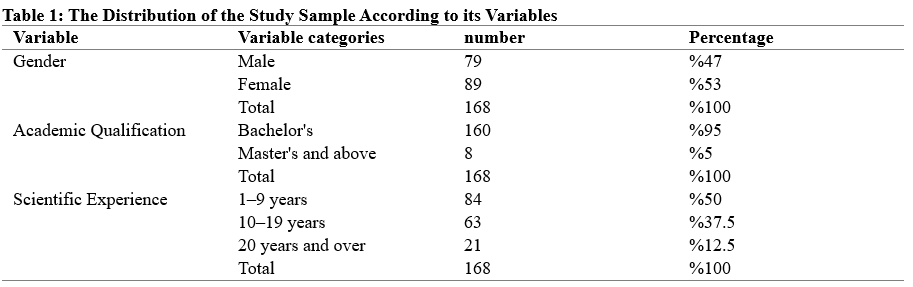
The purpose of this study was to determine if it is feasible to use artificial intelligence (AI) applications to help Iraqi preparatory school students enhance their capacity for creative thinking in order to solve mathematical problems from the viewpoint of math teachers. It also sought to determine how these applications relate to gender, years of experience, and educational background, as well as how much of them are included in school curricula. This goal was accomplished by using a descriptive method to a random sample of 168 male and female preparatory school math instructors. The reliability and validity of a 34-item survey used to collect data were evaluated. Before being included into the preparatory school mathematics curriculum for grades four and five, a 24-item analysis card spanning five domains was created and verified. The results showed that math instructors had a reasonable understanding of AI applications for fostering original problem-solving techniques. Additionally, math instructors were well aware of the perceived value and challenges of using AI algorithms to promote creative problem-solving in mathematics. Additionally, the findings showed that neither gender nor educational attainment were statistically significant factors in the sample mean replies at the significance level (\alpha = 0.05). However, depending on years of experience, statistically significant differences (\alpha = 0.05) in the degree of relevance and barriers to employing AI applications were found, favoring instructors with more years of teaching experience.
Downloads
Published
Issue
Section
Categories
License
Copyright (c) 2026 Luma Ali Ohmayed Al-ogaili

This work is licensed under a Creative Commons Attribution 4.0 International License.


