
Mosquito Species Composition and Resting Distribution in Kuri and Kwadon, Gombe State, Nigeria: Implications within a Changing Climatic Environment
DOI:
https://doi.org/10.33003/fjs-2026-1022-6164Keywords:
Anopheles gambiae, Culex quinquefasciatus, Aedes aegypti, mosquito ecology, resting behaviour, malaria vectors and climate changeAbstract
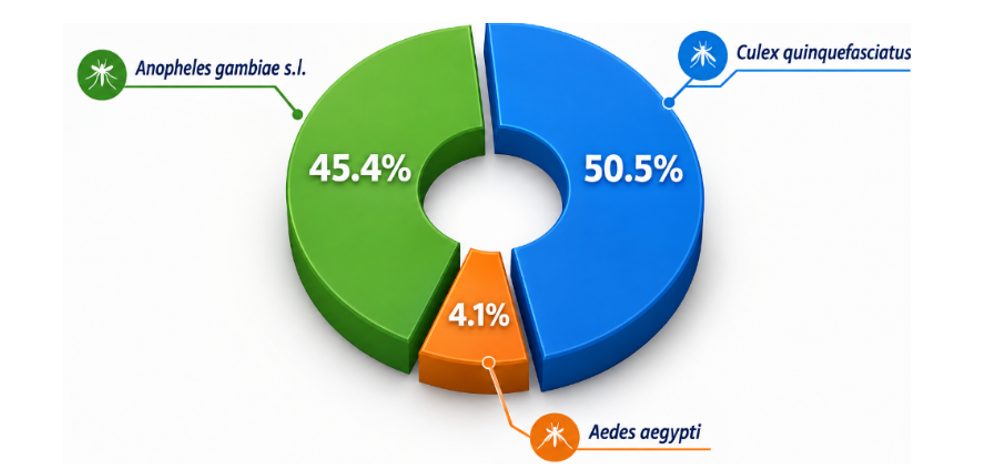
Mosquito species composition, physiological status and resting behavior provide important information for understanding vector ecology and malaria transmission. This study assessed mosquito species composition, physiological status, and indoor and outdoor resting distribution in Kuri and Kwadon, Gombe State, Nigeria, and considered their implications within a changing climatic environment. Adult mosquitoes were collected from indoor and outdoor resting sites and identified using morphological characteristics. Specimens were classified as unfed, blood-fed, half-gravid, gravid, or male. A total of 778 mosquitoes were collected in Kuri, comprising Anopheles gambiae s.l. (45.4%), Culex quinquefasciatus (50.5%), and Aedes aegypti (4.1%). In Kwadon, 1,037 mosquitoes were collected, comprising An. gambiae s.l. (29.6%), C. quinquefasciatus (61.4%), and Ae. aegypti (9.0%). Species abundance differed significantly in Kuri (F = 12.42, p = 0.008) and Kwadon (F = 9.85, p = 0.012). Indoor collections were significantly higher than outdoor collections in both Kuri (t = 3.24, p = 0.048) and Kwadon (t = 2.58, p = 0.046). Blood-fed and gravid females indicated active feeding and reproductive activity. Climatic variables were not measured in this study; the climatic context discussed is therefore drawn from previously published evidence of changing temperature and rainfall patterns in North-Eastern Nigeria and is not a finding of the present data. The findings highlight the need for continued community-level entomological surveillance and climate-informed vector-control planning in the study area.
References
Adeleke, M. A., Babalola, A. S., Busari, L. O., Surakat, O. A., Rufai, A. M., Fasasi, K. A., Adekunle, T. A., Adeniyi, Y. A., Adeogun, A., & Olatunde, G. (2025). Modelling species distribution of Anopheles gambiae s.l. in Osun state using random forest modeling approach. Scientific Reports, 15(1), 16524. https://doi.org/10.1038/s41598-025-95001-1
Bello, A. B., Hassan, A. A., Oladejo, S. O., Awoniran, D. R., & Popoola, K. O. K. (2025). Influence of meteorological variables on the abundance and distribution patterns of Anopheles mosquitoes in Epe and Orimedu, Lagos, Nigeria. Discover Animals, 2(1). https://doi.org/10.1007/s44338-025-00076-9
Carlson, C. J., Carleton, T., Odoulami, R. C., Molitor, C. D., & Trisos, C. H. (2026). The past and future impact of climate change on childhood malaria in Africa. Nature, 657(8131), 487–494. https://doi.org/10.1038/s41586-026-10840-w
Chapoterera, B., Naidoo, K., & Marume, A. (2025). Impact of climate change on malaria transmission in Africa: A scoping review of literature. Journal of Public Health in Africa, 16(1), 1346. https://doi.org/10.4102/jphia.v16i1.1346
Degefa, T., Yewhalaw, D., & Yan, G. (2024). Methods of sampling malaria vectors and their reliability in estimating entomological indices in Africa. Journal of Medical Entomology, 61(3), 573–583. https://doi.org/10.1093/jme/tjae015
Ishaku, D., Umaru, E. T., Adebayo, A. A., Löwner, R., & Okhimamhe, A. A. (2024). Analysis of the observed trends in rainfall and temperature patterns in North-Eastern Nigeria. Climate, 12(12), 219. https://doi.org/10.3390/cli12120219
Ishaku, M., Pukuma, S. M., Chessed, G., Ahmanullah, A. A., & Abdurrauf, T. U. (2026, May 9). Prevalence of malaria and plasmodium parasite speciation in selected local government areas of Gombe North, Gombe State, north eastern Nigeria. https://atbuscienceforum.com.ng/index.php/jpas/article/view/300
Living-Jamala, U., Nzeako, S., Abajue, M., & Ezenwaka, C. (2024). Impact of climatic factors on indoor mosquito species abundance in Rivers State, Nigeria. Scientia Africana, 23(4), 255–264. https://doi.org/10.4314/sa.v23i4.22
Obembe, A., Oduola, A. O., Adeogun, A., Inyang, U., Oyeniyi, T., Olakiigbe, A., Babalola, A., Inyama, P., Lazarus, S., Okeke, I., Esema, M., Okoko, O. O., Omo-Eboh, M., Uhomoibhi, P., Bala, M., & Awolola, S. (2024). Implementation of malaria vector surveillance and insecticide resistance monitoring interventions in Nigeria. Global Health Research and Policy, 9(1), 55. https://doi.org/10.1186/s41256-024-00397-4
Symons, T. L., Moran, A., Balzarolo, A., Vargas, C., Robertson, M., Lubinda, J., Saddler, A., McPhail, M., Harris, J., Rozier, J., Browne, A., Amratia, P., Bertozzi-Villa, A., Bhatt, S., Cameron, E., Golding, N., Smith, D. L., Noor, A. M., Rumisha, S. F., . . . Gething, P. W. (2026). Projected impacts of climate change on malaria in Africa. Nature, 651(8105), 390–396. https://doi.org/10.1038/s41586-025-10015-z
Theodoridis, L., & Carvalho, T. G. (2025). Antimalarial drug resistance and drug discovery: learning from the past to innovate the future. International Journal for Parasitology Drugs and Drug Resistance, 28, 100602. https://doi.org/10.1016/j.ijpddr.2025.100602
van der Deure, T., Nogués‐Bravo, D., Njotto, L. L., & Stensgaard, A. (2025). Climate change favors African malaria vector mosquitoes. Global Change Biology, 31(11), e70610. https://doi.org/10.1111/gcb.70610
World Health Organization. (2024). Operational manual on indoor residual spraying: Control of vectors of malaria, Aedes-borne diseases, Chagas disease, leishmaniases and lymphatic filariasis. World Health Organization.
World Health Organization. (2025). World malaria report 2025: Addressing the threat of antimalarial drug resistance. World Health Organization.
Downloads
Published
Issue
Section
Categories
License
Copyright (c) 2026 Farida Goje

This work is licensed under a Creative Commons Attribution 4.0 International License.


