
Evaluating Health Facility Preparedness and Response to Lassa Fever Outbreaks in Lafia, Nasarawa State, Nigeria
DOI:
https://doi.org/10.33003/fjs-2026-1019-6165Keywords:
Health System Preparedness, Lassa Fever, Epidemic Response, Infection Control, Nasarawa State, Disease SurveillanceAbstract
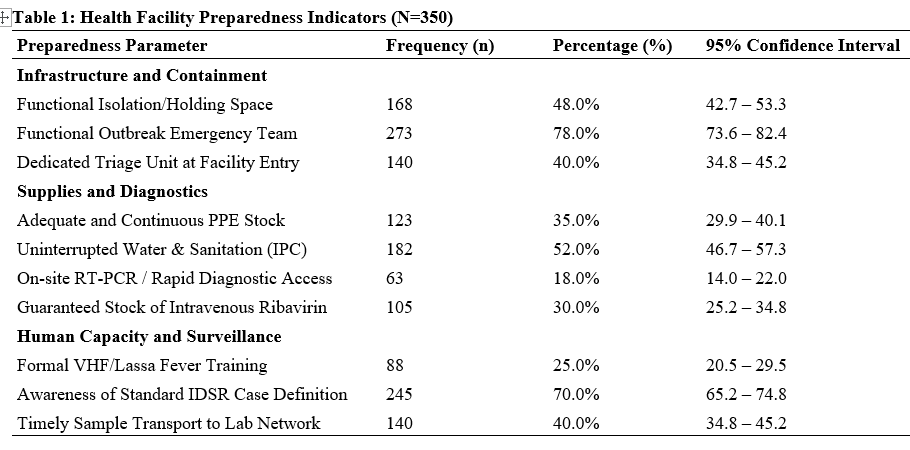
Lassa fever remains an endemic viral hemorrhagic illness in Nigeria, with agrarian hubs like Lafia, Nasarawa State, bearing recurrent seasonal outbreaks that severely strain front line healthcare systems. This study evaluated health facility preparedness and operational response capacity during periodic Lassa fever epidemics across public and private health sectors in Lafia. descriptive cross-sectional study was conducted among 350 multi-disciplinary healthcare workers across primary, secondary, and tertiary health facilities in Lafia Local Government Area. Quantitative data gathered using a validated, structured questionnaire were analyzed using SPSS Version 26.0. Pearson’s Chi-square tests were performed to determine associations between facility ownership/level and readiness parameters (p<0.05). Findings revealed an asymmetric, fragile state of readiness. While 78.0% of respondents reported functional emergency outbreak response teams, structural execution was bottle necked: only 48.0% had operational isolation spaces, 35.0% had continuous access to personal protective equipment (PPE), and 25.0% had received formal training on Viral Hemorrhagic Fevers (VHFs). Surveillance mechanisms showed high reporting structural awareness (70.0%) but low operational timeliness (40.0%). Facility ownership significantly influenced readiness, with public facilities demonstrating higher structural response teams (χ2=14.82,p<0.001) but severe material stock outs compared to private facilities. Key systemic barriers identified were chronic under funding (85.0%), acute personnel shortages (75.0%), and absent point-of-care laboratory diagnostic capacity (70.0%). Health facility preparedness in Lafia is fragile, creating high vulnerability to nosocomial transmission and delayed outbreak containment. Institutionalizing routine workforce VHF training, subsidizing emergency diagnostics, and guaranteeing stock-piles of Ribavirin and PPE are critical to building resilient health systems in Nasarawa State.
References
Adokiya, M. N., Awoonor-Williams, J. K., Beiersmann, C., & Müller, O. (2015). Evaluation of the Integrated Disease Surveillance and Response system for infectious diseases control in northern Ghana. BMC Public Health, 15(1), 75.
Agbonlahor, D. E., Agba, M. I., & Erah, F. S. (2018). Lassa fever transmission mechanisms and environmental risk factors in endemic West Africa. African Journal of Clinical Microbiology, 12(2), 45–53.
Ajayi, N. A., Nwigwe, C. G., & Palle, J. (2021). Health system readiness and infection prevention challenges during viral hemorrhagic fever outbreaks in Nigeria. African Journal of Infectious Diseases, 15(2), 45–53.
Asogun, D. A., Günther, S., Akpede, G. O., Ibekwe, T. S., & Ehrlich, S. (2019). Lassa fever: Epidemiology, clinical features, diagnosis, and management. The Lancet Infectious Diseases, 19(11), e388–e398.
Bamberger, E. S., Unigwe, U. S., & Okokhere, E. C. (2023). Ecological drivers and seasonal dynamics of Lassa fever transmission in West Africa. International Journal of Infectious Diseases, 128, 112–119.
BMC Public Health. (2024). National surveillance data analysis and geographic expansion of Lassa fever detection in Nigeria. BMC Public Health, 24, 101–112.
Buckley, S. M., & Casals, J. (1970). Lassa fever, a new virus disease of man from West Africa: Isolation and characterization of the virus. American Journal of Tropical Medicine and Hygiene, 19(4), 680–691.
Carey, D. E., Causey, O. R., & Moore, D. L. (1972). Lassa fever: Epidemiological features of the 1970 outbreak in Jos, Nigeria. Transactions of the Royal Society of Tropical Medicine and Hygiene, 66(3), 402–408.
Frame, J. D., Baldwin, J. M., Gocke, D. J., & Troup, J. M. (1970). Lassa fever, a new virus disease of man from West Africa: Clinical description and course. American Journal of Tropical Medicine and Hygiene, 19(4), 670–679.
Gwomson, D., Mark, M., & Lar, L. A. (2018). Epidemiological trends and health system challenges of Lassa fever in North-Central Nigeria. Journal of Public Health and Epidemiology, 10(8), 290–298.
Gyang, V. P., Ombugadu, A., & Lapang, R. (2016). Knowledge, attitudes and practices of Lassa fever in and around Lafia, Central Nigeria. International Journal of Public Health and Epidemiological Research, 2(2), 22–29.
Hallam, S., Hallam, C., & Rodriguez, S. E. (2018). Arenaviridae pathogenesis and host immune responses during acute hemorrhagic fever. Viral Immunology, 31(2), 114–123.
Hamblion, E. L., Raftery, P., & Wendland, A. (2018). The pivotal role of rapid laboratory diagnostics in managing viral hemorrhagic fever epidemics. The Lancet Infectious Diseases, 18(9), e280–e288.
Heymann, D. L. (Ed.). (2008). Control of communicable diseases manual (19th ed.). American Public Health Association.
Ilesanmi, O. S., Afolabi, A. A., & Akande, A. (2022). Assessment of health facility isolation capacity and infection control supplies during Lassa fever epidemics in endemic Nigerian states. Pan African Medical Journal, 41(102), 1–11.
Kieny, M. P., Evans, D. B., Schmets, G., & Kadandale, S. (2014). Health-system resilience: Beyond the Ebola crisis. Bulletin of the World Health Organization, 92(12), 850–850A.
Kouadio, L., Alers, R., & Bamba, S. (2015). Rodent host ecology and spatial dynamics of Mastomys natalensis in West Africa. Veterinary Parasitology, 209(3), 180–189.
Lukashevich, I. S., Clegg, J. C., & Sidibe, K. (1993). Seroprevalence of Lassa virus infection in West Africa. Bulletin of the World Health Organization, 71(5), 515–521.
Mateo, R., Lorente, M., & Sanches, A. (2019). Preclinical evaluation of candidate vaccines against Lassa virus infection. Vaccine, 37(14), 1902–1910.
Mazzola, L. T., & Kelly-Cirino, C. (2019). Diagnostic landscape for Lassa fever: Current assays and future needs. Global Health Action, 12(1), Article 1612723.
McCormick, J. B., Webb, P. A., Krebs, J. W., & Johnson, K. M. (1987). A prospective study of Lassa fever in Sierra Leone. The Journal of Infectious Diseases, 155(3), 437–444.
Mehand, M. S., Al-Shorbaji, F., Millett, P., & Murgue, B. (2018). The WHO R&D Blueprint: Methodological approach to prioritizing infectious diseases for research and development. Antiviral Research, 159, 63–67.
Musa, E., Kida, M., & Okwuraiwe, A. (2023). Socio-ecological determinants and community-level drivers of Lassa fever exposure in agrarian settings. BMC Public Health, 23(412), 1–10.
Mylne, A., Brady, O. J., & Ojowuro, A. (2015). Mapping the geographical distribution of Lassa fever in West Africa. PLOS Neglected Tropical Diseases, 9(3), Article e0003554.
Nigeria Centre for Disease Control and Prevention. (2023). Lassa fever situation report: Epidemiological week 52. NCDC Publications.
Nigeria Centre for Disease Control and Prevention. (2024). Lassa fever situation report: Epidemiology week 15. NCDC Publications.
Ogbole, E. A., Inegbenosun, C. U., & Asogun, D. (2024). Trends in Lassa fever case detection and surveillance sensitivity in Nigeria. BMC Public Health, 24(115), 1–12.
Ogbu, O., Ajana, E., & Uba, G. O. (2007). Lassa fever: Theory and practice in endemic West Africa. The Yale Journal of Biology and Medicine, 80(4), 179–188.
Ogoina, D. (2015). Lassa fever: Historical perspective, epidemiology, and operational challenges in Nigeria. West African Journal of Medicine, 34(2), 101–109.
Ogoina, D., Izibewule, J. H., & Ogunro, A. (2020). Infection prevention and control practices and protective equipment availability in Nigerian tertiary hospitals during epidemic threats. Journal of Hospital Infection, 105(4), 721–728.
Okoh, A. I., Enabulele, O., & Isere, E. E. (2021). Epidemiological evaluation of Lassa fever outbreaks and case positivity trends in Nigeria. Journal of Community Health, 46(3), 512–520.
Okonkwo, P., Umeh, C. A., & Bassey, E. (2025). Housing infrastructure, rodent density, and community vulnerability to Lassa fever in agrarian populations. Tropical Medicine & International Health, 30(1), 45–54.
Olayemi, A., Cadar, D., & Magassouba, N. (2016). Dynamics of Lassa virus reservoir host interaction and secondary human transmission risks. Current Opinion in Virology, 16, 54–60.
Pal, M. (2007). Lassa fever: A serious zoonotic viral disease of public health concern. International Journal of Livestock Research, 2(1), 12–18.
Pal, M. (2013). Zoonoses: Overview and public health importance in developing nations. Journal of Veterinary Public Health, 11(1), 1–8.
Reuben, R. C., Gyar, S. D., & Makut, M. D. (2021). Safety practices and knowledge of Lassa fever infection prevention among healthcare workers in Lafia, Nasarawa State. Niger Delta Journal of Medicine & Medical Research, 1(1), 12–19.
Richmond, J. K., & Baglole, D. J. (2003). Lassa fever: Epidemiology, clinical features, and management. BMJ, 327(7426), 1271–1275.
Salami, K., Gouglas, D., & Schmaljohn, C. (2019). Vaccine development initiatives for Lassa virus: Progress and structural barriers. Vaccine, 37(36), 5420–5428.
Shehu, N. Y., Gomwalk, N. E., & Isa, S. E. (2016). Lassa fever in North-Central Nigeria: Clinical presentation and diagnostic challenges. Journal of Infection in Developing Countries, 10(4), 340–347.
Silenou, B. C., Tom-Aba, D., Wade, D., Kouangnet, R., & Krause, G. (2020). Use of Surveillance Outbreak Response Management and Analysis System (SORMAS) for public health surveillance and disease outbreak management in Nigeria: A review of system implementation. JMIR Public Health and Surveillance, 6(2), e17420.
Sogoba, N., Feldmann, H., & Kouressy, O. (2012). Lassa virus in West Africa: Vector ecology and disease burden. The Journal of Infectious Diseases, 206(suppl_1), S45–S51.
Takah, N. F., Nditanchou, R., & Anchang-Kimbi, J. (2019). Molecular diagnostic capacities for viral hemorrhagic fevers in sub-Saharan Africa. BMC Infectious Diseases, 19(1), 210.
Thairu, Y., & Egenti, N. (2015). Differential diagnosis of acute febrile illnesses in endemic Lassa fever zones. African Journal of Medical Sciences, 8(3), 112–119.
Tomori, O., Fabiyi, A., & Sorungbe, A. (1988). Viral hemorrhagic fevers in Nigeria: A retrospective epidemiological assessment. Reviews of Infectious Diseases, 10(suppl_4), S680–S687.
World Health Organization. (2000). Lassa fever factsheet No. 179. World Health Organization.
World Health Organization. (2017). Lassa fever: Key facts. World Health Organization.
World Health Organization. (2022). Disease Outbreak News: Lassa Fever – Nigeria. World Health Organization.
World Health Organization. (2023). Lassa fever in the African Region: Weekly epidemiological record. World Health Organization.
World Organisation for Animal Health. (2022). Zoonotic diseases and global health security. WOAH Risk Reports.
Yun, N. E., & Walker, D. H. (2012). Pathogenesis of Lassa fever. Viruses, 4(10), 2031–2048.
Downloads
Published
Issue
Section
Categories
License
Copyright (c) 2026 Salamatu Ibrahim Mohammed, Ishaku Akyala Adamu, Yahuza Abdullahi Ahmad, Daniel Terhemen Yakubu, Abubakar Halilu Awe

This work is licensed under a Creative Commons Attribution 4.0 International License.


