
Water Absorption and Sulphuric Acid Resistance of Metakaolin–Sisal Fibre Concrete
DOI:
https://doi.org/10.33003/fjs-2026-1021-6182Keywords:
Metakaolin, Sisal fibre, Water absorption, Sulphuric Acid, Residual StrengthAbstract
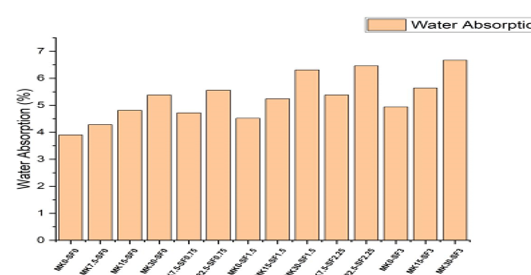
This study investigated water absorption and sulphuric-acid resistance of metakaolin (MK) and alkali-treated sisal fibre (SF) concrete using a Grade 50 reference mixture. Nineteen experimental runs represented 14 unique formulations and five repeated design points, covering 0–30% MK replacement and 0–3% SF addition by binder mass at a constant water-to-binder ratio of 0.28. Three specimens per formulation were assigned to each acid-exposure period. The 28-day pre-exposure compressive strengths ranged from 15.60 to 52.04 MPa across the formulations. Water absorption was determined at 28 days using a 24-h room-temperature immersion procedure based on ASTM C642-13, while acid resistance was evaluated after 28, 56 and 112 days of exposure to 5% (v/v) H₂SO₄ using mass loss, residual compressive strength and percentage strength loss. Water absorption increased from 3.90% in the control to 6.67% for MK30-SF3. MK7.5-SF0.75 recorded the highest residual compressive strengths at 28 and 56 days, with values of 44.40 and 38.40 MPa, respectively, whereas MK0-SF3 recorded the highest 112-day residual strength at 28.24 MPa. Although MK30-SF3 recorded a relatively low 112-day mass loss of 7.08%, its residual strength was only 8.00 MPa. The results show that durability ranking depended on mixture composition, exposure duration and the indicator considered under the tested acid-exposure conditions. Mass loss and residual compressive strength should therefore be considered together when assessing prolonged sulphuric-acid exposure.
References
ASTM International. (2013). ASTM C642-13: Standard test method for density, absorption, and voids in hardened concrete. ASTM International.
Badogiannis, E., & Tsivilis, S. (2009). Exploitation of poor Greek kaolins: Durability of metakaolin concrete. Cement and Concrete Composites, 31(2), 128–133. https://doi.org/10.1016/j.cemconcomp.2008.11.001
Bassuoni, M. T., & Nehdi, M. L. (2007). Resistance of self-consolidating concrete to sulfuric acid attack with consecutive pH reduction. Cement and Concrete Research, 37(7), 1070–1084. https://doi.org/10.1016/j.cemconres.2007.04.014
British Standards Institution. (2009). BS EN 12390-3:2009 testing hardened concrete—Compressive strength of test specimens. British Standards Institution.
Castoldi, R. S., de Souza, L. M. S., Souto, F., Liebscher, M., Mechtcherine, V., & de Andrade Silva, F. (2022). Effect of alkali treatment on physical–chemical properties of sisal fibers and adhesion towards cement-based matrices. Construction and Building Materials, 345, 128363. https://doi.org/10.1016/j.conbuildmat.2022.128363
Council for the Regulation of Engineering in Nigeria. (2017). Concrete mix design manual (1st ed., Special Publication No. COREN/2017/016/RC). COREN.
de Klerk, M. D., Kayondo, M., Moelich, G. M., de Villiers, W. I., Combrinck, R., & Boshoff, W. P. (2020). Durability of chemically modified sisal fibre in cement-based composites. Construction and Building Materials, 241, 117835. https://doi.org/10.1016/j.conbuildmat.2019.117835
Dinakar, P., Sahoo, P. K., & Sriram, G. (2013). Effect of metakaolin content on the properties of high strength concrete. International Journal of Concrete Structures and Materials, 7(3), 215–223. https://doi.org/10.1007/s40069-013-0045-0
Fode, T. A., Jande, Y. A. C., Kivevele, T., & Rahbar, N. (2024). A review on degradation improvement of sisal fiber by alkali and pozzolana for cement composite materials. Journal of Natural Fibers, 21(1), 2335327. https://doi.org/10.1080/15440478.2024.2335327
Liang, J., Wang, X., Fu, Z., Li, Z., Liang, L., Luo, Q., & Long, W. (2025). Enhancing the applicability of sisal fibers in cement-based materials through alkali treatment and penetrating crystallization. Journal of Cleaner Production, 490, 144736. https://doi.org/10.1016/j.jclepro.2025.144736
Melo Filho, J. A., de Andrade Silva, F., & Toledo Filho, R. D. (2013). Degradation kinetics and aging mechanisms on sisal fiber cement composite systems. Cement and Concrete Composites, 40, 30–39. https://doi.org/10.1016/j.cemconcomp.2013.04.003
Mobasher, B., Shekarchi, M., Bonakdar, A., Bakhshi, M., & Mirdamadi, A. (2010). Transport properties in metakaolin blended concrete. Construction and Building Materials, 24(11), 2217–2223. https://doi.org/10.1016/j.conbuildmat.2010.04.035
Okeola, A. A., Abuodha, S. O., & Mwero, J. (2018). Experimental investigation of the physical and mechanical properties of sisal fiber-reinforced concrete. Fibers, 6(3), 53. https://doi.org/10.3390/fib6030053
Poon, C. S., Lam, L., Kou, S. C., Wong, Y. L., & Wong, R. (2001). Rate of pozzolanic reaction of metakaolin in high-performance cement pastes. Cement and Concrete Research, 31(9), 1301–1306. https://doi.org/10.1016/S0008-8846(01)00581-6
Siddique, R., Sidhu, A. S., & Klemczak, B. (2026). High strength concrete and the impact of metakaolin on its mechanical, durability and microstructural characteristics—A review. Journal of Building Engineering, 118, 114925. https://doi.org/10.1016/j.jobe.2025.114925
Toledo Filho, R. D., Scrivener, K., England, G. L., & Ghavami, K. (2000). Durability of alkali-sensitive sisal and coconut fibres in cement mortar composites. Cement and Concrete Composites, 22(2), 127–143. https://doi.org/10.1016/S0958-9465(99)00039-6
Usman, J., & Sam, A. M. (2017). Acid resistance of palm oil fuel ash and metakaolin ternary blend cement mortar. Sustainable Environment Research, 27(4), 181–187. https://doi.org/10.1016/j.serj.2017.02.003
Wang, X., Wang, W., Liu, Q., Wang, S., Luo, H., Ji, S., & Zhu, J. (2022). Effects of metakaolin on sulfate and sulfuric acid resistance of grouting restoration materials. Construction and Building Materials, 349, 128714. https://doi.org/10.1016/j.conbuildmat.2022.128714
Wei, J., & Meyer, C. (2014). Improving degradation resistance of sisal fiber in concrete through fiber surface treatment. Applied Surface Science, 289, 511–523. https://doi.org/10.1016/j.apsusc.2013.11.024
Xiao, J., Long, X., Qu, W., Li, L., Jiang, H., & Zhong, Z. (2022). Influence of sulfuric acid corrosion on concrete stress–strain relationship under uniaxial compression. Measurement, 187, 110318. https://doi.org/10.1016/j.measurement.2021.110318
Downloads
Published
Issue
Section
Categories
License
Copyright (c) 2026 Zainab Giwa, Solomon Olalere Ajamu

This work is licensed under a Creative Commons Attribution 4.0 International License.


