
Evaluation of Air Quality and Major Pollutants in Al-Zubair City, Southern Iraq
DOI:
https://doi.org/10.33003/fjs-2026-1021-6191Keywords:
Carbon Monoxide Gas, Nitrogen Dioxide Gas, Particulate Matter, Sulphur Dioxide GasAbstract
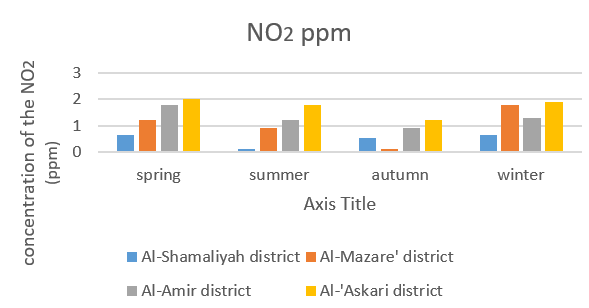
Atmospheric contamination presents a significant danger to urban areas and community well-being, requiring methodical surveillance of environmental air standards. Consequently, the current research sought to evaluate significant atmospheric pollutants in Al-Zubair City throughout 2025–2026. Air quality indicators were assessed at four important sites, with two seasonal repetitions carried out during spring, summer, autumn, and winter. The results indicated clear regional and seasonal discrepancies among contaminants. Nitrogen dioxide (NO2) reached a maximum concentration of 2.0ppm in the Al-Askari district in spring, while its minimum level of 0.1 ppm was observed in Al-Mazare' and Al-Shamaliyah during autumn and summer. Carbon monoxide (CO) peaked at 1.6 ppm in Al-Askari during the winter season, whilst the lowest concentration of 0.18 ppm was recorded in Alamir in the autumn. Total suspended particle matter (TSP) peaked at 102 µg/m³ in Al-Shamaliyah in winter and dipped to 18.9 µg/m³ in Al-Mazare' in spring. In contrast, sulphur dioxide (SO2) was consistently found at undetectable amounts throughout all sites and seasons. In summary, urban endeavors in Al-Askari and seasonal climatic conditions markedly increase localised pollution concentrations, especially in winter and spring. Consequently, ongoing air quality surveillance and targeted emission regulation strategies are highly advised to alleviate public health hazards.
Downloads
Published
Issue
Section
Categories
License
Copyright (c) 2026 Dhurgham Abbas Qasim

This work is licensed under a Creative Commons Attribution 4.0 International License.


