
Metallic Constituents, Human Cancer Risk Assessment, and Allium Cepa Genotoxicity Bioassay of a Municipal Dumpsite Soil and Simulated Leachate in Anyigba, Kogi State, Nigeria
DOI:
https://doi.org/10.33003/fjs-2026-1022-6196Keywords:
Dumpsite, heavy metals, health risk, hazard, Allium cepa, genotoxicity, AnyigbaAbstract
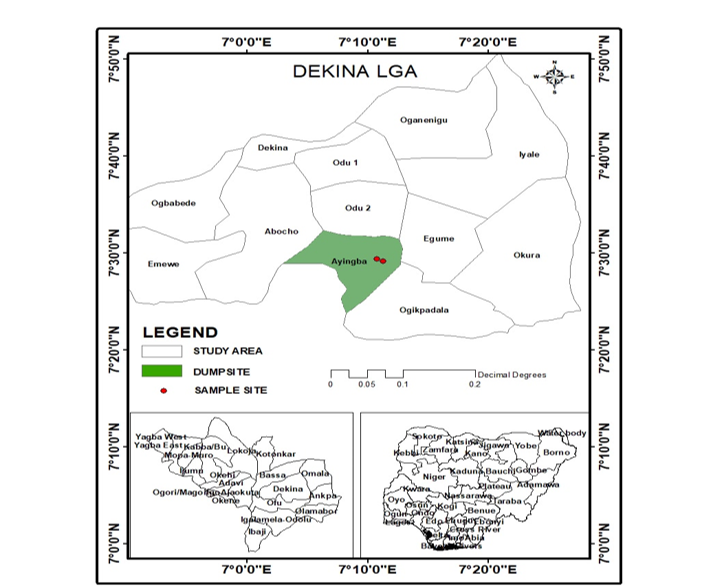
This study investigated heavy metal contamination in soil from the Anyigba municipal dumpsite, located within Anyigba Main Market, Kogi State, Nigeria, and assessed associated human health risks and plant-based cytogenotoxicity. Composite soil samples were collected using grid sampling, while simulated leachate was prepared through aqueous extraction. Fifteen metals were analysed using inductively coupled plasma optical emission spectrometry (ICP-OES). Human health risks were evaluated using the Hazard Quotient (HQ), Hazard Index (HI), and Lifetime Cancer Risk (LCR) for ingestion, inhalation, and dermal exposure among children and adults, following the USEPA framework. Leachate cytogenotoxicity was assessed using the Allium cepa root tip assay at 20, 40, and 60% concentrations. Iron (97.42 mg/kg), manganese (66.04 mg/kg), zinc (42.84 mg/kg), silver (31.71 mg/kg), and copper (13.39 mg/kg) were the predominant soil metals. Copper, zinc, iron, manganese, and chromium exceeded permissible limits in both soil and leachate. Children exhibited HI values above unity for manganese (6.73), copper (4.72), iron (3.02), and zinc (2.26), primarily through ingestion, whereas adult HI values remained below 1.0. Chromium presented unacceptable cancer risks for children (TLCR = 7.23 × 10⁻⁴) and adults (TLCR = 1.06 × 10⁻⁴). The Allium cepa assay revealed concentration-dependent toxicity, with root growth inhibition reaching 92.73% and mitotic index decreasing from 11.75% in controls to 2.25% at 60% leachate concentration. These findings identify the dumpsite as a potential source of significant environmental contamination and human health risks, particularly for children, highlighting the urgent need for remediation and effective environmental regulatory enforcement.
References
Ademola, O. J., Alimba, C. G., Bakare, A. A. (2020). Reproductive toxicity assessment of Olusosun municipal landfill leachate in Mus musculus using abnormal sperm morphology and dominant lethal mutation assays. Environ Anal, Health and Toxico, 35, e2020010. https://doi.org/10.5620/eaht.e2020010
Alabi, O. A., Ayeni, F. E., Afolabi, T. A. (2025). Health risk assessment of toxic metals and DNA damage in somatic and germ cells by soil and groundwater of a major cement factory in Nigeria. Toxicological Sciences, 203(2), 227–241. https://doi.org/10.1093/toxsci/kfae140
Alabi, O. A., Omosebi, O., Chizea, I. (2013). Determination of the mutagenic and genotoxic potential of simulated leachate from an automobile workshop soil on eukaryotic systems. Toxicology and Industrial Health, 29(1), 9–15.
Alao, J. O., Ayejoto, D. A., Fahad, A., Mohammed, M. A. A., Saqr, A. M., Joy, A. O. (2024). Environmental burden of waste generation and management in Nigeria. In Technical landfills and waste management: Volume 2: Municipal solid waste management (pp. 27–56). Springer Nature. https://doi.org/10.1007/978-3-031-55665-4_2
Alimba, C. G., Bakare, A. A. (2016). In vivo micronucleus test in the assessment of cytogenotoxicity of landfill leachates in three animal models from various ecological habitats. Ecotoxicology, 25(2), 310–319. https://doi.org/10.1007/s10646-015-1589-3
Alimba, C. G., Gandhi, D., Sivanesan, S., Bhanarkar, M. D., Naoghare, P. K., Bakare, A. A., Krishnamurthi, K. (2016). Chemical characterization of simulated landfill soil leachates from Nigeria and India and their cytotoxicity and DNA damage inductions on three human cell lines. Chemosphere, 164, 469–479. https://doi.org/10.1016/j.chemosphere.2016.08.134
Alimba, C. G., Sivanesan, S., Krishnamurthi, K. (2022). Mitochondrial dysfunctions elicited by solid waste leachates provide insights into mechanisms of leachates induced cell death and pathophysiological disorders. Chemosphere, 307, 136085.
Amadi, C. N., Igweze, Z. N., Orisakwe, O. E. (2017). Heavy metals in miscarriages and stillbirths in developing nations. Middle East Fertility Society Journal, 22(2), 91–100. https://doi.org/10.1016/j.mefs.2017.03.003
American Public Health Association. (2005). Standard methods for the examination of water and wastewater (21st ed.). American Public Health Association.
Atapattu, A. M. P. E. K., Jayawardena, U. A. (2026). Allium cepa bioassay as an assessment tool in toxicology with special emphasis on environmental toxicity assessments. Ceylon Journal of Science, 55(2).
Auwalu, F. K., Bello, M. (2023). Exploring the contemporary challenges of urbanization and the role of sustainable urban development: a study of Lagos City, Nigeria. Journal of Contemporary Urban Affairs, 7(1), 175-188.
Bakare, A. A., Akpofure, A., Gbadebo, A. M., Fagbenro, O. S., Oyeyemi, I. T. (2022). Aqueous extract of Moringa oleifera Lam. induced mitodepression and chromosomal aberration in Allium cepa, and reproductive genotoxicity in male mice. Advances in Traditional Medicine, 22(4), 685–695. https://doi.org/10.1007/s13596-021-00564-9
Bakare, A. A., Balogun, K. B., Ogunbona, M. A., Onyia, E. C., Coker, M. M., Pitso, K. M., Bakare, O. C., Maduna, L. D., Fagbenro, O. S., Magama, S., Taole, M. M., Adeniji, A. O., Phalatsi, M. S., Gbadebo, A. M., Chatanga, P., Alabi, O. A. (2025). Genetic and systemic disruption by a municipal solid waste leachate in aquatic and terrestrial models, and human cancer risk assessment of the leachate’s metallic constituents. Discover Toxicology, 2, 22. https://doi.org/10.1007/s44339-025-00044-8
Bakare, A. A., Pandey, A. K., Bajpayee, M., Bhargav, D., Chowdhuri, D. K., Singh, K. P., Murthy, R. C., Dhawan, A. (2007). DNA damage induced in human peripheral blood lymphocytes by industrial solid waste and municipal sludge leachates. Environ and Mol. Mut, 48, 30–37. https://doi.org/10.1002/em.20277
Costa, A. M., Valentim, M. R. dos S., Azevedo, D. J. M. de, Quintaes, B. R., Daflon, S. D. A., Campos, J. C. (2023). Evaluation of the main pollutants present in Brazilian landfill leachates using ecotoxicity assays. Process Safety and Environmental Protection, 173, 426–436. https://doi.org/10.1016/j.psep.2023.03.020
Edet, A., Ukpong, A., Ekwere, A. S., Wiche, O., Nganje, T., Adamu, C., Kudamnya, E. (2025). Assessment of surface water and groundwater quality and their associated human health risks around dumpsites, Cross River State, Southern Nigeria. Environmental Earth Sciences, 84(9), 234. https://doi.org/10.1007/s12665-025-12186-4
Eid, M. H., Eissa, M., Mohamed, E. A., Ramadan, H. S., Tamás, M., Kovács, A., Szűcs, P. (2024). New approach into human health risk assessment associated with heavy metals in surface water and groundwater using Monte Carlo method. Scientific Reports, 14, 1008. https://doi.org/10.1038/s41598-023-50000-y
Ekere, N. R., Ugbor, M. C. J., Ihedioha, J. N., Ukwueze, N. N., Abugu, H. O. (2020). Ecological and potential health risk assessment of heavy metals in soils and food crops grown in abandoned urban open waste dumpsite. Journal of Environmental Health Science and Engineering, 18(2), 711–721. https://doi.org/10.1007/s40201-020-00497-6
Escalante-Mena, A. M., Hernández-Núñez, E., Méndez-Novelo, R. I., Giacoman-Vallejos, G., González-Sánchez, A. A., Quintanilla-Mena, M. A., Romellón-Orozco, M. E., Puch-Hau, C. (2022). Exposure to landfill leachates affects the embryonic development of zebrafish, Danio rerio: A case study in Yucatan, Mexico. Bulletin of Environmental Contamination and Toxicology, 108(4), 526–531. https://doi.org/10.1007/s00128-021-03387-8
Fagbenro, O. S., Alimba, C. G., Bakare, A. A. (2024). Developmental and heritable genetic defects induced in mice by municipal landfill leachate. Chemosphere, 363, 142838. https://doi.org/10.1016/j.chemosphere.2024.142838
Fiskesjö, G. (1997). Allium test for screening chemicals; evaluation of cytological parameters. In W. Wang, J. W. Gorsuch, and J. S. Hughes (Eds.), Plants for environmental studies (pp. 307–333). CRC Lewis Publishers. https://doi.org/10.1201/9781420048711.ch11
Ganiyu, S. A., Badmus, B. S., Oladunjoye, M. A., Aizebeokhai, A. P., Ozebo, V. C., Idowu, O. A., Olurin, O. T. (2016). Assessment of groundwater contamination around active dumpsite in Ibadan southwestern Nigeria using integrated electrical resistivity and hydrochemical methods. Environmental Earth Sciences, 75(8), 643. https://doi.org/10.1007/s12665-016-5463-2
Ghosh, P., Gupta, A., Thakur, I. S. (2015). Combined chemical and toxicological evaluation of leachate from municipal solid waste landfill sites of Delhi, India. Environmental Science and Pollution Research, 22(12), 9148–9158.
Gill, D. A., Mix, T. L. (2020). Love Canal: A classic case study of a contaminated community. In An introduction to interdisciplinary toxicology (pp. 341–352). Academic Press.
Gupta, A., Verma, A., Rajamani, P. (2024). Impact of landfill leachate on groundwater quality: A review. In A. Anouzla and S. Souabi (Eds.), A review of landfill leachate: Characterization, leachate environment impacts and sustainable treatment methods (pp. 93–107). Springer Nature. https://doi.org/10.1007/978-3-031-55513-8_6
Ibe, F. C., Opara, A. I., Amaobi, C. E., Ibe, B. O. (2021). Environmental risk assessment of the intake of contaminants in aquifers in the vicinity of a reclaimed waste dumpsite in Owerri municipal, southeastern Nigeria. Applied Water Science, 11(2), 24.
Ibor, O. R., Eni, G., Andem, A. B., Bassey, I. U., Arong, G. A., Asor, J., Regoli, F., Arukwe, A. (2020). Biotransformation and oxidative stress responses in relation to tissue contaminant burden in Clarias gariepinus exposed to simulated leachate from a solid waste dumpsite in Calabar, Nigeria. Chemosphere, 253, 126630. https://doi.org/10.1016/j.chemosphere.2020.126630
Ike, C. C., Ezeibe, C. C., Anijiofor, S. C., Daud, N. N. (2018). Solid waste management in Nigeria: problems, prospects, and policies. The Journal of Solid Waste Technology and Management, 44(2), 163-172.
Kamunda, C., Mathuthu, M., Madhuku, M. (2016). Health risk assessment of heavy metals in soils from Witwatersrand Gold Mining Basin, South Africa. International Journal of Environmental Research and Public Health, 13(7), 663. https://doi.org/10.3390/ijerph13070663
Khalil, C., Al Hageh, C., Korfali, S., Khnayzer, R. S. (2018). Municipal leachates health risks: Chemical and cytotoxicity assessment from regulated and unregulated municipal dumpsites in Lebanon. Chemosphere, 208, 1–13.
Mama, C. N., Nnaji, C. C., Nnam, J. P., Opata, O. C. (2021). Environmental burden of unprocessed solid waste handling in Enugu State, Nigeria. Environmental Science and Pollution Research, 28(15), 19439–19457. https://doi.org/10.1007/s11356-020-12265-y
Mohammadi, A. A., Zarei, A., Esmaeilzadeh, M., Taghavi, M., Yousefi, M., Yousefi, Z., Sedighi, F., Javan, S. (2020). Assessment of heavy metal pollution and human health risks assessment in soils around an industrial zone in Neyshabur, Iran. Biological Trace Element Research, 195(1), 343–352. https://doi.org/10.1007/s12011-019-01816-1
Mor, S., Ravindra, K., Dahiya, R. P., Chandra, A. (2006). Leachate characterization and assessment of groundwater pollution near municipal solid waste landfill site. Environmental Monitoring and Assessment, 118(1–3), 435–456. https://doi.org/10.1007/s10661-006-1505-7
Mshelia, Y. M., Arhyel, M., Boniface, A. (2024). Assessment of heavy metal contamination and health risk associated with selected borehole water proximal to a dumpsite in Giwo, Bauchi State. FUDMA Journal of Sciences, 8(3), 66–70. https://doi.org/10.33003/fjs-2024-0803-2318
Musarrat, J., Zaidi, A., Khan, M. S., Siddiqui, M. A., Al-Khedhairy, A. A. (2011). Genotoxicity assessment of heavy metal-contaminated soils. In Biomanagement of metal-contaminated soils. 323–342.
National Environmental Standards and Regulations Enforcement Agency. (2009). National Environmental (Sanitation and Wastes Control) Regulations, S. I. No. 28 of 2009. Federal Republic of Nigeria.
Nnaji, C. C. (2015). Status of municipal solid waste generation and disposal in Nigeria. Management of Environmental Quality: An International Journal, 26(1), 53–71. https://doi.org/10.1108/MEQ-08-2013-0092
Nriagu, J. O., Pacyna, J. M. (1988). Quantitative assessment of worldwide contamination of air, water and soils by trace metals. Nature, 333(6169), 134–139. https://doi.org/10.1038/333134a0
Nwadibie, A., Atuanya, E. I. (2018). Assessment of physicochemical and microbial characteristics of leachates from dumpsites in Benin City, Nigeria. Journal of Applied Sciences and Environmental Management, 22(2), 183–188. https://doi.org/10.4314/jasem.v22i2.4
Nwankwoala, H. O. (2013). Evaluation of heavy metal in soils from Enyimba dumpsite in Aba, southeastern Nigeria using contamination factor and geo-accumulation index. Energy and Environment Research.
Ogunlaja, A., Abarikwu, S. O., Otuechere, C. A., Oshoro, O. O. (2019). Characterization of leachates from waste landfill sites in a religious camp along Lagos-Ibadan Expressway, Nigeria and its hepatotoxicity in rats. Chemosphere, 217, 636–645. https://doi.org/10.1016/j.chemosphere.2018.11.042
Ogunyemi, A. K., Samuel, A. T., Amund, O. O., Ilori, M. O. (2019). Genotoxicity evaluation of landfill solid leachates from waste dumpsite in Lagos State, Nigeria using the Allium cepa assay. Plant and Animal Research Journal, 1(3), 68–76. https://doi.org/10.11594/parj.01.03.02
Okechukwu, V. U., Onwukeme, V. (2025). Health risk assessment of selected heavy metals in surface water and sediments from Aba River in Abia State, Nigeria. Chemical Research and Technology, 2(3), 115–127.
Onoja, A. O., Alimba, C. G., Nwani, C. D. (2026). Genotoxic evaluation and gene expression in Mus musculus exposed to landfill soil simulated leachates. Chemosphere, 409, 144995.
Onyegeme-Okerenta, B. M., West, L. O. (2023). Potential toxic elements in shellfish from three rivers in Niger Delta, Nigeria: Bioaccumulation, dietary intake, and human health risk assessment. Environmental Analysis, Health and Toxicology, 38(2), e2023011. https://doi.org/10.5620/eaht.2023011
Oshode, O. A., Bakare, A. A., Adeogun, A. O., Efuntoye, M. O., Sowunmi, A. A. (2008). Ecotoxicological assessment using Clarias gariepinus and microbial characterization of leachate from municipal solid waste landfill. International Journal of Environmental Research, 2(4), 391–400.
Peddi, N. R., Adlagunvan, S. R., Gumma, R. K. (2022). Understanding the contaminant chemistry of water resources at urban solid waste disposal site, Hyderabad, India. Journal of the Geological Society of India, 98, 703–711. https://doi.org/10.1007/s12594-022-2047-5
Sales Junior, S. F., da Costa, N. M., de Farias Araújo, G., Souza Soares, L. O., Mannarino, C. F., Correia, F. V., Saggioro, E. M. (2024). Antioxidant system alterations, oxidative, and genotoxic effects in Danio rerio (zebrafish) exposed to leachate from a dumpsite. Environmental Science and Pollution Research. https://doi.org/10.1007/s11356-024-31883-4
Samuel, O. B., Osuala, F. I., Odeigah, P. G. C. (2010). Cytogenotoxicity evaluation of two industrial effluents using Allium cepa assay. African Journal of Environmental Science and Technology, 4(1), 21–27. https://doi.org/10.5897/AJEST09.138
Siddiqua, A., Hahladakis, J. N., Al-Attiya, W. A. K. (2022). An overview of the environmental pollution and health effects associated with waste landfilling and open dumping. Environmental Science and Pollution Research, 29(39), 58514–58536.
U.S. Environmental Protection Agency. (2011). Exposure factors handbook: 2011 edition (EPA/600/R-09/052F).
Downloads
Published
Issue
Section
Categories
License
Copyright (c) 2026 Andrew Omachoko Onoja, Patience Omojo Ejembi, Dangana Elizabeth Ojochebo, Azeez Zainab, Momoh Theophilus Boniface

This work is licensed under a Creative Commons Attribution 4.0 International License.


