
Longitudinal Learning Analytics for Academic Trajectories and Non-Graduation Risk: Evidence from a Nigerian College of Education
DOI:
https://doi.org/10.33003/Keywords:
Learning Analytics, NCE Students, Academic Trajectories, K-means Clustering, Non graduation prediction, Logistic RegressionAbstract
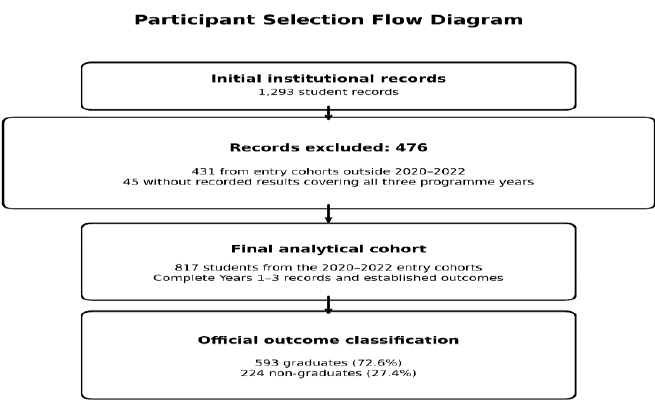
Student progression and successful programme completion are important concerns in higher education. This study combined longitudinal trajectory analysis and explainable machine learning to examine academic progression and predict recorded non-graduation among Nigeria Certificate in Education (NCE) students. Academic records of 817 students from the 2020–2022 entry cohorts were analysed. Fifteen features derived from three programme years were examined using K-means clustering, while 18 predictors from Years 1 and 2 were used for early prediction. Recorded outcomes comprised 593 graduates and 224 non-graduates. Internal clustering validation favoured two clusters, with non-graduation rates of 87.1% and 12.5% (χ²(1) = 364.68, p < .001; Cramér’s V = 0.668). An exploratory four-cluster solution revealed more detailed progression patterns, with non-graduation rates ranging from 5.9% to 92.1%. Logistic Regression, Random Forest, Gradient Boosting and Support Vector Machine were compared using nested five-fold cross-validation. Logistic Regression achieved the highest ROC-AUC (0.9089) and average precision (0.8361), with a Brier score of 0.1085. Bootstrap analysis yielded a 95% confidence interval of 0.8846–0.9327 for ROC-AUC. Coefficient and SHAP analyses identified academic marks, course failures and changes in failure rates as influential predictors. The findings suggest that longitudinal learning analytics can characterise academic trajectories and support earlier identification of students requiring academic assistance
References
A modular and explainable machine learning pipeline for student dropout prediction in higher education. (2025). Algorithms, 18(10), 662.
A novel AI-driven model for student dropout risk analysis with explainable AI insights. (2025). Computers and Education: Artificial Intelligence, 8, 100352. https://doi.org/10.1016/j.caeai.2024.100352
Borges, A. R. P., & Bernardino, J. (2026). Machine learning and deep learning for dropout prediction in higher education: A review. Computers, 15(3), 164.
Cardona, T., Cudney, E. A., Hoerl, R., & Snyder, J. (2023). Data mining and machine learning retention models in higher education. Journal of College Student Retention: Research, Theory & Practice, 25(1).
Goren, O., Cohen, L., & Rubinstein, A. (2024). Early prediction of student dropout in higher education using machine learning models. Proceedings of the International Conference on Educational Data Mining.
Lim, H., Kim, S., Chung, K.-M., Lee, K., Kim, T., & Heo, J. (2022). Is college students' trajectory associated with academic performance? Computers & Education, 178, 104397. https://doi.org/10.1016/j.compedu.2021.104397
Marzouk, O. A. (2025). Benchmarking retention, progression, and graduation rates in undergraduate higher education across different time windows. Cogent Education, 12(1), 2498170.
Nagy, M., & Molontay, R. (2024). Interpretable dropout prediction: Towards XAI-based personalized intervention. International Journal of Artificial Intelligence in Education, 34, 274–300. https://doi.org/10.1007/s40593-023-00331-8
Osemwegie, E. E., & Amadin, F. I. (2023). Student dropout prediction using machine learning. FUDMA Journal of Sciences, 7(6). https://doi.org/10.33003/fjs-2023-0706-2103
Pan, J., Zhao, Z., & Han, D. (2025). Academic performance prediction using machine learning approaches: A survey. IEEE Transactions on Learning Technologies, 18, 351-368.
Pêgo, J. P., Miguéis, V. L., & Soeiro, A. (2024). Students' complex trajectories: Exploring degree change and time to degree. International Journal of Educational Technology in Higher Education, 21, 8. https://doi.org/10.1186/s41239-024-00438-5
Pelima, R., & Sukmana, H. T. (2024). Predicting university student graduation using academic performance and machine learning: A systematic literature review. IEEE Access, 12, 25410-25425
Quimiz-Moreira, M., Delgadillo, R., Parraga-Alava, J., & Maculan, N. (2025). Factors, prediction, explainability, and simulating university dropout through machine learning: A systematic review, 2012–2024. Computers, 14(8), 198.
Tete, M. F., Sousa, M. de M., Goiano, T. S. de S., & Silva, S. F. (2022). Predictive models for higher education dropout: A systematic literature review. Education Policy Analysis Archives, 30. https://doi.org/10.14507/epaa.30.6845
Tiukhova, E., Vemuri, P., López Flores, N., Islind, A. S., Óskarsdóttir, M., Poelmans, S., Baesens, B., & Snoeck, M. (2024). Explainable learning analytics: Assessing the stability of student success prediction models by means of explainable AI. Decision Support Systems, 182, 114229. https://doi.org/10.1016/j.dss.2024.114229
Vaarma, M., & Li, H. (2024). Predicting student dropouts with machine learning: An empirical study in Finnish higher education. Technology in Society, 76, 102474. https://doi.org/10.1016/j.techsoc.2024.102474
Villar, A., & Robledo Velini de Andrade, C. (2024). Supervised machine learning algorithms for predicting student dropout and academic success: A comparative study. Discover Artificial Intelligence.
Downloads
Published
Issue
Section
Categories
License
Copyright (c) 2026 Ismail Adegbola, Sheriffdeen Yinusa, Taiwo Abdulsalam, Taiwo Salaudeen, Maruf Alimi

This work is licensed under a Creative Commons Attribution 4.0 International License.


