
Prevalence of Haemoparasitic Infections and Associated Risk Factors Among Hunting Dogs in Ilorin Metropolis, Kwara State, Nigeria
DOI:
https://doi.org/10.33003/fjs-2026-1021-6214Keywords:
Hunting Dog, Haemoparasite, Babesia, Ehrlichia, Prevalence, Ilorin, NigeriaAbstract
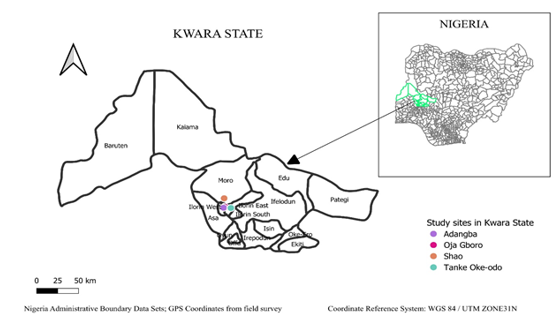
Haemoparasitic infections are common in dogs and are particularly relevant in hunting dogs because of their frequent exposure to tick-infested environments. However, limited information exists on the occurrence of these infections among hunting dogs in Ilorin metropolis. This study therefore determined the prevalence of haemoparasites and associated risk factors among hunting dogs in Ilorin metropolis, Nigeria. A total of 75 hunting dogs were sampled from four locations in Ilorin metropolis between May and July 2025, comprising 41 (54.7%) males and 34 (45.3%) females. Of these, 23 (30.7%) were less than two years old, 14 (18.7%) were above two years old, while the ages of 38 (50.7%) were unknown. Blood samples were examined microscopically following preparation of thin blood smears. The overall prevalence of haemoparasites was 53.3% (40/75). Babesia spp. and Ehrlichia spp. were the predominant haemoparasites, with prevalence of 26.7% (20/75) and 25.3% (19/75), respectively, while mixed infection was recorded in 1.3% (1/75) of the dogs. Haemoparasite infection was detected in 58.5% of males and 47.1% of females. Odds ratio analysis showed that male dogs were 1.59 times more likely to be infected than females. However, haemoparasite infection was not significantly associated with age (p = 0.098), sex (p = 0.32), or body condition score (p = 0.62). The findings indicate a high occurrence of haemoparasitic infections among hunting dogs in Ilorin metropolis, with Babesia spp. and Ehrlichia spp. being the predominant parasites identified. This highlights the need for appropriate preventive measures.
References
Akande, F., Adebowale, A., Takeet, M., & Omisile, O. (2017). Prevalence of Babesia species in hunting dogs in Ogun State South West Nigeria. Alexandria Journal of Veterinary Sciences, 54(1), 1. https://doi.org/10.5455/ajvs.264467
Amissah-Reynolds, P. K., Monney, I., Adowah, L. M., & Agyemang, S. O. (2016). Prevalence of Helminths in Dogs and Owners’ Awareness of Zoonotic Diseases in Mampong, Ashanti, Ghana. Journal of Parasitology Research, 2016, 1–6. https://doi.org/10.1155/2016/1715924
Aquino, L. C., Kamani, J., Haruna, A. M., Paludo, G. R., Hicks, C. A., Helps, C. R., & Tasker, S. (2016). Analysis of risk factors and prevalence of haemoplasma infection in dogs. Veterinary Parasitology, 221, 111–117. https://doi.org/10.1016/j.vetpar.2016.03.014
Araújo, B. V. S. D., Bezerra, I. L. P. D., Leite, G. L., Haisi, A., Araújo Júnior, J. P., Souza, F. D. A. L., Alves, L. C., Antunes, J. M. A. D. P., & Braga, J. F. V. (2025). Single and co-infections by Anaplasma platys, Babesia vogeli, Ehrlichia canis, and Hepatozoon canis in dogs from Rio Grande do Norte, Brazil: Frequency and molecular characterization. Revista Brasileira de Parasitologia Veterinária, 34(4), e004825. https://doi.org/10.1590/s1984-29612025067
Audu, Y., Mustapha, M., Ezema, K. U., Mairig, I. A., Bukar-kolo, Y. M., & Mamman, M. M. (2022). Prevalence of Haemoparasites and Associated Haematological Changes in Dogs in Potiskum Local Government Area, Yobe State, Nigeria. 5, n. 1, p. 33.
Baneth, G. (2018). Antiprotozoal treatment of canine babesiosis. Veterinary Parasitology, 254, 58–63. https://doi.org/10.1016/j.vetpar.2018.03.001
Chamsai, T., Saechin, A., Mongkolphan, C., Sariya, L., & Tangsudjai, S. (2024). Tick-borne pathogens Ehrlichia, Hepatozoon, and Babesia co-infection in owned dogs in Central Thailand. Frontiers in Veterinary Science, 11, 1341254. https://doi.org/10.3389/fvets.2024.1341254
Cortese, L., Beall, M., Buono, F., Buch, J., Pacifico, L., Neola, B., Palatucci, A. T., Tyrrell, P., Fioretti, A., Breitschwerdt, E. B., Veneziano, V., Chandrashekar, R., & Piantedosi, D. (2020). Distribution and risk factors of canine haemotropic mycoplasmas in hunting dogs from southern Italy. Veterinary Microbiology, 251, 108910. https://doi.org/10.1016/j.vetmic.2020.108910
Ehimiyein, A. M., Maishanu, D. D., & Ehimiyein, I. O. (2018). Prevalence of gastrointestinal and haemo-parasites in hunting dogs in Zaria, Nigeria. Sokoto Journal of Veterinary Sciences, 16(3), 55. https://doi.org/10.4314/sokjvs.v16i3.8
Ezema, K. U., Audu, Y., Mustapha, M., & Malgwi, S. A. (2021). Prevalence of haemoparasites of dogs in Maiduguri, Nigeria. 1(1: 47-51).
Gruenberger, I., Liebich, A.-V., Ajibade, T. O., Obebe, O. O., Ogbonna, N. F., Wortha, L. N., Unterköfler, M. S., Fuehrer, H.-P., & Ayinmode, A. B. (2023). Vector-Borne Pathogens in Guard Dogs in Ibadan, Nigeria. Pathogens, 12(3), 406. https://doi.org/10.3390/pathogens12030406
Happi, A. N., Toepp, A. J., Ugwu, C. A., Petersen, C. A., & Sykes, J. E. (2018). Detection and identification of blood-borne infections in dogs in Nigeria using light microscopy and the polymerase chain reaction. Veterinary Parasitology: Regional Studies and Reports, 11, 55–60. https://doi.org/10.1016/j.vprsr.2017.12.002
Kamani, J., Baneth, G., & Harrus, S. (2019). An annotated checklist of tick-borne pathogens of dogs in Nigeria. Veterinary Parasitology: Regional Studies and Reports, 15, 100255. https://doi.org/10.1016/j.vprsr.2018.12.001
Obeta, S. S., Ibrahim, B., Lawal, I. A., Natala, J. A., Ogo, N. I., & Balogun, E. O. (2020). Prevalence of canine babesiosis and their risk factors among asymptomatic dogs in the federal capital territory, Abuja, Nigeria. Parasite Epidemiology and Control, 11, e00186. https://doi.org/10.1016/j.parepi.2020.e00186
Ola-Fadunsin, S. D., Abdulrauf, A. B., Abdullah, D. A., Ganiyu, I. A., Hussain, K., Sanda, I. M., Rabiu, M., & Akanbi, O. B. (2023). Epidemiological studies of gastrointestinal parasites infecting dogs in Kwara Central, North Central, Nigeria. Comparative Immunology, Microbiology and Infectious Diseases, 93, 101943. https://doi.org/10.1016/j.cimid.2023.101943
Olubanjo O. O. (2019). Climate Variation Assessment Based on Rainfall and Temperature in Ilorin, Kwara State, Nigeria: Se-j-arjee-2019.0201001. 2(1). https://skies.education/journal-arjee
Osathanon, R., Saechin, A., Mongkolphan, C., Bhusri, B., & Tangsudjai, S. (2025). Ehrlichia , Hepatozoon , and Babesia Coinfection Patterns Among Owned Dogs in Central Thailand. Journal of Veterinary Internal Medicine, 39(4), jvim70154. https://doi.org/10.1111/jvim.70154
Pawełczyk, O., Iwase, P., Wierzba, B., Kretschmer, M., Wojtyczka, R., & Solarz, K. (2024). A Retrospective Epidemiological Analysis of Microscopically Detected Babesiosis in Dogs of Southern Poland (2018–2022). Pathogens, 13(12), 1104. https://doi.org/10.3390/pathogens13121104
Peter, H. D., Odetokun, I. A., Akintola, O. O., & Elelu, N. (2019). Prevalence of ticks and haemoparasitic infections in dogs presented at the University of Ilorin Veterinary Teaching Hospital.
Phuyal, S., Jha, V. C., & Subedi, M. (2017). Prevalence of Blood Parasites in Dogs of Kathmandu Valley. Nepalese Veterinary Journal, 34, 107–112. https://doi.org/10.3126/nvj.v34i0.22909
Prasitsuwan, W., Suwannachote, T., Sumalai, T., Lertpatarakomol, R., Trairatapiwan, T., & Ruenphet, S. (2025). A comparison of diagnostic methods for canine Ehrlichiosis: Microscopy and RNases hybridization-assisted amplification technology compared with the quantitative polymerase chain reaction. Veterinary World, 1214–1223. https://doi.org/10.14202/vetworld.2025.1214-1223
Sgroi, G., Iatta, R., Lia, R. P., Napoli, E., Buono, F., Bezerra‐Santos, M. A., Veneziano, V., & Otranto, D. (2022). Tick exposure and risk of tick‐borne pathogens infection in hunters and hunting dogs: A citizen science approach. Transboundary and Emerging Diseases, 69(4). https://doi.org/10.1111/tbed.14314
Sharma, M., Kumar, T., Kumar, A., Kumar, S., Lata, S., Sharma, S., & Jain, V. K. (2025). Concurrent infection of Babesia canis vogeli and Ehrlichia canis in a non-descriptive Indian dog: Case study. Journal of Parasitic Diseases, 49(2), 287–294. https://doi.org/10.1007/s12639-024-01754-3
Sumbria, D., Sudan, V., & Kour, R. (2024). Prevalence of haemoparasites infection in diseased bovine and canine of Bhatinda district of Punjab, India. Journal of Parasitic Diseases, 48(2), 301–307. https://doi.org/10.1007/s12639-024-01665-3
Tunde, A. M., & Ajadi, B. S. (2019). INDIGENOUS UNDERSTANDING OF CLIMATECHANGE, IMPACTS AND COPING STRATEGIES IN A RURAL SETTING OF KWARA STATE, NIGERIA. GEOGRAPHY, ENVIRONMENT, SUSTAINABILITY, 11(4), 85–99. https://doi.org/10.24057/2071-9388-2018-11-4-85-99
Ybanez, R. H. D., Ybanez, A. P., Arnado, L. L. A., Belarmino, L. M. P., Malingin, K. G. F., Cabilete, P. B. C., Amores, Z. R. O., Talle, M. G., Liu, M., & Xuan, X. (2018). Detection of Ehrlichia, Anaplasma, and Babesia spp. In dogs of Cebu, Philippines. Veterinary World, 11(1), 14–19. https://doi.org/10.14202/vetworld.2018.14-19
Downloads
Published
Issue
Section
Categories
License
Copyright (c) 2026 Karimat Hussain, Maryam Nasir, Abdulganiy Adeyinka Adebayo, Hikmot Abdulkareem, Isau Aremu Ganiyu, Musa Rabiu, Abdulhakeem Yusuf Sadiq, Aishat Omobolanle Olatunji, Musa Imam Abubakar

This work is licensed under a Creative Commons Attribution 4.0 International License.


