
Physicochemical Characterisation and Strength-Based Screening of The Calcination Temperature for Locust Bean Pod Ash
DOI:
https://doi.org/10.33003/fjs-2026-1021-6215Keywords:
Locust bean pod ash, calcination temperature, agro-waste ash, supplementary cementitious materialAbstract
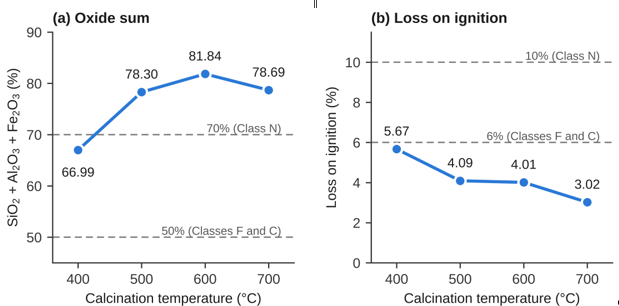
Locust bean pod ash (LBPA) is an abundant West African agricultural residue with potential as a supplementary cementitious material, but the effect of calcination temperature on its composition and performance is poorly documented. Pods were pre-burnt in open air and then calcined in a muffle furnace for 2 hours at 400, 500, 600 and 700 °C. The ashes were characterised by X-ray fluorescence (XRF), X-ray diffraction (XRD) and nitrogen physisorption, and each ash replaced 5% of the cement by mass in concrete with a water-to-binder ratio of 0.58. Calcination raised the SiO2 + Al2O3 + Fe2O3 sum from 66.99% at 400 °C to 78.30–81.84% at 500–700 °C and lowered the loss on ignition from 5.67 to 3.02%. Carbonate phases matched by XRD at 400–500 °C were no longer leading matches at 600–700 °C, where potassium and calcium-bearing phases were the main matches. The BET surface area was highest at 400 °C (13.38 m²/g) and did not follow the strength ranking, so surface area alone is a poor guide to performance for this ash. The 600 °C ash gave the highest 28-day strength (24.58 N/mm², a relative strength index of 90.67%) and was significantly stronger than the other blends (p ≤ 0.008). It was 1.68% below the 25 N/mm² design strength and 9.33% below the control, whereas the other blends ranged from 20.03 to 21.49 N/mm². Calcination at 600 °C is therefore recommended as the best of the tested temperatures for preparing LBPA.
References
Akpenpuun, TD., Akinyemi, B., Olawale, O., Aladegboye, OJ. and Adesina, OI. 2019. Mechanical and structural characteristics of cement mortars blended with locust bean pod ash. Agricultural Engineering International: CIGR Journal, 21(4): 48–55.
Aprianti, E. 2017. A huge number of artificial waste material can be supplementary cementitious material (SCM) for concrete production – a review part II. Journal of Cleaner Production, 142: 4178–4194. https://doi.org/10.1016/j.jclepro.2015.12.115
Arrieta Baldovino, J., Torres Ortega, R. and Luna Velasco, M. 2025. Characterization of the pozzolanic potential of oil palm kernel shell ash obtained through optimization of physicochemical processes. Materials, 18(6): 1248. https://doi.org/10.3390/ma18061248
ASTM C311/C311M-25. 2025. Standard test methods for sampling and testing coal ash or natural pozzolans for use in concrete. ASTM International, West Conshohocken, PA.
ASTM C618-23e1. 2023. Standard specification for coal ash and raw or calcined natural pozzolan for use in concrete. ASTM International, West Conshohocken, PA.
ASTM C1709-22. 2022. Standard guide for evaluation of alternative supplementary cementitious materials (ASCM) for use in concrete. ASTM International, West Conshohocken, PA.
Bentz, DP., Durán-Herrera, A. and Galvez-Moreno, D. 2012. Comparison of ASTM C311 strength activity index testing versus testing based on constant volumetric proportions. Journal of ASTM International, 9(1): JAI104138. https://doi.org/10.1520/JAI104138
Brunauer, S., Emmett, PH. and Teller, E. 1938. Adsorption of gases in multimolecular layers. Journal of the American Chemical Society, 60(2): 309–319. https://doi.org/10.1021/ja01269a023
BS 1881-102:1983. Testing concrete. Method for determination of slump. British Standards Institution, London.
BS 1881-103:1983. Testing concrete. Method for determination of compacting factor. British Standards Institution, London.
BS 1881-108:1983. Testing concrete. Method for making test cubes from fresh concrete. British Standards Institution, London.
BS EN 197-1:2011. Cement. Composition, specifications and conformity criteria for common cements. British Standards Institution, London.
BS EN 1008:2002. Mixing water for concrete. British Standards Institution, London.
Cordeiro, GC., Toledo Filho, RD. and Fairbairn, EMR. 2009. Effect of calcination temperature on the pozzolanic activity of sugar cane bagasse ash. Construction and Building Materials, 23(10): 3301–3303. https://doi.org/10.1016/j.conbuildmat.2009.02.013
Cyr, M., Lawrence, P. and Ringot, E. 2006. Efficiency of mineral admixtures in mortars: quantification of the physical and chemical effects of fine admixtures in relation with compressive strength. Cement and Concrete Research, 36(2): 264–277. https://doi.org/10.1016/j.cemconres.2005.07.001
Della, VP., Kühn, I. and Hotza, D. 2002. Rice husk ash as an alternate source for active silica production. Materials Letters, 57(4): 818–821. https://doi.org/10.1016/S0167-577X(02)00879-0
Elinwa, AU. and Mahmood, YA. 2002. Ash from timber waste as cement replacement material. Cement and Concrete Composites, 24(2): 219–222. https://doi.org/10.1016/S0958-9465(01)00039-7
Gartner, E. and Sui, T. 2018. Alternative cement clinkers. Cement and Concrete Research, 114: 27–39. https://doi.org/10.1016/j.cemconres.2017.02.002
Ikumapayi, CM. 2016. Crystal and microstructure analysis of pozzolanic properties of bamboo leaf ash and locust beans pod ash blended cement concrete. Journal of Applied Sciences and Environmental Management, 20(4): 943–950. https://doi.org/10.4314/jasem.v20i4.6
Isa, FN., Johari, MAM., Anum, I., Soji, SM., Salihu, CH. and Agabus, JL. 2023. Properties of concrete and mortar containing locust bean pod ash as cement replacement: a review. Civil Engineering and Architecture, 11(6): 3479–3487. https://doi.org/10.13189/cea.2023.110618
Juenger, MCG. and Siddique, R. 2015. Recent advances in understanding the role of supplementary cementitious materials in concrete. Cement and Concrete Research, 78: 71–80. https://doi.org/10.1016/j.cemconres.2015.03.018
Juenger, MCG., Snellings, R. and Bernal, SA. 2019. Supplementary cementitious materials: new sources, characterization, and performance insights. Cement and Concrete Research, 122: 257–273. https://doi.org/10.1016/j.cemconres.2019.05.008
Kilani, AJ., Ikotun, BD., Abdulwahab, R. and Olubambi, A. 2025. A review on the structural performance of sustainable composite construction materials incorporating locust bean and mango wastes. Discover Applied Sciences, 7(9): 1022. https://doi.org/10.1007/s42452-025-07591-0
Li, X., Snellings, R., Antoni, M. et al. 2018. Reactivity tests for supplementary cementitious materials: RILEM TC 267-TRM phase 1. Materials and Structures, 51: 151. https://doi.org/10.1617/s11527-018-1269-x
López-Pérez, L., Zarubina, V. and Melián-Cabrera, I. 2021. The Brunauer–Emmett–Teller model on alumino-silicate mesoporous materials. How far is it from the true surface area? Microporous and Mesoporous Materials, 319: 111065. https://doi.org/10.1016/j.micromeso.2021.111065
Lothenbach, B., Scrivener, K. and Hooton, RD. 2011. Supplementary cementitious materials. Cement and Concrete Research, 41(12): 1244–1256. https://doi.org/10.1016/j.cemconres.2010.12.001
Nair, DG., Fraaij, A., Klaassen, AAK. and Kentgens, APM. 2008. A structural investigation relating to the pozzolanic activity of rice husk ashes. Cement and Concrete Research, 38(6): 861–869. https://doi.org/10.1016/j.cemconres.2008.01.013
Ndububa, EE. and Uloko, JO. 2015. Locust bean pod ash (LBPA) as a pozzolanic material in concrete. In: Proceedings of the International Academic Conference for Sub-Sahara African Transformation and Development, 3(4): 1–8.
Ochola, AB., Otaru, KU. and Musa, U. 2021. Suitability of locust beans waste ash and alkaline activated rice husk ash as partial replacement for cement in concrete. African Scholar Journal of Environmental Design and Construction Management, 22(4): 243–252.
Ojewumi, ME., Ayomide, AA., Obanla, OM., Awolu, OO. and Ojewumi, EO. 2017. Pozzolanic properties of waste agricultural biomass – African locust bean pod waste. World Journal of Environmental Biosciences, 6(3): 1–7.
Okeke, FO., Ahmed, A., Imam, A. and Hassanin, H. 2026. Calcination optimisation of corncob ash for sustainable cementitious applications: a pathway to low-carbon construction. Sustainability, 18(1): 311. https://doi.org/10.3390/su18010311
Olubajo, OO., Jibril, A. and Osha, OA. 2020. Effect of locust bean pod ash and eggshell ash on the mortar compressive and flexural strengths of cement blends. Path of Science, 6(3): 4001–4016.
Paris, JM., Roessler, JG., Ferraro, CC., DeFord, HD. and Townsend, TG. 2016. A review of waste products utilized as supplements to Portland cement in concrete. Journal of Cleaner Production, 121: 1–18. https://doi.org/10.1016/j.jclepro.2016.02.013
Raheem, AA. and Ikotun, BD. 2020. Incorporation of agricultural residues as partial substitution for cement in concrete and mortar – a review. Journal of Building Engineering, 31: 101428. https://doi.org/10.1016/j.jobe.2020.101428
Scrivener, K., Snellings, R. and Lothenbach, B. (eds.) 2016. A Practical Guide to Microstructural Analysis of Cementitious Materials. CRC Press, Boca Raton. https://doi.org/10.1201/b19074
Scrivener, KL., John, VM. and Gartner, EM. 2018. Eco-efficient cements: potential economically viable solutions for a low-CO2 cement-based materials industry. Cement and Concrete Research, 114: 2–26. https://doi.org/10.1016/j.cemconres.2018.03.015
Snellings, R. 2016. Assessing, understanding and unlocking supplementary cementitious materials. RILEM Technical Letters, 1: 50–55. https://doi.org/10.21809/rilemtechlett.2016.12
Snellings, R. and Scrivener, KL. 2016. Rapid screening tests for supplementary cementitious materials: past and future. Materials and Structures, 49(8): 3265–3279. https://doi.org/10.1617/s11527-015-0718-z
Snellings, R., Li, X., Avet, F. and Scrivener, K. 2019. Rapid, robust, and relevant (R3) reactivity test for supplementary cementitious materials. ACI Materials Journal, 116(4): 155–162. https://doi.org/10.14359/51716719
Šupić, S., Malešev, M., Radonjanin, V., Bulatović, V. and Milović, T. 2021. Reactivity and pozzolanic properties of biomass ashes generated by wheat and soybean straw combustion. Materials, 14(4): 1004. https://doi.org/10.3390/ma14041004
Thomas, BS. 2018. Green concrete partially comprised of rice husk ash as a supplementary cementitious material – a comprehensive review. Renewable and Sustainable Energy Reviews, 82: 3913–3923. https://doi.org/10.1016/j.rser.2017.10.081
Thommes, M., Kaneko, K., Neimark, AV., Olivier, JP., Rodriguez-Reinoso, F., Rouquerol, J. and Sing, KSW. 2015. Physisorption of gases, with special reference to the evaluation of surface area and pore size distribution (IUPAC Technical Report). Pure and Applied Chemistry, 87(9–10): 1051–1069. https://doi.org/10.1515/pac-2014-1117
Vassilev, SV., Baxter, D., Andersen, LK. and Vassileva, CG. 2013. An overview of the composition and application of biomass ash. Part 1. Phase–mineral and chemical composition and classification. Fuel, 105: 40–76. https://doi.org/10.1016/j.fuel.2012.09.041
Downloads
Published
Issue
Section
Categories
License
Copyright (c) 2026 Manasseh Tyogo, Bala Makoji Innocent, Akuha Simon Iorshagher

This work is licensed under a Creative Commons Attribution 4.0 International License.


