
Hybrid Recursive Feature Elimination and Principal Component Analysis for Dimensionality Reduction in Network Intrusion Detection on the UNSW-NB15 Dataset
DOI:
https://doi.org/10.33003/fjs-2026-1022-6225Keywords:
Feature selection, intrusion detection, machine learning, principal component analysis, recursive feature eliminationAbstract
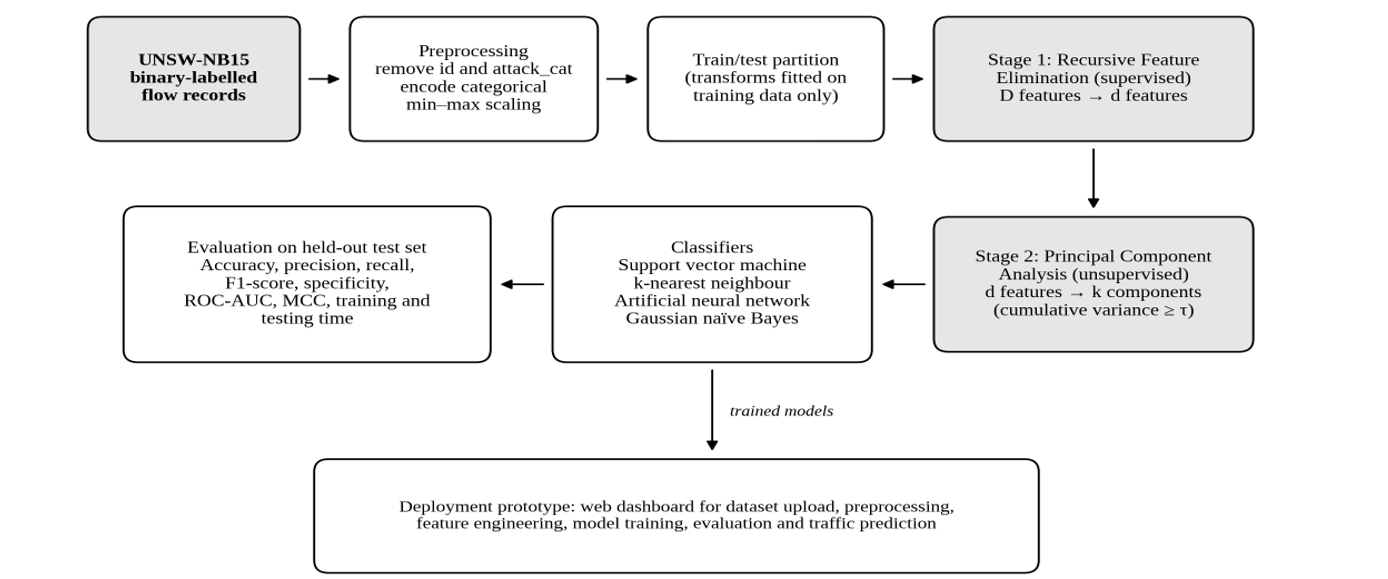
Machine-learning-based network intrusion detection is often limited by the high dimensionality of traffic records, whose redundant and correlated attributes increase computational cost. Recursive feature elimination (RFE) retains class-relevant attributes, whereas principal component analysis (PCA) decorrelates attributes without reference to class labels. This study evaluated a sequential pipeline in which RFE with a random-forest estimator retained 30 of the 42 attributes of the UNSW-NB15 dataset and PCA projected them onto 10 orthogonal components explaining 95.6% of their variance. The 175,341-record training partition of the dataset was split 70:30 by stratified sampling into 122,738 training and 52,603 testing records, and every transformer was fitted on the training records only. Four classifiers from different learning paradigms were evaluated with accuracy, precision, recall, F1-score, specificity, the area under the receiver operating characteristic curve (ROC-AUC) and the Matthews correlation coefficient (MCC), averaged over five runs, and compared with full-feature, RFE-only and PCA-only baselines. On the hybrid representation, the artificial neural network achieved the highest accuracy (93.72 ± 0.21%), ROC-AUC (0.982) and MCC (0.855), followed by k-nearest neighbour (93.41%; MCC 0.847), the support vector machine (91.56%; 0.806) and Gaussian naïve Bayes (86.82%; 0.698). All classifiers detected 90–99% of attacks but correctly identified only 76–87% of normal flows. Relative to the full attribute set, the hybrid representation reduced the input dimension by 76% with an MCC change between −0.041 and +0.017, and reduced k-nearest-neighbour testing time from 15.16 s to 0.73 s
References
Arp, D., Quiring, E., Pendlebury, F., Warnecke, A., Pierazzi, F., Wressnegger, C., Cavallaro, L., & Rieck, K. (2022). Dos and don’ts of machine learning in computer security. In Proceedings of the 31st USENIX Security Symposium (USENIX Security 22) (pp. 3971–3988). USENIX Association. https://www.usenix.org/conference/usenixsecurity22/presentation/arp
Chicco, D., & Jurman, G. (2020). The advantages of the Matthews correlation coefficient (MCC) over F1 score and accuracy in binary classification evaluation. BMC Genomics, 21(1), Article 6. https://doi.org/10.1186/s12864-019-6413-7
Daoud, M. S., Abualhaj, M. M., Al-Khatib, S. S., Al-Zyoud, M., Abu-Shareha, A., Al-Aqrabi, H., Alsharaiah, M. A., & Anbar, M. (2026). A unified machine learning-based IDS/IPS framework with bio-inspired feature selection for real-time detection of malware-laden URLs. Journal of Information and Communication Technology, 25(3), 1–30. https://doi.org/10.32890/jict2026.25.3.1
Efron, B., & Tibshirani, R. J. (1994). An introduction to the bootstrap. Chapman and Hall/CRC. https://doi.org/10.1201/9780429246593
Ghani, H., Salekzamankhani, S., & Virdee, B. S. (2023). A hybrid dimensionality reduction for network intrusion detection. Journal of Cybersecurity and Privacy, 3(4), 830–843. https://doi.org/10.3390/jcp3040037
Guyon, I., Weston, J., Barnhill, S., & Vapnik, V. (2002). Gene selection for cancer classification using support vector machines. Machine Learning, 46(1–3), 389–422. https://doi.org/10.1023/A:1012487302797
Jolliffe, I. T., & Cadima, J. (2016). Principal component analysis: A review and recent developments. Philosophical Transactions of the Royal Society A: Mathematical, Physical and Engineering Sciences, 374(2065), Article 20150202. https://doi.org/10.1098/rsta.2015.0202
Kasongo, S. M., & Sun, Y. (2020). Performance analysis of intrusion detection systems using a feature selection method on the UNSW-NB15 dataset. Journal of Big Data, 7, Article 105. https://doi.org/10.1186/s40537-020-00379-6
McNemar, Q. (1947). Note on the sampling error of the difference between correlated proportions or percentages. Psychometrika, 12(2), 153–157. https://doi.org/10.1007/BF02295996
Moustafa, N., & Slay, J. (2015). UNSW-NB15: A comprehensive data set for network intrusion detection systems (UNSW-NB15 network data set). In 2015 Military Communications and Information Systems Conference (MilCIS) (pp. 1–6). IEEE. https://doi.org/10.1109/MilCIS.2015.7348942
Moustafa, N., & Slay, J. (2016). The evaluation of network anomaly detection systems: Statistical analysis of the UNSW-NB15 data set and the comparison with the KDD99 data set. Information Security Journal: A Global Perspective, 25(1–3), 18–31. https://doi.org/10.1080/19393555.2015.1125974
Ngo, V.-D., Vuong, T.-C., Van Luong, T., & Tran, H. (2024). Machine learning-based intrusion detection: Feature selection versus feature extraction. Cluster Computing, 27(3), 2365–2379. https://doi.org/10.1007/s10586-023-04089-5
Salo, F., Nassif, A. B., & Essex, A. (2019). Dimensionality reduction with IG-PCA and ensemble classifier for network intrusion detection. Computer Networks, 148, 164–175. https://doi.org/10.1016/j.comnet.2018.11.010
Yin, Y., Jang-Jaccard, J., Xu, W., Singh, A., Zhu, J., Sabrina, F., & Kwak, J. (2023). IGRF-RFE: A hybrid feature selection method for MLP-based network intrusion detection on UNSW-NB15 dataset. Journal of Big Data, 10, Article 15. https://doi.org/10.1186/s40537-023-00694-8
Downloads
Published
Issue
Section
Categories
License
Copyright (c) 2026 Ajibola khadijat Ayinde, Olawale Mustapha Issa, Kamil Kayode Saka, Opeyemi Ademola Adefila, Lateefat Abiola Jimoh

This work is licensed under a Creative Commons Attribution 4.0 International License.


