
Coconut-Shell Activated Carbon-Supported CaO for Biodiesel Production from Waste Cooking Oil: Catalyst Preparation and Process-Parameter Screening
DOI:
https://doi.org/10.33003/fjs-2026-1022-6227Keywords:
Biodiesel, Waste Cooking Oil, Calcium Oxide, Activated Carbon, Coconut Shell, Heterogeneous Catalyst, TransesterificationAbstract
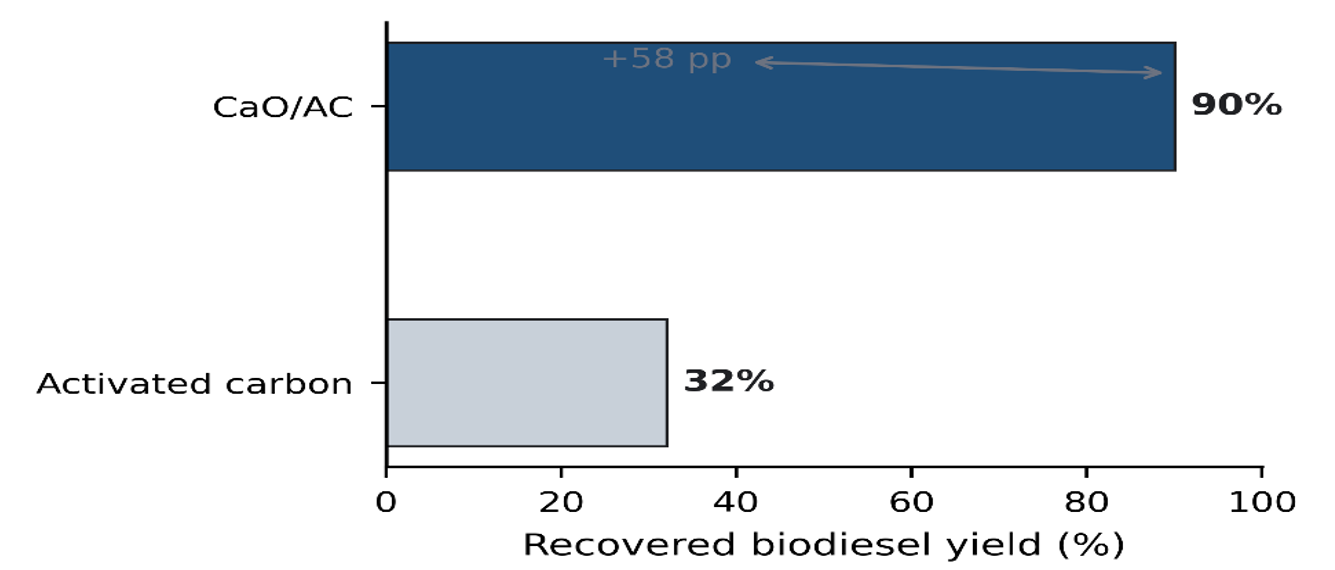
Valorising waste cooking oil and agricultural residues provides a practical route to integrate low-cost biodiesel production with the circular use of biomass resources. In this study, we produced activated carbon (AC) from waste coconut shell and used it as a support for a calcium-based heterogeneous catalyst prepared by wet impregnation with calcium nitrate, followed by thermal treatment. We evaluated the resulting CaO/AC material for transesterification of pretreated waste cooking oil with methanol at 60 °C. A one-factor-at-a-time screening examined nominal oil:methanol ratios of 1:4, 1:8, and 1:16; catalyst loadings of 0.05, 0.10, and 0.20 g; and reaction times of 30, 60, and 120 min. We used FTIR and atomic absorption spectroscopy (AAS) to characterise the prepared catalyst. FTIR bands were consistent with oxygen-containing surface groups and calcium-containing species, while AAS confirmed calcium in the supported material. The highest gravimetric yield of recovered biodiesel-rich product was approximately 90%, obtained at an oil: methanol ratio of 1:16, a catalyst loading of 0.10 g, and a reaction time of 60 min. Under the selected conditions, CaO/AC substantially outperformed activated carbon alone (approximately 90% versus 32%). These findings support the feasibility of coconut-shell-derived activated carbon as a low-cost support for calcium-based transesterification catalysts. Because the source dataset lacked replicate variability, XRD/SEM-EDX confirmation, FAME quantification, and standardised fuel-property data, the results are interpreted as process screening rather than definitive statistical optimisation or proof of fuel-standard compliance.
References
Abo El-Khair, M. A., Yadav, K. K., Aldosari, F. M., Fallatah, A. M., Alreshidi, M. A., Hameed, T. A., Ewies, E. F., & Morshedy, A. S. (2026). Activated carbon and biochar-based catalysts for sustainable biodiesel production: A comparative insight into transesterification efficiency, mechanism, and design. Materials Research Bulletin, 201. https://doi.org/10.1016/j.materresbull.2026.114119
Buasri, A., Chaiyut, N., Loryuenyong, V., Rodklum, C., Chaikwan, T., Kumphan, N., Jadee, K., Klinklom, P., & Wittayarounayut, W. (2012). Transesterification of waste frying oil for synthesizing biodiesel by KOH supported on coconut shell activated carbon in packed bed reactor. ScienceAsia, 38(3), 283–288. https://doi.org/10.2306/scienceasia1513-1874.2012.38.283
Ibrahim, N. A., Rashid, U., Hazmi, B., Moser, B. R., Alharthi, F. A., Rokhum, S. L., & Ngamcharussrivichai, C. (2022). Biodiesel production from waste cooking oil using magnetic bifunctional calcium and iron oxide nanocatalysts derived from empty fruit bunch. Fuel, 317. https://doi.org/10.1016/j.fuel.2022.123525
Kouzu, M., Kasuno, T., Tajika, M., Sugimoto, Y., Yamanaka, S., & Hidaka, J. (2008). Calcium oxide as a solid base catalyst for transesterification of soybean oil and its application to biodiesel production. Fuel, 87(12), 2798–2806. https://doi.org/10.1016/j.fuel.2007.10.019
Lam, M. K., Lee, K. T., & Mohamed, A. R. (2010). Homogeneous, heterogeneous and enzymatic catalysis for transesterification of high free fatty acid oil (waste cooking oil) to biodiesel: A review. Biotechnology Advances, 28(4), 500–518. https://doi.org/10.1016/j.biotechadv.2010.03.002
Mohadesi, M., Aghel, B., Gouran, A., & Razmehgir, M. H. (2022). Transesterification of waste cooking oil using clay/CaO as a solid base catalyst. Energy, 242. https://doi.org/10.1016/j.energy.2021.122536
Monika, Banga, S., & Pathak, V. V. (2023). Biodiesel production from waste cooking oil: A comprehensive review on the application of heterogenous catalysts. Energy Nexus, 10. https://doi.org/10.1016/j.nexus.2023.100209
Rashad, M. A., Hussain, M., Jamil, F., Hamayun, M. H., Ahsan, A., Akhter, P., & Park, Y.-K. (2026). Dual-waste valorization of eggshell and coconut shell–pith biomass into CaO/activated carbon catalysts: Synthesis, characterization, and structure–performance correlations in biodiesel transesterification. Carbon Letters, 36(3), 1321–1335. https://doi.org/10.1007/s42823-026-01065-y
Rocha Meneses, L., Hari, A., Inayat, A., Yousef, L., Alarab, S., Abdallah, M., Shanableh, A., Ghenai, C., Sabarathinam, S., & Kikas, T. (2023). Recent advances on biodiesel production from waste cooking oil (WCO): A review of reactors, catalysts, and optimization techniques impacting the production. Fuel, 348. https://doi.org/10.1016/j.fuel.2023.128514
Singh, D., Sharma, D., Soni, S. L., Inda, C. S., Sharma, S., Sharma, P. K., & Jhalani, A. (2021). A comprehensive review of biodiesel production from waste cooking oil and its use as fuel in compression ignition engines: 3rd generation cleaner feedstock. Journal of Cleaner Production, 307, Article 127299. https://doi.org/10.1016/j.jclepro.2021.127299
Sun, H., Sun, K., Wang, F., Liu, Y., Ding, L., Xu, W., Sun, Y., & Jiang, J. (2021). Catalytic self-activation of Ca-doped coconut shell for in-situ synthesis of hierarchical porous carbon supported CaO transesterification catalyst. Fuel, 285. https://doi.org/10.1016/j.fuel.2020.119192
Downloads
Published
Issue
Section
Categories
License
Copyright (c) 2026 Usman Abubakar, Jiya Mohammed

This work is licensed under a Creative Commons Attribution 4.0 International License.


