
Wind–Solar Climate-Resource Adequacy in Semi-Arid Iraq: Reconstructed ERA5 Diagnostics and Conditional CMIP6 Models
DOI:
https://doi.org/10.33003/fjs-2026-1024-6234Keywords:
Wind–solar resources, Climate-resource reliability, Compound resource deficits, Renewable-energy droughts, CMIP6 projectionsAbstract
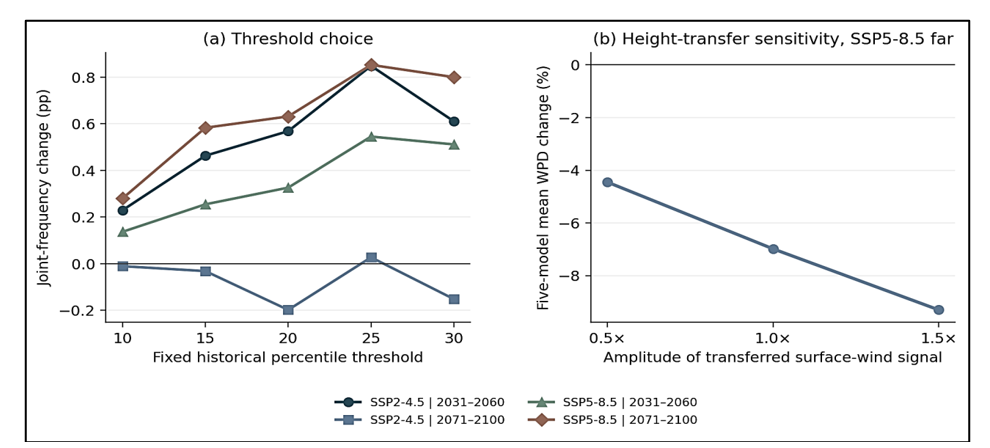
Mean-resource assessments miss days when wind and PV potential are simultaneously weak. Wind–solar resource indicators were reconstructed for the Al-Shahabi region in southeastern Iraq using 227,928 hourly ERA5 time steps across 12 grid cells during 1995–2020. Conditional resource responses were subsequently assessed using five CMIP6 models under SSP2-4.5 and SSP5-8.5.WPD is calculated from hourly 100 m wind vectors and air density; a temperature-adjusted PV proxy is derived from hourly horizontal irradiation. Historical 20th-percentile (P20) thresholdsdefine comparable low resource days. The mean wind power density was 296.74 W m⁻², while the mean daily temperature-adjusted PV resource indicator was 0.7508 kWh m⁻² d⁻¹. Simultaneous deficiencies occur on 643/9497 (6.77%) days, mostly in boreal winter. For four future scenario–horizon combinations, the equal-weight five-model mean WPD changes −3.19% to −6.98% (all five models are reduced under transfer assumptions), while concurrent low-resource frequency changes range from −0.20 to +0.63 percentage points (pp) in the ensemble mean and are not signed consistently among individual models. Sensitivity analyses show strong seasonality dependence of thresholds and wind change amplitude transferred. These results separate a relatively coherent mean wind-resource response from much less robust compound-deficitbehaviour. Because monthly change signals are imposed on historical sequences, the adjusted daily episodes are conditional threshold outcomes but not predictions for weather persistence or operational electricity system reliability.
References
Bhatt, U. S., Carreras, B. A., Barredo, J. M. R., Newman, D. E., Collet, P., & Gomila, D. (2022). The potential impact of climate change on the efficiency and reliability of solar, hydro, and wind energy sources. Land, 11(8), 1275. https://doi.org/10.3390/land11081275
Bracken, C., Voisin, N., Burleyson, C. D., Campbell, A. M., Hou, Z. J., & Broman, D. (2024). Standardized benchmark of historical compound wind and solar energy droughts across the Continental United States. Renewable Energy, 220, 119550. https://doi.org/10.1016/j.renene.2023.119550
Bracken, C., Voisin, N., Mongird, K., Burleyson, C. D., & Oikonomou, K. (2025). Intensifying renewable energy droughts in the Western US amid evolving infrastructure and climate. Earth's Future, 13(6), e2024EF005313. https://doi.org/10.1029/2024EF005313
Chen, G., & Ji, Z. (2024). A review of solar and wind energy resource projection based on the Earth system model. Sustainability, 16(8), 3339. https://doi.org/10.3390/su16083339
Copernicus Climate Change Service. (2018). ERA5 hourly data on single levels from 1940 to present [Data set]. https://doi.org/10.24381/cds.adbb2d47
Costoya, X., Decastro, M., Carvalho, D., & Gómez-Gesteira, M. (2023). Assessing the complementarity of future hybrid wind and solar photovoltaic energy resources for North America. Renewable and Sustainable Energy Reviews, 173, 113101. https://doi.org/10.1016/j.rser.2022.113101
Eyring, V., Bony, S., Meehl, G. A., Senior, C. A., Stevens, B., Stouffer, R. J., & Taylor, K. E. (2016). Overview of the Coupled Model Intercomparison Project Phase 6 (CMIP6) experimental design and organization. Geoscientific Model Development, 9(5), 1937-1958. https://doi.org/10.5194/gmd-9-1937-2016
Floors, R., & Nielsen, M. (2019). Estimating air density using observations and re-analysis outputs for wind energy purposes. Energies, 12(11), 2038. https://doi.org/10.3390/en12112038
Hersbach, H., Bell, B., Berrisford, P., Hirahara, S., Horányi, A., Muñoz‐Sabater, J., Nicolas, J., Peubey, C., Radu, R., & Schepers, D. (2020). The ERA5 global reanalysis. Quarterly journal of the royal meteorological society, 146(730), 1999-2049. https://doi.org/10.1002/qj.3803
Kapica, J., Jurasz, J., Canales, F. A., Bloomfield, H., Guezgouz, M., De Felice, M., & Kobus, Z. (2024). The potential impact of climate change on European renewable energy droughts. Renewable and Sustainable Energy Reviews, 189, 114011. https://doi.org/10.1016/j.rser.2023.114011
Kendall, M. G. (1938). A new measure of rank correlation. Biometrika, 30(1-2), 81-93. https://doi.org/10.1093/biomet/30.1-2.81
Li, M., Ma, Q., Shan, R., Abdulla, A., Virguez, E., Gao, S., & Patiño-Echeverri, D. (2024). Renewable energy quality trilemma and coincident wind and solar droughts. Communications Earth & Environment, 5(1), 661. https://doi.org/10.1038/s43247-024-01850-5
Mann, H. B. (1945). Nonparametric tests against trend. Econometrica: Journal of the econometric society, 245-259. https://doi.org/10.2307/1907187
Morin, B., Far, A. M., Flynn, D., & Sweeney, C. (2025). Reducing RES droughts through the integration of wind and solar PV. Renewable Energy, 252, 123392. https://doi.org/10.1016/j.renene.2025.123392
O'Neill, B. C., Tebaldi, C., Van Vuuren, D. P., Eyring, V., Friedlingstein, P., Hurtt, G., Knutti, R., Kriegler, E., Lamarque, J.-F., & Lowe, J. (2016). The scenario model intercomparison project (ScenarioMIP) for CMIP6. Geoscientific Model Development, 9(9), 3461-3482. https://doi.org/10.5194/gmd-9-3461-2016
Pantic, L. S., Pavlović, T. M., Milosavljević, D. D., Radonjic, I. S., Radovic, M. K., & Sazhko, G. (2016). The assessment of different models to predict solar module temperature, output power and efficiency for Nis, Serbia. Energy, 109, 38-48. https://doi.org/10.1016/j.energy.2016.04.090
Pedruzzi, R., Silva, A. R., Dos Santos, T. S., Araujo, A. C., Weyll, A. L. C., Kitagawa, Y. K. L., da Silva Ramos, D. N., De Souza, F. M., Narciso, M. V. A., & Araujo, M. L. S. (2023). Review of mapping analysis and complementarity between solar and wind energy sources. Energy, 283, 129045. https://doi.org/10.1016/j.energy.2023.129045
Sachit, M. S., Shafri, H. Z. M., Abdullah, A. F., & Rafie, A. S. M. (2022). Combining re-analyzed climate data and landcover products to assess the temporal complementarity of wind and solar resources in Iraq. Sustainability, 14(1), 388. https://doi.org/10.3390/su14010388
Sen, P. K. (1968). Estimates of the regression coefficient based on Kendall's tau. Journal of the American statistical association, 63(324), 1379-1389. https://doi.org/10.1080/01621459.1968.10480934
Skoplaki, E., & Palyvos, J. A. (2009). Operating temperature of photovoltaic modules: A survey of pertinent correlations. Renewable Energy, 34(1), 23-29. https://doi.org/10.1016/j.renene.2008.04.009
Tebaldi, C., Debeire, K., Eyring, V., Fischer, E., Fyfe, J., Friedlingstein, P., Knutti, R., Lowe, J., O'Neill, B., & Sanderson, B. (2021). Climate model projections from the scenario model intercomparison project (ScenarioMIP) of CMIP6. Earth System Dynamics, 12(1), 253-293. https://doi.org/10.5194/esd-12-253-2021
Wilczak, J. M., Akish, E., Capotondi, A., & Compo, G. P. (2024). Evaluation and bias correction of the ERA5 reanalysis over the United States for wind and solar energy applications. Energies, 17(7), 1667. https://doi.org/10.3390/en17071667
Wilczak, J. M., Kirk-Davidoff, D. B., Bloomfield, H., Bracken, C., & Sharp, J. (2025). Wind and solar energy droughts: Potential impacts on energy system dynamics and research needs. Journal of Renewable and Sustainable Energy, 17(2), 022301. https://doi.org/10.1063/5.0253058
Downloads
Published
Issue
Section
Categories
License
Copyright (c) 2026 Safaa Al-Swaiedi

This work is licensed under a Creative Commons Attribution 4.0 International License.


