
Usability and Technology Acceptance of a Web-Based Digital Repository in Nigerian Army University Biu
DOI:
https://doi.org/10.33003/fjs-2026-1023-6249Keywords:
Performance, , Technology, Perceived Ease of Use, Perceived Usefulness, User-Centred DesignAbstract
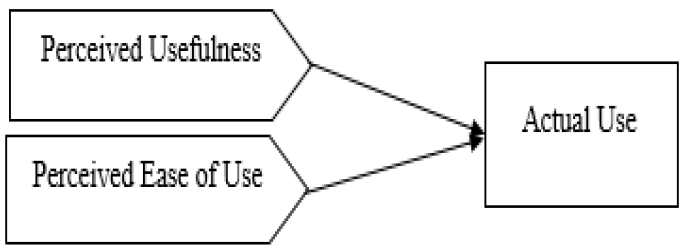
The detrimental environmental impacts of traditional paper usage, hence, advocating for digital solutions. The paper examines the usability of the User-Centered Web-Based Digital Repository (UCDER) as a sustainable e-book platform among students at Nigerian Army University Biu using Technology Adoption Model (TAM). Quantitative approach was employed, Questionnaires was designed to validate the Perceived Usefulness and Perceived Ease of Use of the (UCDER). 291 questionnaires were distributed and 265 was retrieved with response rate of 91%. Random sampling was used to administer the questionnaires. Amos Graphics was used to analyse the data. The results revealed that Perceived Usefulness has path coefficient of 0.18 with a p-value of 0.001. This indicated that the effect of Perceived Usefulness PU on Actual Use of UCDER is significant. Therefore, it can be interpreted that the perception of respondents (users), on performance and functionality of UCDER technology has been achieved. Similarly, Perceived Ease of Use path coefficient of 0.13 with a p-value of 0.000. This implies that the effect of Perceived Ease of Use PEU on Actual Use of UCDER is significant. This established that, performance and functionality of UCDER technology is user-friendly. The findings contribute to the understanding of user-centered design in digital repositories and highlight the importance of usability in fostering technology adoption within educational settings. The findings of the paper is limited to Nigerian Army University, suggesting further research is needed to generalize results across different academic environments.
References
Awang, Z., Afthanorhan, A., & Mamat, M. (2016). The Likert scale analysis using parametric based Structural Equation Modeling (SEM). Computational Methods in Social Sciences, 4(1), 13.
Bandura, A. (1982). Self-efficacy mechanism in human agency. American Psychologist, 37(2), 122-147.
Conservatree (2015). Trees into paper. http://conservatree.org/learn/EnviroIssues/TreeStats.shtml, viewed 6 August 2015.
Counsell, T. & Allwood, J.M. (2007). Reducing climate change gas emissions by cutting out stages in the life cycle of office paper. Resources, Conservation and Recycling, 49(4), 340–352.
Hoyle, R. H. & Panter, A. T. (1995). Writing about structural equation modeling. In R. H. Hoyle (Ed.), Structural equation modeling: Concepts, issues, and applications (pp. 1-24). Thousand Oaks, CA: Sage Publications.
Isaias & Issa (2020). Sustainability Awareness and Green Information Technologies. ISBN: 978-3-030-47975-6.
Koufteros, X. A. (1999). Testing a model of pull production: A multi-method approach. Journal of Operations Management, 17(3), 289-306.
Lozano, R. (2011). The state of sustainability reporting in universities. International Journal of Sustainability in Higher Education, 12(1), 67-78.
Lozano, R. et al. (2011). Declarations for sustainability in higher education: Becoming better leaders through university systems. Journal of Cleaner Production, 1–10.
Nielsen, J. (1994). Usability engineering. Boston: Academic Press.
Omonigho, T. (2023). The Importance of Usability and User-Centred Design in Web Applications: A Critical Review of Literature.
Omonigho, Toje Joel (2023). The Importance of Usability and User-Centred Design in Web Applications: A Critical Review of Literature.
Robin, R., Potter, S. & Yarrow, K. (2002). Factoring sustainability into the higher education product service. Journal of Sustainable Product Design, 2, 105–117.
Rogers, E. M. & Shoemaker, F. F. (1971). Communication of Innovations: A Cross-Cultural Approach. New York: Free Press.
Roy, R., Potter, S., & Yarrow, K. (2008). Designing low carbon higher education systems: Environmental impacts of campus and distance learning systems. International journal of sustainability in higher education, 9(2), 116-130.
Roy, R., Potter, S., Smith, M., & Yarrow, K. (2002). Towards Sustainable Higher Education: Environmental Impacts of Conventional Campus.
Saunders, M., Lewis, P., Thornhill, A., & Wilson, J. (2009). Business research methods. Financial Times, Prentice Hall: London.
Shah, R. & Goldstein, S. M. (2006). Use of structural equation modeling in operations management research: Looking back and forward. Journal of Operations Management, 24(2), 148-169.
Vredenburg, K. & Butler, K. (1996). Current practice and future directions in user-centered design.
www. https://naub.edu.ng/news/2025.
Yin, R. K. (2011). Applications of case study research (Vol. 34). Sage.
Downloads
Published
Issue
Section
Categories
License
Copyright (c) 2026 Ahmed Sarkin Aska, Abdulkadir Hassan Disina

This work is licensed under a Creative Commons Attribution 4.0 International License.


