
SPATIAL DISTRIBUTION OF POTENTIALLY TOXIC ELEMENTS AND PHYSICOCHEMICAL PROPERTIES OF SOILS AT A MILITARY SHOOTING RANGE IN BUNI YADI, YOBE STATE, NIGERIA
DOI:
https://doi.org/10.33003/fjs-2026-1021-6254Keywords:
Potentially toxic elements, Military shooting range, Soil properties, Lead, CadmiumAbstract
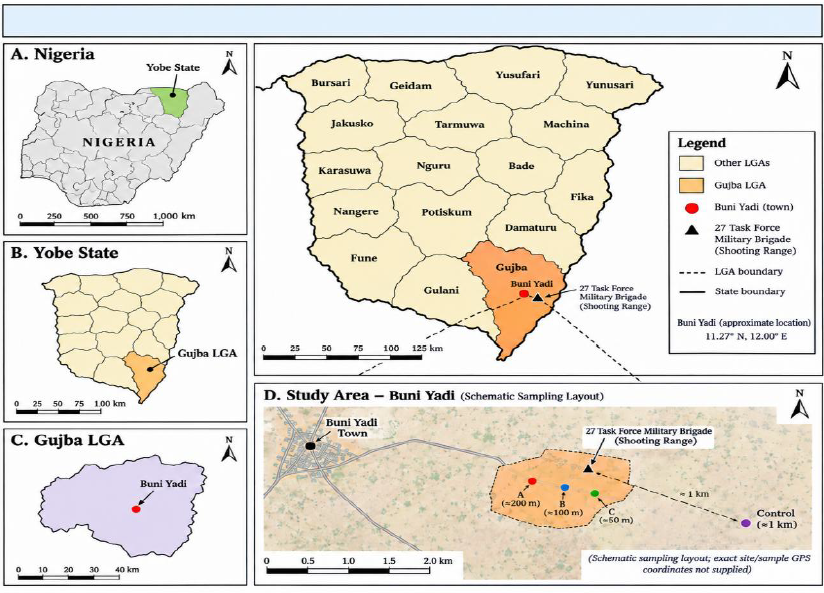
Military shooting ranges may receive inputs of metal containing ammunition, which can contribute to the localized accumulation of trace elements in soil. This study evaluated selected physicochemical properties and concentrations of lead (Pb), cadmium (Cd), chromium (Cr), arsenic (As) and copper (Cu) in soils from the 27 Task Force Military Brigade Shooting Range in Buni Yadi, Yobe State, Nigeria. Twelve independent soil samples were collected, comprising three samples from each of three distances from the main shooting point (200 m, 100 m and 50 m) and three samples from a control location approximately 1 km away from the main shorting range. Soil pH, electrical conductivity (EC), bulk density, water-holding capacity, total nitrogen and temperature were assessed, while trace element concentrations were determined using atomic absorption spectrophotometry (AAS). Soil pH ranged from 5.7 to 6.4, and EC ranged from 1.975 to 1.997 mS/cm. Point C (50 m) had the highest mean concentrations of all five elements. Lead concentrations ranged from 24.45 ± 0.07 mg/kg in the control soil to 205.53 ± 0.03 mg/kg at Point C, while cadmium concentrations ranged from 0.30 ± 0.01 to 3.01 ± 0.03 mg/kg. Relative enrichment at Point C compared with the control was 8.41-fold for Pb, 10.03-fold for Cd, 1.36-fold for Cr, 3.46-fold for As and 1.64-fold for Cu. These findings indicate localized enrichment, particularly of Pb and Cd, and highlight the need for continued monitoring and further investigation of element mobility and bioavailability
References
References
Alloway, B. J. (2013). Heavy metals in soils: Trace metals and metalloids in soils and their bioavailability (3rd ed.). Springer.
Anderson, J. M., & Ingram, J. S. I. (1989). Tropical soil biology and fertility: A handbook of methods. CAB International.
Bai, J., & Zhao, X. (2020). Ecological and human health risks of heavy metals in shooting range soils: A meta assessment from China. Toxics, 8(2), 32. https://doi.org/10.3390/toxics8020032
Cao, X., Ma, L. Q., Chen, M., Hardison, D. W., & Harris, W. G. (2003). Lead transformation and distribution in the soils of shooting ranges in Florida, USA. Science of the Total Environment, 307(1–3), 179–189. https://doi.org/10.1016/S0048-9697(02)00543-0
Etim, E. U., & Onianwa, P. C. (2012). Lead contamination of soil in the vicinity of a military shooting range in Ibadan, Nigeria. Toxicological & Environmental Chemistry, 94(5), 895–905. https://doi.org/10.1080/02772248.2012.678997
Kabata-Pendias, A. (2011). Trace elements in soils and plants (4th ed.). CRC Press.
Lawal, I. A., Uba, S., & Ekwumemgbo, P. A. (2019). Concentrations of lead, cadmium and copper in soil samples at a shooting range in Nasinta, Katsina, Nigeria. Nigerian Research Journal of Chemical Sciences, 7(2), 133–142.
Mariussen, E., Johnsen, I. V., & Strømseng, A. E. (2017). Distribution and mobility of lead (Pb), copper (Cu), zinc (Zn), and antimony (Sb) from ammunition residues on shooting ranges for small arms located on mires. Environmental Science and Pollution Research, 24(11), 10182–10196.
McLean, E. O. (1982). Soil pH and lime requirement. In A. L. Page, R. H. Miller, & D. R. Keeney (Eds.), Methods of soil analysis: Part 2. Chemical and microbiological properties (2nd ed., pp. 199–224). American Society of Agronomy and Soil Science Society of America.
Okkenhaug, G., Grasshorn Gebhardt, K.-A., Amstaetter, K., Bue, H. L., Herzel, H., Mariussen, E., Almås, Å. R., Cornelissen, G., Breedveld, G. D., Rasmussen, G., & Mulder, J. (2016). Antimony (Sb) and lead (Pb) in contaminated shooting range soils: Sb and Pb mobility and immobilization by iron based sorbents, a field study. Journal of Hazardous Materials, 307, 336–343. https://doi.org/10.1016/j.jhazmat.2016.01.005
Rhoades, J. D. (1982). Soluble salts. In A. L. Page, R. H. Miller, & D. R. Keeney (Eds.), Methods of soil analysis: Part 2. Chemical and microbiological properties (2nd ed., pp. 167–179). American Society of Agronomy and Soil Science Society of America.
Sanderson, P., Naidu, R., Bolan, N., Bowman, M., & McLure, S. (2012). Effect of soil type on distribution and bioaccessibility of metal contaminants in shooting range soils. Science of the Total Environment, 438, 452–462. https://doi.org/10.1016/j.scitotenv.2012.08.014
Sanderson, P., Qi, F., Seshadri, B., Wijayawardena, A., & Naidu, R. (2018). Contamination, fate and management of metals in shooting range soils: A review. Current Pollution Reports, 4(2), 175–187. https://doi.org/10.1007/s40726-018-0089-5
Tchounwou, P. B., Yedjou, C. G., Patlolla, A. K., & Sutton, D. J. (2012). Heavy metal toxicity and the environment. EXS, 101, 133–164.
Yobe State Government. (2023). Yobe State profile. https://pfm.yb.gov.ng/wp-content/uploads/2025/03/Yobe_state_PHC_HRH_strategic-plan_Validated-1.pdf
Zhu, Y., Che, R., Tu, B., Miao, J., Lu, X., Li, J., Zhu, Y., & Wang, F. (2024). Contamination and remediation of contaminated firing ranges—An overview. Frontiers in Environmental Science, 12, 1352603. https://doi.org/10.3389/fenvs.2024.1352603
Downloads
Published
Issue
Section
Categories
License
Copyright (c) 2026 Muhammad Modu, Magaji Yakubu, Bashir Muhammad Sanda

This work is licensed under a Creative Commons Attribution 4.0 International License.


