
Design and Preliminary Performance Evaluation of a SIMON–LWE Hybrid Encryption Scheme for Cloud-Based IoT
DOI:
https://doi.org/10.33003/fjs-2026-1024-6258Keywords:
Cloud Computing, Lightweight Cryptography, Lattice-Based Cryptography, SIMON Cipher, Data Encryption, Internet of Things (IoT)Abstract
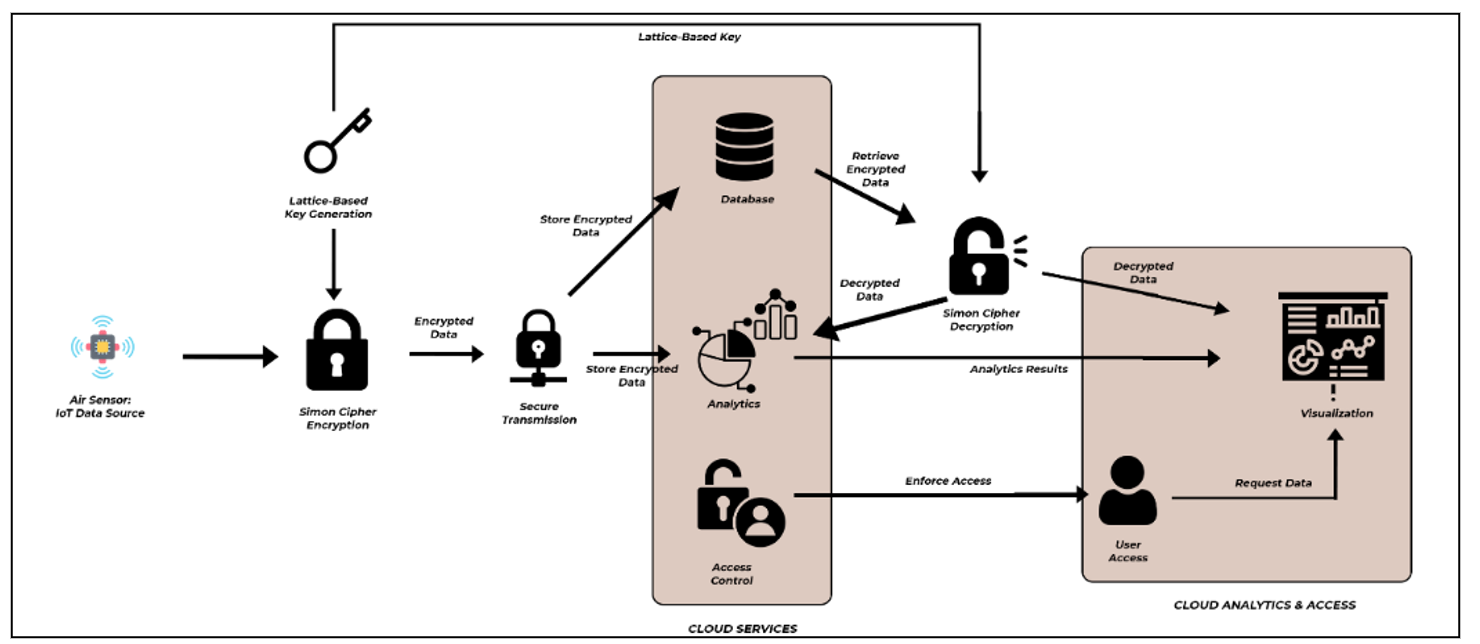
Cloud-based Internet of Things (IoT) networks have transformed data collection, processing and communication across a wide variety of industries, including healthcare, agriculture, manufacturing, smart cities, transportation, and environmental monitoring. But, most of the resource constrained IoT devices have limited battery power, memory, storage and processing power, which make it hard to implement conventional cryptographic algorithms such as Advanced Encryption Standard (AES), Rivest–Shaumir–Adleman (RSA), and Elliptic Curve Cryptography (ECC) in them. Moreover, standard cryptographic systems are vulnerable to quantum computing attacks. In this work, we propose a resource-efficient encryption framework called SIMON-LBA, combining the SIMON block cipher with a key-generation scheme based on LWE lattice cryptography to achieve quantum resistance and compromise minimal resources. Numerical experimentation with the model was carried out in a simulated cloud-IoT environment using Python in a quantitative experimental approach. Over 100 iterations, the representative sensor data was assessed, such as PM2.5, temperature, and humidity data. Encryption and decryption times, throughput, energy usage, CPU usage and memory usage were measured and compared with a 100 iterations for each of the following algorithms: AES, RSA, ECC, DES, ChaCha20, SIMON, SPECK, Attribute-Based Signcryption (ABSC) and Homomorphic Encryption. The results indicated that the time for encryption is 0.644 ms, the time for decryption is 0.589 ms, the throughput is 1,038.40 kbps, the CPU utilization is about 0.12%, the memory consumption is 0.48 MB and the energy consumption per operation is 0.009974 J. The SIMON-LBA shows a promising computational efficiency-potential postquantum security tradeoff.
References
Abed, S., Jaffal, R., Mohd, B. J., & Alshayeji, M. (2019). FPGA Modeling and Optimization of a SIMON Lightweight Block Cipher. Sensors, 19(4), 913. https://doi.org/10.3390/s19040913.
Abualkas, Y. M. A., and Bhaskari, D. L. (2024). Hybrid Approach to Cloud Storage Security Using ECC-AES Encryption and Key Management Techniques. International Journal of Engineering Trends and Technology, 72(4): 92-100..
Almutairi, Y., & Sheldon, F. T. (2025). IoT-cloud integration security: A survey of challenges, solutions, and directions. Electronics, 14(7).
Beaulieu, R., Treatman-Clark, S., Shors, D., Weeks, B., Smith, J., & Winger, L. (2015). The SIMON and SPECK lightweight block ciphers. In Proceedings of the 52nd Design Automation Conference (DAC) (pp. 1–6).
Dhanda, S., Singh, B., & Jindal, P. (2020). Lightweight cryptography: A solution to secure IoT. Wireless Personal Communications, 112(3), 1947-1980.
Ekwueme, C. P., Adam, I. H., & Dwivedi, A. (2024). Lightweight cryptography for Internet of Things: A review. EAI Endorsed Transactions on Internet of Things, 10(1).
Grover, L. K. (1996). A fast quantum mechanical algorithm for database search. In Proceedings of the 28th Annual ACM Symposium on Theory of Computing (pp. 212–219).
Hatzivasilis, G., Fysarakis, K., Papaefstathiou, I., & Manifavas, C. (2018). A review of lightweight block ciphers. Journal of Cryptographic Engineering, 8(2), 141–184.
Kumar, D., and Kumar, M. (2024). Hybrid Cryptographic Approach for Data Security Using Elliptic Curve Cryptography for IoT. International Journal of Computer Network and Information Security, 16(2): 42-54.
Kwala, A. K., Kant, S., & Mishra, A. (2024). Comparative analysis of lattice-based cryptographic schemes for secure IoT communications. Discover Internet of Things, 4, Article 13.
Kyado, D. J., Iliya, A. J., Mohammed, T., & Kenneth, S. N. (2025). IoT-Based Telemedicine System to Address Healthcare Access Challenges in Nigeria. FUDMA Journal of Sciences, 9(7), 142-150. https://doi.org/10.33003/fjs-2025-0907-3675
Liu, T., Ramachandran, G., & Jurdak, R. (2024). Post-quantum cryptography for Internet of Things: A survey on performance and optimization. arXiv. https://doi.org/10.48550/arXiv.2401.17538
Mohammed, M. A., & Abdul Wahab, H. B. (2024). Enhancing IoT data security with lightweight blockchain and Okamoto Uchiyama homomorphic encryption. Computer Modeling in Engineering & Sciences, 138(2), 1731–1748. https://doi.org/10.32604/cmes.2023.030528
Myroshnyk, Y., Krishnan, A., Taparia, A., Paraskevopoulos, D., Pasqua, E., Brügge, F., Fernandez, J., Sava, J.-A., Baviskar, K., Lueth, K. L., Kulezak, M., Hasan, M., Demir, O., Wegner, P., Kadian, R., Nair, R., Sinha, S., & Annaswamy, S. (2024). State of IoT summer 2024. IoT Analytics. https://iot-analytics.com/product/state-of-iot-summer-2024/
Radhakrishnan, I., Jadon, S., & Honnavalli, P. B. (2024). Efficiency and security evaluation of lightweight cryptographic algorithms for resource-constrained IoT devices. Sensors, 24(12), Article 4008. https://doi.org/10.3390/s24124008
Shor, P. W. (1994). Algorithms for quantum computation: Discrete logarithms and factoring. In Proceedings of the 35th Annual Symposium on Foundations of Computer Science (pp. 124–134). IEEE Computer Society Press. https://doi.org/10.1109/SFCS.1994.365700
Suryateja, P. S., & Rao, K. V. (2024). A survey on lightweight cryptographic algorithms in IoT. Cybernetics and Information Technologies, 24(1), 21–34. https://doi.org/10.2478/cait-2024-0002
Sutikno, T., & Thalmann, D. (2022). Insights on the internet of things: Past, present, and future directions. TELKOMNIKA (Telecommunication Computing Electronics and Control), 20(6), 1399–1420. https://doi.org/10.12928/telkomnika.v20i6.22028
Thakor, V. A., Razzaque, M. A., & Khandaker, M. R. A. (2021). Lightweight cryptography algorithms for resource-constrained IoT devices: A review, comparison and research opportunities. IEEE Access, 9, 28177-28193. https://doi.org/10.1109/ACCESS.2021.3052867
Downloads
Published
Issue
Section
Categories
License
Copyright (c) 2026 Alowolodu Olufunso Dayo, Ibam Onwuka Emmanuel, Jolayemi Olaoluwa Daniel

This work is licensed under a Creative Commons Attribution 4.0 International License.


