
Reconciling Blockchain Immutability and Statutory Revocation in Land Administration: An Integrated Conceptual Framework
DOI:
https://doi.org/10.33003/fjs-2026-1022-6259Keywords:
blockchain, non-fungible token, land administration, statutory revocation, Hybrid Social Oracle, MQTT, Conceptual FrameworkAbstract
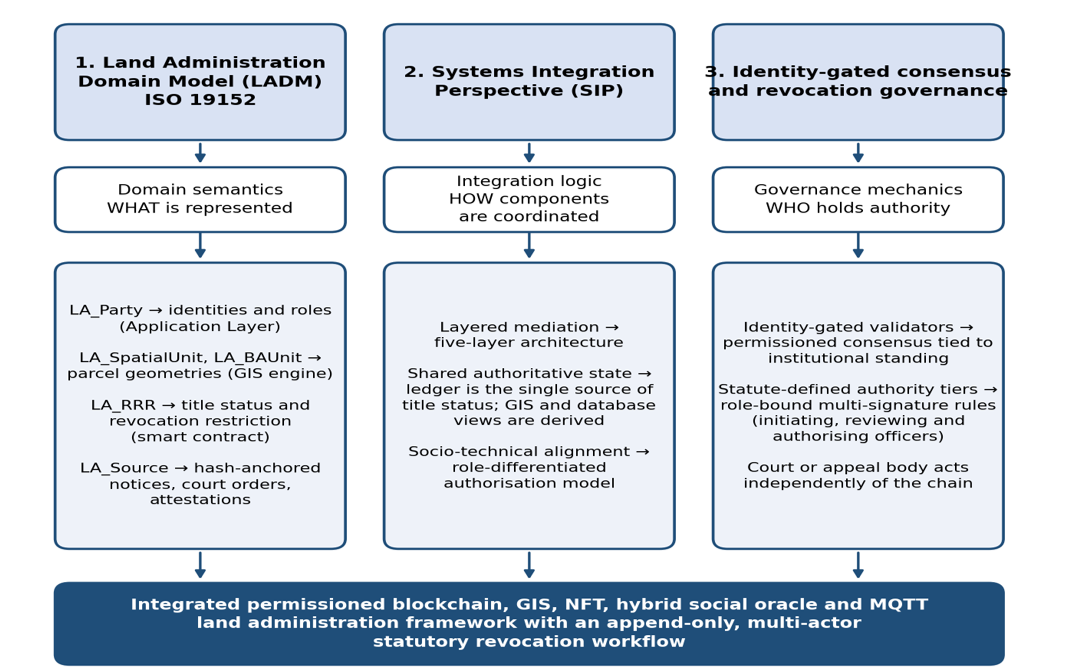
Much of the blockchain-based land administration literature reviewed appears to assume that a registry’s primary value lies in its absolute immutability. This assumption is difficult to reconcile with statutory revocation, such as that provided under Section 28 of Nigeria’s Land Use Act of 1978. This paper develops a conceptual framework that treats lawful mutability as a primary architectural requirement. Drawing on the Land Administration Domain Model (LADM), a Systems Integration Perspective (SIP) and the identity-gated consensus literature, the framework integrates a five-component technology stack: a permissioned blockchain ledger; Geographic Information System (GIS) spatial verification; Non-Fungible Token (NFT) title representation; a hybrid social oracle for community attestation; and offline-resilient Message Queuing Telemetry Transport (MQTT) messaging. Revocation is modelled as an append-only event rather than a deletion. A title moves through defined statuses (proposal, notice, appeal and revocation), and the transition to “revoked” requires proof of service, a lapsed notice period, the absence of a stay and signatures from separate statutory roles, while community attestations are recorded as evidence and conflicts place the title on hold. A bounded explicit-state check of the specified transition system found no violation of its safety properties and detected four deliberately injected faults. The framework is a conceptual contribution: it has not been implemented, legally approved or empirically evaluated, and recommendations, future research directions and a validation agenda are set out to guide future work.
References
Ajayi, O., Riekkinen, K., & Adekola, O. (2026). User-centric dimensions of trust and acceptance in blockchain adoption for land administration systems: A systematic literature review. Land Use Policy, 164, Article 107944. https://doi.org/10.1016/j.landusepol.2026.107944
Ameyaw, P. D., & de Vries, W. T. (2020). Transparency of land administration and the role of blockchain technology, a four-dimensional framework analysis from the Ghanaian land perspective. Land, 9(12), Article 491. https://doi.org/10.3390/land9120491
Ameyaw, P. D., & de Vries, W. T. (2021). Toward smart land management: Land acquisition and the associated challenges in Ghana: A look into a blockchain digital land registry for prospects. Land, 10(3), Article 239. https://doi.org/10.3390/land10030239
Ameyaw, P. D., & de Vries, W. T. (2023). Blockchain technology adaptation for land administration services: The importance of socio-cultural elements. Land Use Policy, 125, Article 106485. https://doi.org/10.1016/j.landusepol.2022.106485
Ansah, B. O., Voss, W., Asiama, K. O., & Wuni, I. Y. (2023). A systematic review of the institutional success factors for blockchain-based land administration. Land Use Policy, 125, Article 106473. https://doi.org/10.1016/j.landusepol.2022.106473
Ateniese, G., Magri, B., Venturi, D., & Andrade, E. (2017). Redactable blockchain – or – rewriting history in Bitcoin and friends. In 2017 IEEE European Symposium on Security and Privacy (EuroS&P) (pp. 111–126). IEEE. https://doi.org/10.1109/EuroSP.2017.37
Babalola, K. H., Hull, S., & Whittal, J. (2024). Peri-urban land administration and management: Understanding the challenges in Ekiti state, Nigeria, using case study and soft systems methodologies. Survey Review, 57(399), 120–139. https://doi.org/10.1080/00396265.2024.2370598
Bao, Y., Gui, Z., Sun, Z., An, Z., & Huang, Z. (2023). Spatial blockchain: Enhancing spatial queries and applications through integrating blockchain and spatial database technologies. Electronics, 12(20), Article 4287. https://doi.org/10.3390/electronics12204287
Chandra, S. S. V., Elrashidi, A., Purushotham, S., Karthick, C., Manogna, D., & Dinesh, M. (2025). A blockchain based secured land registration system using dynamic smart contracts. In 2025 International Conference on Recent Innovation in Science, Engineering and Technology (ICRISET) (pp. 1–9). IEEE. https://doi.org/10.1109/icriset64803.2025.11252328
Chowanetz, M., Legner, C., & Thiesse, F. (2012). Integration: An omitted variable in information systems research. In ECIS 2012 Proceedings (Article 227). AIS Electronic Library. https://aisel.aisnet.org/ecis2012/227
Constitution of the Federal Republic of Nigeria, 1999 (as amended).
De Filippi, P., & Wright, A. (2018). Blockchain and the law: The rule of code. Harvard University Press.
Entriken, W., Shirley, D., Evans, J., & Sachs, N. (2018). ERC-721: Non-fungible token standard (Ethereum Improvement Proposal 721). https://eips.ethereum.org/EIPS/eip-721
Evidence Act, 2011 (Nigeria).
Faku, N., & Amadi-Echendu, A. (2026). The economic benefit of blockchain-based land registry for South Africa: A systematic literature review. South African Journal of Information Management, 28(1), Article a2002. https://doi.org/10.4102/sajim.v28i1.2002
Gadagkar, A. V., & Begum, S. (2024, August). PropeTrust: Enhancing Land Registration with Ethereum Blockchain and Smart Contracts. In 2024 International Conference on Intelligent Algorithms for Computational Intelligence Systems (IACIS) (pp. 1-6). IEEE. https://doi.org/10.1109/iacis61494.2024.10721690
Gesang, R. N., & Dirgahayu, T. (2025). Development of a blockchain-based decentralised application with NFT for land registration. Jurteksi, 11(4), 661–668. https://doi.org/10.33330/jurteksi.v11i4.4147
Graglia, J. M., & Mellon, C. (2018). Blockchain and property in 2018: At the end of the beginning. Innovations: Technology, Governance, Globalization, 12(1–2), 90–116.
Griggs, L., Thomas, R., Low, R., & Scheibner, J. (2017). Blockchains, trust and land administration: The return of historical provenance. Property Law Review, 6, 179–194. https://figshare.utas.edu.au/articles/journal_contribution/Blockchains_trust_and_land_administration_the_return_of_historical_provenance/22954325/1
Hasan, O., Brunie, L., & Bertino, E. (2022). Privacy-preserving reputation systems based on blockchain and other cryptographic building blocks: A survey. ACM Computing Surveys, 55(2), 1–37. https://doi.org/10.1145/3490236
Hasselbring, W. (2000). Information system integration. Communications of the ACM, 43(6), 32–38.
Hevner, A. R., March, S. T., Park, J., & Ram, S. (2004). Design science in information systems research. MIS Quarterly, 28(1), 75–105. https://doi.org/10.2307/25148625
Hojati, M., Feick, R., Roberts, S. A., Farmer, C., & Robertson, C. (2023). Distributed spatial data sharing: A new model for data ownership and access control. Journal of Spatial Information Science, 27, 1–26. https://doi.org/10.5311/josis.2023.27.220
International Organization for Standardization. (2012). Geographic information—Land administration domain model (LADM) (ISO 19152:2012). ISO.
Jabareen, Y. (2009). Building a conceptual framework: Philosophy, definitions, and procedure. International Journal of Qualitative Methods, 8(4), 49–62. https://doi.org/10.1177/160940690900800406
Johnson, A. G., Pepple, G. T., Okoli, F. U., & Yaya, A. L. (2024). Digital cadastre for potable water distribution network in Lokoja, Kogi State. FUDMA Journal of Sciences, 8(1), 277–285. https://doi.org/10.33003/fjs-2024-0801-2225
Kalaiarasi, P., Varma, P. S. R., Sanjay, U., Sujan, K. L., & Tharun, A. (2025, December). A Blockchain-based Framework for Land Registration Ensuring Transparency, Tamper-Proof Records. In 2025 6th International Conference on IoT Based Control Networks and Intelligent Systems (ICICNIS) (pp. 645-650). IEEE. https://doi.org/10.1109/icicnis66685.2025.11315589
Lamport, L. (2002). Specifying systems: The TLA+ language and tools for hardware and software engineers. Addison-Wesley.
Land Use Act, Cap. L5, Laws of the Federation of Nigeria (2004) (originally Decree No. 6 of 1978).
Langaliya, V., & Gohil, J. A. (2021). A comparative and comprehensive analysis of smart contract enabled blockchain applications. International Journal on Recent and Innovation Trends in Computing and Communication, 9(9), 16–26. https://doi.org/10.17762/ijritcc.v9i9.5489
Lemmen, C., van Oosterom, P., & Bennett, R. (2015). The land administration domain model. Land Use Policy, 49, 535–545. https://doi.org/10.1016/j.landusepol.2015.01.014
Maikano, S., Maisamari, I. J., Jayeola, W. A., Dare, A., Okechalu, S. O., & Bako, A. (2020). Creation for a cadastral information system for Gonin Gora layout in Chikun Local Government Area of Kaduna State, Nigeria. FUDMA Journal of Sciences, 4(3), 554–562. https://doi.org/10.33003/fjs-2020-0403-321
Majigi, M. U. M., Idris, I., Abdulhamid, S. M., & Uduimoh, A. A. (2023). Blockchain-based zero knowledge proof model for secure data sharing scheme in a distributed vehicular networks. FUDMA Journal of Sciences, 7(3), 45–54. https://doi.org/10.33003/fjs-2023-0703-1786
Mallya, A., Ananth, A., Baliga, A. R., Veetil, A. M., Jadon, S., & Honnavalli, P. B. (2025). SLR-GPoA: A smart land registry system using blockchain and geographic proof of authority. Journal of Advances in Information Technology, 16(12), 1758–1779. https://doi.org/10.12720/jait.16.12.1758-1779
Markus, M. L., & Tanis, C. (2000). The enterprise systems experience: From adoption to success. In R. W. Zmud (Ed.), Framing the domains of IT management: Projecting the future through the past (pp. 173–207). Pinnaflex Educational Resources. Nigeria Data Protection Act, 2023.
Nugraha, A. R. P., Arkeman, Y., Hermadi, I., & Nurhadryani, Y. (2026). A blockchain based hybrid ZKP-Merkle tree framework for secure and regulation-compliant e-governance identity verification. Engineering, Technology & Applied Science Research, 16(3), 36470–36481. https://doi.org/10.48084/etasr.17425
OASIS. (2019). MQTT version 5.0 (OASIS Standard). Organization for the Advancement of Structured Information Standards.
Okoli, F. U., Oludiji, S. M., Ofoegbunam, E. I., Oyesiji, A. O., & Akindiya, O. M. (2024). Blockchain technology for land registration in Nigeria: A review of opportunities and challenges. FUDMA Journal of Sciences, 8(6), 252–257. https://doi.org/10.33003/fjs-2024-0806-2919
Omeke, J., Boitt, M., & Nyangweso, D. (2025). The Social Tenure Domain Model (STDM): Conceptual foundations, comparative insights, and practical applications for inclusive land governance. International Journal of Innovative Science and Research Technology, 10(12), 2441–2444. https://doi.org/10.38124/ijisrt/25dec1471
Panwar, A., Agarwal, J., Sugandh, U., Sharma, N., & Jain, A. (2024, December). Decentralized Land Registry Systems: Revolutionizing Property Rights Management with Blockchain. In 2024 4th International Conference on Innovative Sustainable Computational Technologies (CISCT) (pp. 1-6). IEEE.https://doi.org/10.1109/cisct62494.2024.11134198
Patil, A. S. (2026). Blockchain-enabled land transaction validation framework (government-integrated) [Data set]. Zenodo. https://doi.org/10.5281/zenodo.18169445
Peffers, K., Tuunanen, T., Rothenberger, M. A., & Chatterjee, S. (2007). A design science research methodology for information systems research. Journal of Management Information Systems, 24(3), 45–77. https://doi.org/10.2753/MIS0742-1222240302
Seun, O. A., & Eguavoen, V. O. (2022). A literature review of land title with the aim of maximising the benefits of blockchain technology in the management of land title in Nigeria. Studia Universitatis Babeș-Bolyai Engineering, 67(1), 124–135. https://doi.org/10.24193/subbeng.2022.1.12
Shava, E., & Mhlanga, D. (2023). Mitigating bureaucratic inefficiencies through blockchain technology in Africa. Frontiers in Blockchain, 6, Article 1053555. https://doi.org/10.3389/fbloc.2023.1053555
Thakur, V., Doja, M. N., Dwivedi, Y. K., Ahmad, T., & Khadanga, G. (2019). Land records on blockchain for implementation of land titling in India. International Journal of Information Management, 52, Article 101940. https://doi.org/10.1016/j.ijinfomgt.2019.04.013
Waring, T., & Wainwright, D. (2000). Interpreting integration with respect to information systems in organizations: Image, theory and reality. Journal of Information Technology, 15(2), 131–147. https://doi.org/10.1177/026839620001500205
Werbach, K., & Cornell, N. (2017). Contracts ex machina. Duke Law Journal, 67(2), 313–382.
Yahya, S., Bello, L. M., & Salihu, I. A. (2026). A scoping review on the viability of blockchain solution for land registry systems in Nigeria. FUDMA Journal of Sciences, 10(3), 266–272. https://doi.org/10.33003/fjs-2026-1003-4419
Zhao, P., Jimenez, J. R. C., Brovelli, M. A., & Mansourian, A. (2022). Towards geospatial blockchain: A review of research on blockchain technology applied to geospatial data. AGILE: GIScience Series, 3, Article 71. https://doi.org/10.5194/agile-giss-3-71-2022
Downloads
Published
Issue
Section
Categories
License
Copyright (c) 2026 Emmanuel Anagu, Etemi Joshua Garba, Manluira Datilo Philemon, Haruna Usman

This work is licensed under a Creative Commons Attribution 4.0 International License.


