
Geoelectrical Investigation of Groundwater Potential around the Cattle Yard, Ovia North-East Local Government Area, Edo State, Nigeria
DOI:
https://doi.org/10.33003/fjs-2026-1022-6279Keywords:
Geoelectrical Investigation, Groundwater Potential, Electrical Resistivity, Vertical Electrical Sounding (VES)Abstract
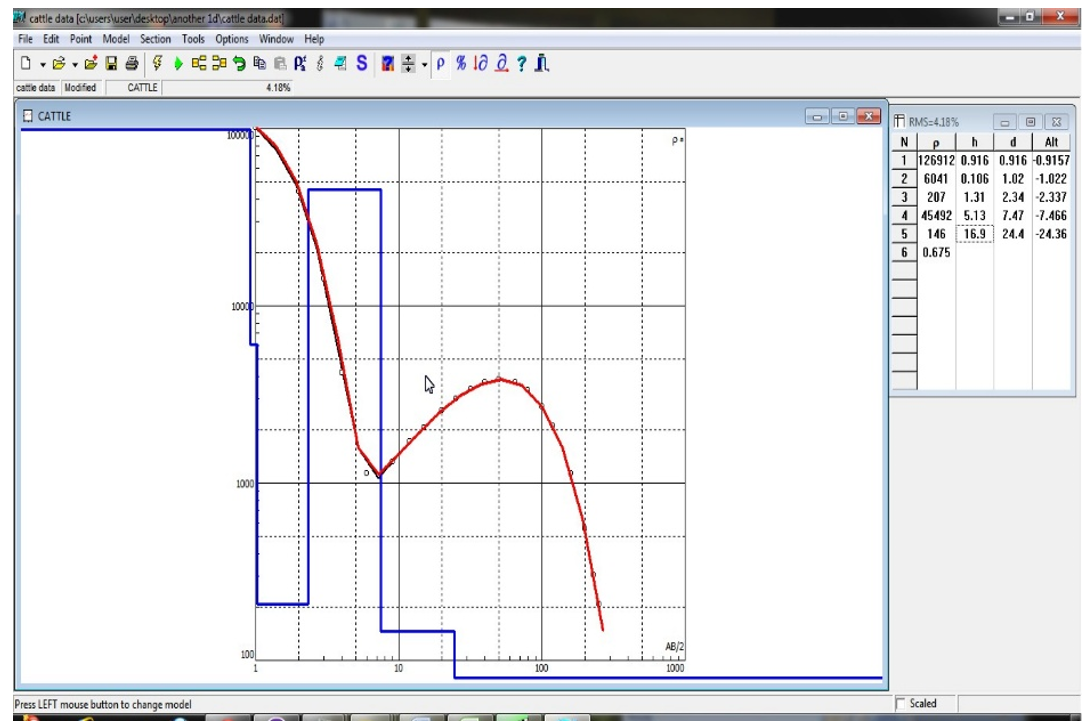
Groundwater scarcity around the Cattle Yard in Ovia North-East Local Government Area, Edo State, Nigeria, necessitates investigation to identify geoelectric conditions that may support groundwater occurrence. A vertical electrical sounding (VES) survey was conducted using a Parsi (A.C) Earth Resistivity Meter, and the Schlumberger electrode configuration with a maximum current electrode separation (AB) of 500m. The geodetic coordinates of the vertical electrical station were recorded using a Global Positioning System (GPS). The VES data collected during the field survey were processed and interpreted using IPI2WIN software. Six subsurface geoelectric layers were interpreted with layer boundaries occurring at depths of approximately 0.916m, 1.02m, 2.34m, 7.47m, and 24.40m. Resistivity values range from 0.675Ωm to 126912Ωm, indicating marked electrical heterogeneity. The interpreted units comprise materials tentatively associated with cemented sandstone or gravel, dry sand or lateritic gravel, wet or saturated sand, and lateritic or sandy material. The fifth layer with a resistivity of 146 Ωm and a thickness of 16.9m may represent a relatively conductive sandy or lateritic interval that could have groundwater bearing potential. However, resistivity alone cannot establish saturation or aquifer productivity. The sixth layer has an undefined thickness and depth and exceptionally low resistivity of 0.675 Ωm. It is therefore interpreted conservatively as a highly conductive zone that may reflect clay rich material, mineralized water or another conductive lithology. The results provide a preliminary geoelectrical basis for groundwater assessment, but confirmation through borehole drilling, lithological logging and groundwater quality testing is required before development decisions are made.
References
Aizebeokhai, A. P., Ogungbade, O., & Oyeyemi, K. D. (2021). Application of geoelectrical resistivity for delineating crystalline basement aquifers in Basiri, Ado-Ekiti, Southwestern Nigeria. Arabian Journal of Geosciences, 14(1), 51. https://doi.org/10:1007/s12517-020-06440-1
Akor, M., Akpaneno, A., & Afuwai, C. G. (2023). Geoelectrical investigation of groundwater potential of administrative block at permanent site, Federal University Dutsin-Ma, Katsina State, Nigeria. FUDMA Journal of Science, 1(1), 161-169.
Alile, O.M., Ujuanbi, O., & Evbuomwan, I.A. (2011). Geoelectric Investigation of Groundwater in Obaretin-Iyanomon Locality, Edo State, Nigeria. Journal of Geology and Mining Research, 3(1), Pp.13 – 20.
Amadi, A. N., Olasehinde, P. I., Okosun, E. A., Okoye, N. O., & Alkali, Y.B. (2012). A comparative study on the aquifer properties from electrical sounding and pumping test in Mubi, northeastern Nigeria. Journal of Geology and Mining Research, 4(1), 1-6.
Bernard, J. (2003): Short notes on the principles of geophysical methods for groundwater investigations. IRIS Instruments.
Diat, K.A.N.A., Awawi, M.N.M.N. & Abdullah, K.A. (2013). Application of multi-criteria decision analysis to geoelectric and geologic parameters for spatial prediction of groundwater resources potential and aquifer evaluation. Journal of Applied Geophysics, 91, 1–10.
Ehirim, C. N., & Ebeniro, J. O. (2013). Comparative analysis of vertical electrical sounding and borehole data in delineating aquifer potential in a sedimentary terrain. Scientific Research and Essays, 8(9), 354-363.
Foster, S., & Chilton, P. (2003). Groundwater: the processes and global significance of aquifer degradation. Philosophical Transactions of the Royal Society B: Biological Sciences 358(1440), 1957–1972.
Macdonald, A. M., Davies, J., & Calow, R. C. (2008). African hydrogeology and rural water supply. In M.A.H. Chidley et al. (Eds.), Applied groundwater studies in Africa (IAH Selected Papers on Hydrogeology, Vol. 13, pp. 127–148). CRC Press.
Nwozor, R.N., Bassey, N.E George, N.J. & Harry, T.A. (2025a). Characterization of depositional environment within parts of Benin Formation, Akwa Ibom State, Nigeria using vertical electrical sounding technique. European Journal of Environment and Earth Sciences, 6(4), 10-20.https://doi.org/10.24018/ejgeo.2025.6.4.528
Nwozor, R.N., Bassey, N.E George, N.J. & Harry, T.A. (2025b). Hydrogeophysical and hydrogeological characterization of groundwater in Parts of the Benin Formation, Akwa Ibom State, Nigeria: Implications for sustainable water resource management. Researchers Journal of Science and Technology, 5(1), 45-68. https://doi.org/10.83080/rejost.vol5no1.169
Odigwe A. P., Ezomo, F. A., & Jackson-Abara, M.E. (2025). Groundwater exploration in Nifor area of Edo State using electrical resistivity method. Nigerian Journal of Theoretical and Environmental Physics (NJTEP); Volume 3(2), Pp.91.
Olayinka, A.I., & Yaramanci, U. (2000). Assessment of the reliability of 2-D inversion of apparent resistivity data. Geophysical Prospecting, 48 (2), 293-316.
Oyeyemi, K.D., Aizebeokhai, A.P., Olaojo, A.A., Okon, E.E., Kalu, D.V., & Metwaly, M. (2023). Hydrogeophysical investigation in parts of the eastern Dahomey Basin, Southwestern Nigeria: Implications for sustainable groundwater resources development and management. Water, 15(16), 2862. https://doi.org/10.3390/w15162862
Singh, H.N., Bhardwaj, S.K. Arya, M., & Khatri, M. (2020). Environmental impacts of oil spills and their remediation by magnetic nanomaterial. Environmental Nanotechnology, Monitoring & Management, 14, 100305. https://doi.org/10.1016/j.enmm.2020.100305
Downloads
Published
Issue
Section
Categories
License
Copyright (c) 2026 Promise Odigwe, Matthew Jackson-Abara, Paul Alufar

This work is licensed under a Creative Commons Attribution 4.0 International License.


