
Prevalence, Symptom Severity and Factors Associated with Convergence Insufficiency among Undergraduate Students of University of Benin, Benin City, Edo State, Nigeria
DOI:
https://doi.org/10.33003/Keywords:
convergence insufficiency, near point of convergence, positive fusional vergence, Convergence Insufficiency Symptom Survey, undergraduate students, near workAbstract
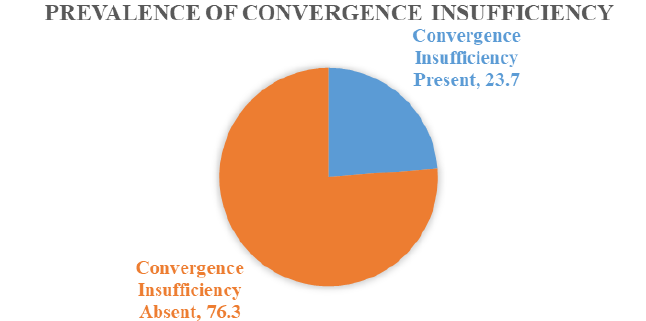
Co-ordinated binocular function is essential for comfortable near vision, and involves convergence, accommodation and sensory fusion. Prolonged near work is strongly associated with vergence dysfunction, contributing to visual eye strain. This study determined the prevalence of convergence insufficiency (CI), relationship between CI and socio-demographic characteristics, symptoms and near-work exposure among undergraduate students of the University of Benin. The cross sectional study subjects were 152 students from 14 faculties and 100–600 academic levels. Participants had near point of convergence (NPC), distance and near horizontal phoria (H) and near positive fusional vergence (PFV) assessed along with 15 item Convergence Insufficiency Symptom Survey (CISS) completed. The four criteria used to define CI were: CISS ≥21, NPC break ≥6 cm, near exophoria ≥4 prism dioptres more than distance phoria, and failure of Sheard's criterion at near. Data was analyzed descriptively, by chi-square test and Fisher's exact test, with p < .05 considered significant. Prevalence of CI was found to be 23.7%. There was no significant association (p > .05) between age, sex, faculty or academic level with CI. There was a significant association between the severity of CISS and clinical CI (χ² = 30.071, p< .001). Daily reading duration was also associated with CI (χ² = 7.164, p = .028), whereas daily digital-device use was not (χ² = 1.481, p = .477). CI was relatively common among the study population, and was associated particularly with symptom burden and reading duration. Symptom monitoring and binocular-vision evaluation can be helpful in identifying students who are affected
References
Alvarez, T., Scheiman, M., Santos, E., Morales, C., Yaramothu, C., D’Antonio-Bertagnolli, J., Biswal, B., Gohel, S., & Li, X. (2020). The Convergence Insufficiency Neuro-mechanism in Adult Population Study (CINAPS) Randomized Clinical Trial: Design, Methods, and Clinical Data. Ophthalmic Epidemiology, 27(1), 52–72. https://doi.org/10.1080/09286586.2019.1679192
Cochran, W. G. (1963). Sampling Techniques (2nd Ed). John Wiley and Sons, Inc. https://www.scirp.org/reference/ReferencesPapers?ReferenceID=1837525
Dahal, M., Kaiti, R., Shah, P., & Ghimire, R. (2021). Prevalence of Non Strabismic Binocular Vision Dysfunction among Engineering Students in Nepal. Medical and Surgical Ophthalmology Research, 3(2), MSOR.000559. https://doi.org/ 10.31031/MSOR.2021.03.000559
Darko-Takyi, C., Owusu-Ansah, A., Boampong, F., Morny, E., Hammond, F., & Ocansey, S. (2022). Convergence insufficiency symptom survey (CISS) scores are predictive of severity and number of clinical signs of convergence insufficiency in young adult Africans. Journal of Optometry, 15(3), 228–237. https://doi.org/10.1016/j.optom.2021.05.001
Emurotu, E. O., Moyegbone, E. J., Otutu, O. M., & Nwose, E. (2026). Epidemiology of binocular vision anomalies in children : a narrative review. African Scientific Reports, 5, 447. https://doi.org/10.46481/asr.2026.5.1.447
Gantz, L., & Stiebel-Kalish, H. (2022). Convergence insufficiency: Review of clinical diagnostic signs. Journal of Optometry, 15(4), 256–270. https://doi.org/10.1016/j.optom.2021.11.002
Godar, S., Khattri, J., & Timsina, L. (2025). Prevalence of Convergence Insufficiency among Young Adults presenting in the Tertiary Care Hospital: A Descriptive Cross-Sectional Study. Medical Journal of Pokhara Academy of Health Sciences, 8(2), 28–31. https://doi.org/10.70250/mjpahs216
Mohamed, Z., & Alrasheed, S. (2023). A Systematic Review and Meta-analysis of Convergence Insufficiency Prevalence and Management Options. The Open Ophthalmology Journal, 17, e187436412306231.
https://doi.org/10.2174/18743641-v17-20230712-2023-8
Moyegbone, J. E., Nwose, E., Kio, F., Agege, E., Omatsuli, T., Odoko, J., & Akuirene, O. (2023). Prevalence and Pattern of Visual Impairment among Adult Population in Mangu Local Government Area of Plateau State, Nigeria. Ophthalmology Research: An International Journal, 18(2), 18–29. https://doi.org/10.9734/or/2023/v18i2381
Ovenseri-Ogbomo, G. O., & Eguegu, O. P. (2016). Vergence findings and horizontal vergence dysfunction among first year university students in Benin City, Nigeria. Journal of Optometry, 9(4), 258–263. https://doi.org/10.1016/j.optom.2016.01.004
Pillay, P., & Munsamy, A. (2021). A review exploring convergence insufficiency in younger populations and e-devices in the digital era. African Vision and Eye Health, 80(1), a623. https://doi.org/10.4102/aveh.v80i1.623
Redondo, B., Jiménez, R., Vera, J., & Rosenfield, M. (2025). The impact of break schedules on digital eye strain symptoms and ocular accommodation during prolonged near work. Experimental Eye Research, 258, 110463. https://doi.org/10.1016/j.exer.2025.110463
Rouse, M., Borsting, E., Mitchell, G., Scheiman, M., Cotter, S., Cooper, J., Kulp, M., London, R., Wensveen, J., & Convergence Insufficiency Treatment Trial Group. (2004). Validity and reliability of the revised convergence insufficiency symptom survey in adults. Ophthalmic and Physiological Optics, 24(5), 384–390. https://doi.org/10.1111/j.1475-1313.2004.00202.x
Scheiman, M., & Wick, B. (2014). Clinical Management of Binocular Vision: Heterophoric, Accommodative and Eye Movement Disorders (4th Editio). Lippincott Williams & Wilkins.
Sharif, Z., Mirzajani, A., & Jafarzadehpur, E. (2014). Prevalence of convergence insufficiency in a population of university students. Journal of Paramedical Sciences and Rehabilitation, 3(1), 47–52. https://sid.ir/paper/245434/en
Vaishali, R., Jha, K., & Srikanth, K. (2019). Prevalence of Convergence Insufficiency between 18 and 35 Years and Its Relation to Body Mass Index. TNOA Journal of Ophthalmic Science and Research, 57(1), 27–30. https://doi.org/10.4103/tjosr.tjosr_11_1912
Wajuihian, S., & Hansraj, R. (2016). Vergence anomalies in a sample of high school students in South Africa. Journal of Optometry, 9(4), 246–257. https://doi.org/10.1016/j.optom.2015.10.006
Downloads
Published
Issue
Section
Categories
License
Copyright (c) 2026 John Esimaje Moyegbone, Praise Amarachi Obasi, Helen Omonigho Lucky-Udi, Bobby Ikponwonsa Ebuehi

This work is licensed under a Creative Commons Attribution 4.0 International License.


