
Characterisation of Air Quality and Respiratory Health Risks: A Management Framework for a Nigerian Aviation Hub
DOI:
https://doi.org/10.33003/fjs-2026-1023-6283Keywords:
Aviation Emissions, Occupational Exposure, Particulate Matter (PM₂.₅), Respiratory Morbidity, Exposure-Awareness ParadoxAbstract
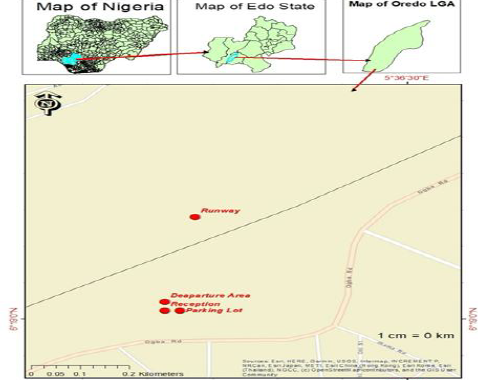
Airport operational environments generate complex emission matrices that pose severe occupational health hazards, particularly in developing nations lacking systematic surveillance frameworks. This study characterised air quality dynamics at Benin City Airport, Nigeria, and evaluated the associated respiratory health burden among personnel. A cross-sectional mixed-methods design was deployed, combining eight weeks of real-time microenvironmental monitoring (CO₂, PM₁₀, PM₂.₅) with an epidemiological survey across 129 eligible airport workers. Significant spatiotemporal variations were detected for particulate matter: the airside zone exhibited peak coarse particle concentrations (PM₁₀: 22.04 ± 0.94 µg/m³) during morning shifts and progressive fine particle accumulation (PM₂.₅) during afternoon shifts, tracking flight operational cycles. Gaseous CO₂ concentrations showed no significant spatial variations across monitoring sites. Respiratory symptom prevalence was high among workers, dominated by chronic cough (57.4%) and shortness of breath (24.0%). Multivariable logistic regression revealed an exposure-awareness paradox: personnel in high-exposure operational zones (Airside and Terminal Halls) experienced significantly higher respiratory morbidity despite reporting higher occupational safety knowledge. Unawareness of safe exposure limits was inversely associated with chronic cough (AOR = 0.38, p = 0.032). High and fluctuating particulate levels create continuous inhalation hazards for frontline personnel. Mitigating these chronic occupational risks requires optimising administrative controls, enforcing mandatory shift rotations, ensuring consistent personal protective equipment (PPE) compliance, and establishing routine environmental health surveillance frameworks.
References
Abozid, H., Patel, J., Burney, P., Hartl, S., Breyer-Kohansal, R., Mortimer, K., ... & BOLD Study Collaborators. (2024). Prevalence of chronic cough, its risk factors and population attributable risk in the Burden of Obstructive Lung Disease (BOLD) study: A multinational cross-sectional study. eClinicalMedicine, 68, 102423. https://doi.org/10.1016/j.eclinm.2024.102423
Amegah, A. K., & Agyei-Mensah, S. (2017). Urban air pollution in Sub-Saharan Africa: Time for action. Environmental Pollution, 220(Pt A), 738–743. https://doi.org/10.1016/j.envpol.2016.09.042
Aroh, R. N., Numbere, A. O., Emoyoma, U. O., & Aroh, K. (2024). Assessment of emission levels at the Port Harcourt International Airport and its environs, Omagwa, River State, Nigeria. Global Journal of Earth and Environmental Science, 9(2), 55–68. https://doi.org/10.31248/gjees2024.152
Assefa, F. G., Xiang, L., Yang, Z., Gebretsadik, A., Wahab, A., Fissha, Y., ... & Zhang, X. (2025). Research on dust concentration and migration mechanisms on open-pit coal mining roads: Effects of meteorological conditions and haul truck movements. Mining, 5(3), 43. https://doi.org/10.3390/mining5030043
Baldauf, R. (2016). Air quality near ports of entry: A review of the characterization of air pollution and its impact on health. Journal of the Air & Waste Management Association, 66(5), 445–463. https://doi.org/10.1080/10962247.2016.1147040
Bende, M., & Millqvist, E. (2012). Prevalence of chronic cough in relation to upper and lower airway symptoms; the Skövde population-based study. Frontiers in Physiology, 3, 251. https://doi.org/10.3389/fphys.2012.00251
Buonanno, G., Morawska, L., Stabile, L., & Pronk, A. (2012). Occupational exposure to ultrafine particles in an airport. Atmospheric Environment, 54, 34–42. https://doi.org/10.1016/j.atmosenv.2012.02.040
Casotti Rienda, I., Alves, C. A., Nunes, T., Soares, M., Amato, F., Sánchez de la Campa, A., ... & Moreno, T. (2023). PM₁₀ resuspension of road dust in different types of parking lots: Emissions, chemical characterisation and ecotoxicity. Atmosphere, 14(2), 305. https://doi.org/10.3390/atmos14020305
Chen, Y., Peng, C., Zhang, H., Cai, Y., Yuan, R., Song, P., ... & Li, F. (2023). Exposure to occupational risk factors is associated with the severity and progression of chronic obstructive pulmonary disease. Medicine, 102(6), e32908. https://doi.org/10.1097/MD.0000000000032908
Cochran, W. G. (1977). Sampling techniques (3rd ed.). John Wiley & Sons.
Cui, Q., Jia, Z., Liu, Y., Wang, Y., & Li, Y. (2024). 24-hour average PM₂.₅ concentration caused by aircraft in Chinese airports from Jan. 2006 to Dec. 2023. Scientific Data, 11(1), 284. https://doi.org/10.1038/s41597-024-03110-9
Ede, P. N., & Edokpa, D. O. (2015). Regional air quality of the Nigeria's Niger Delta. Open Journal of Air Pollution, 4(1), 7–15. https://doi.org/10.4236/ojap.2015.41002
Eghomwanre, A. F., & Oguntoke, O. (2022). Concentrations of indoor gaseous air pollutants and risk factors associated with childhood asthma in Benin City, Nigeria. Environmental Monitoring and Assessment, 194(5), 391. https://doi.org/10.1007/s10661-022-10041-3
Eghomwanre, A. F., Oguntoke, O., & Imarhiagbe, E. E. (2024). Indoor air emissions and risk factors associated with asthma-related symptoms among children in peri-urban areas of Benin City, Nigeria. Ethiopian Journal of Environmental Studies and Management, 17(2), 370–387. https://doi.org/10.4314/ejesm.v17i2.11
Eghomwanre, A. F., Oguntoke, O., Taiwo, A. M., & Ukpebor, E. E. (2022). Air pollutant concentrations and health risk assessment around residential areas in Benin City, Nigeria. Journal of Materials and Environmental Science, 13(9), 1081–1100.
Elechi, C. E., & Chibuzor, C. (2020). Implication of aircraft noise on workers in Port Harcourt International Airport Omuagwa Rivers State. World Journal of Innovative & Modern Technology, 3(1), 39–47.
Greenstone, M., & Hasenkopf, C. (2021). The Air Quality Life Index (AQLI) annual report. Energy Policy Institute at the University of Chicago. https://aqli.epic.uchicago.edu/reports/
International Conference on Prevention & Infection Control (ICPIC). (2019). Abstracts from the 5th International Conference on Prevention & Infection Control (ICPIC 2019): Geneva, Switzerland. 10-13 September 2019. Antimicrobial Resistance & Infection Control, 8(Suppl 1), 148. https://doi.org/10.1186/s13756-019-0567-6
Karagkouni, A., Zantanidis, S., Moutzouri, A., Sartzetaki, M., Constantinidis, T., & Dimitriou, D. (2025). Assessment of occupational health and safety performance in air traffic control: An empirical investigation of stress and well-being. Safety, 11(3), 88. https://doi.org/10.3390/safety11030088
Lelieveld, J., Evans, J. S., Fnais, M., Giannadaki, D., & Pozzer, A. (2015). The contribution of outdoor air pollution sources to premature mortality on a global scale. Nature, 525(7569), 367–371. https://doi.org/10.1038/nature15371
Newby, D. E., Mannucci, P. M., Tell, G. S., Baccarelli, A. A., Brook, R. D., Donaldson, K., ... & Blomberg, A. (2015). Expert position paper on air pollution and cardiovascular disease. European Heart Journal, 36(2), 83–93. https://doi.org/10.1093/eurheartj/ehu458
Orikpete, O. F., Dennis, N. M., Kikanme, K. N., & Ewim, D. R. E. (2024). Advancing noise management in aviation: Strategic approaches for preventing noise-induced hearing loss. Journal of Environmental Management, 363, 121413. https://doi.org/10.1016/j.jenvman.2024.121413
Otu, E., Obia, A., Oyetunji, A., & Eja, T. (2026). Understanding perceptions, behaviours, and population exposure risks to air pollution in a high-activity urban corridor in Nigeria. Sustainable Environment, 12(1), 2652166. https://doi.org/10.1080/27658511.2026.2652166
Pfleger, E., Drexler, H., & Lutz, R. (2024). Health literacy and environmental risks focusing air pollution: Results from a cross-sectional study in Germany. International Journal of Environmental Research and Public Health, 21(3), 366. https://doi.org/10.3390/ijerph21030366
Priolo, G., Vignoli, M., & Nielsen, K. (2025). Risk perception and safety behaviors in high-risk workers: A systematic literature review. Safety Science, 186, 106811. https://doi.org/10.1016/j.ssci.2025.106811
Ramadan, I. M. I., Ali, A. T. A., Tosti, F., Bakry, H. M., & Shaaban, I. G. (2022). An investigation into the impact of airport operations on ambient air quality: The case study of Sphinx International Airport (Technical Report). Ibrahim G. Shaaban's Lab. https://repository.uwl.ac.uk/id/eprint/9457/
Touri, L., Marchetti, H., Sari-Minodier, I., Molinari, N., & Chanez, P. (2013). The airport atmospheric environment: Respiratory health at work. European Respiratory Review, 22(128), 124–130. https://doi.org/10.1183/09059180.00005712
Ucheje, O. O., & Ofoezie, I. E. (2025). Assessment of air pollutant concentration levels in high and low traffic density areas in urban city: A case of Port Harcourt, Nigeria. Journal of Environmental Treatment Techniques, 13(1), 1–27. https://doi.org/10.18502/jett.v13i1.18078
Wood, E., Herndon, S., Miake-Lye, R., Nelson, D., & Seeley, M. (2007). Aircraft and airport-related hazardous air pollutants: Research needs and analysis (ACRP Report 7). Transportation Research Board.
World Health Organization (WHO). (2021). WHO global air quality guidelines: Particulate matter (PM₂.₅ and PM₁₀), ozone, nitrogen dioxide, sulfur dioxide and carbon monoxide. World Health Organization. https://apps.who.int/iris/handle/10665/345329
Yang, X., Chung, K. F., & Huang, K. (2023). Worldwide prevalence, risk factors and burden of chronic cough in the general population: A narrative review. Journal of Thoracic Disease, 15(4), 2300–2313. https://doi.org/10.21037/jtd-22-1435
Zhang, K., & Batterman, S. (2013). Air pollution and health risks in airport environments. Current Environmental Health Reports, 1(1), 13–27. https://doi.org/10.1007/s40572-013-0003-3
Downloads
Published
Issue
Section
Categories
License
Copyright (c) 2026 Aimuanmwosa Frank Eghomwanre, Oghosa Godsown Osabumwenre

This work is licensed under a Creative Commons Attribution 4.0 International License.


