
Nutritional Composition and Chemical Contaminants in Tapioca Processed Near Gas-Flare Sites in the Niger Delta, Nigeria
DOI:
https://doi.org/10.33003/fjs-2026-1024-6287Keywords:
Tapioca, Gas flare sites, Nutritional quality, Potentially toxic metals, Volatile organic compoundsAbstract
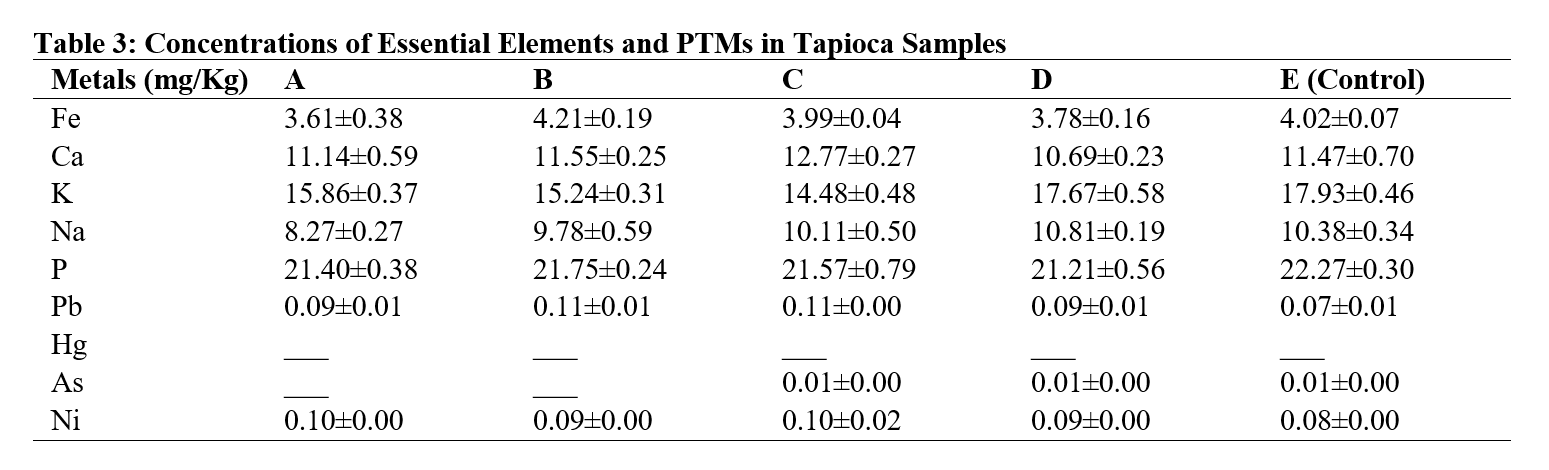
This study investigated the influence of gas flaring on selected potentially toxic metals (PTMs) and volatile organic compounds (VOCs) in tapioca processed in flare-impacted environments of the Niger Delta, Nigeria. Samples collected from gas-flaring locations and a non-flare-exposed control site were analyzed for mineral composition, PTMs, proximate properties, cyanide, vitamin C, and VOCs using standard analytical methods. Results showed significant differences in moisture, protein, ash, carbohydrate, cyanide, crude fibre, and vitamin C, while pH showed no significant difference. Mineral concentrations exhibited low variability, with Fe (3.61–4.21 mg/kg), Ca (10.69–12.77 mg/kg), K (14.48–17.93 mg/kg), Na (8.27–10.81 mg/kg), and P (21.21–22.27 mg/kg), showing no consistent elevation in flare-exposed samples. Lead concentrations ranged from 0.07 to 0.11 mg/kg. Lead concentrations near regulatory limits raise concerns about chronic exposure. Mercury was undetectable, whereas arsenic (≤0.01 mg/kg) and nickel (0.08–0.10 mg/kg) were within acceptable safety limits. The concentrations of VOC were below 0.002 mg/kg in each sample. The findings indicate that gas flaring has minimal influence on macro-mineral composition but may contribute to localized lead enrichment, potentially through atmospheric deposition during open-air drying. Controlled drying systems, enhanced environmental monitoring, and further research integrating soil–air–plant interactions and exposure assessment models are recommended to minimize contamination risks.
References
Adepoju, O. T., Adekola, Y. G., Mustapha, S. O., & Ogunola, S. I. (2010). Effect of processing methods on nutrient retention and contribution of cassava (Manihot spp) to nutrient intake of Nigerian consumers. African Journal of Food, Agriculture, Nutrition and Development, 10(2), 2060-2076. https://doi.org/10.4314/ajfand.v10i2.53353
Alamu, E. O., Maziya-Dixon, B., & Dixon, A. G. (2015). Effect of processing on the retention of total carotenoid, iron and zinc contents of yellow-fleshed cassava roots. Journal of Food and Nutrition Research, 3(8), 483-488. https://doi.org/10.12691/jfnr-3-8-2
Bakwanamaha, R., Buzera, A., Mondo, J. M., Eka, C., Kondo, V., Mugenga, V., Musungayi, E., Sikirou, R., Abass, A., & Adebowale, A. A. (2026). Physicochemical, biochemical, and functional characterization of improved cassava varieties resistant to cassava brown streak disease. Frontiers in Sustainable Food Systems, 10, 1980809. https://doi.org/10.3389/fsufs.2026.1980809
Bamgbose, A., Bello, T. K., & Adeboye, A. S. (2011). Quality characteristic of tapioca from delayed processed cassava. Journal of Agriculture and Veterinary Sciences, 3(1), 1-10.
Chauynarong, N., Elangovan, A. V., & Iji, P. A. (2009). The potential of cassava products in diets for poultry. World's Poultry Science Journal, 65 (1), 23-36. https://doi.org/10.1017/S0043933909000026
Chisenga, S. M., Workneh, T. S., Bultosa, G., & Alimi, B. A. (2019). Proximate composition, cyanide content, and carotenoid retention after boiling of provitamin A-rich cassava grown in Ghana. Foods, 8(9), 380. https://doi.org/10.3390/foods8090380
Connell, D. W. (1990). Bioaccumulation of xenobiotic compounds. CRC Press.
Emoyan, O.O., Akporhonor, E.E., Otobrise, C. (2015). Comparative correlation investigation of polynuclear aromatic hydrocarbons (PAHs) in soils of different land use: Sources Evaluation Perspective. International Journal of Environmental and Ecological Engineering, 9 (9), 1175 – 1180. https://doi.org/10.5281/zenodo.1110005
Enyoh, C. E., Wang, Q., Rabin, M. H., Bakare, R. O., Dadiel, J. L., Shangrong, W., Lu, S., & Ilechukwu, I. (2023). Preliminary characterization and probabilistic risk assessment of microplastics and potentially toxic elements (PTEs) in garri (cassava flake), a common staple food consumed in West Africa. Environmental Analysis Health and Toxicology, 38(1), e2023005. https://doi.org/10.5620/eaht.2023005
FAO. (2013). Save and Grow: Cassava - A guide to sustainable production intensification. Food and Agriculture Organization of the United Nations, Rome.
Gobas, F.A. P. C., & Morrison, H. A. (2000). Bioconcentration and biomagnification in the aquatic environment. In R. Boethling & D. Mackay (Eds.), Handbook of property estimation methods for chemicals: Environmental and health sciences (pp. 189-231). Lewis Publishers.
Ite, A.E. & Ibok, U.J. (2019). Role of plants and microbes in bioremediation of petroleum hydrocarbons contaminated soils. Journal of Food and Nutrition Research, 7(1):1-19. https://doi.org/10.12691/ijebb-7-1-1
Newman, M. C. (2014). Fundamentals of ecotoxicology: The science of pollution (4th ed.). CRC Press.
Okareh, O. T., Fawehinmi, H. B., & Aladekomo, I. (2021). Exposure to air pollutants and heat stress among resource-poor women entrepreneurs in small-scale cassava processing. Environmental Health Insights, 15, 11786302211059377. https://doi.org/10.1007/s10661-019-7811-7
Otobrise, C., Onoabedje, U.C. & Edward, B.A. (2024). Characterisation of essential nutrients in tapioca processed by heat from gas flare sites. Nigerian Journal of Pure and Applied Science, 37, (2) 5029-5037. https://doi.org/10.48198/NJPAS/24.A09
Sanni, L. O., Maziya-Dixon, B., Akanya, J., Okoro, C. I., Alaya, Y., Egwuonwu, C. V., Okechukwu, R. U., Ezedinma, C., Akoroda, M., Lemchi, J., Ogbe, F., Okoro, E., Tarawali, G., Mkumbira, J., Patino, M., Ssemakula, G., & Dixon, A. (2005). Standards for cassava products and guidelines for export. International Institute of Tropical Agriculture (IITA), Ibadan, Nigeria.
Standards Organisation of Nigeria. (1988). Nigerian Industrial Standard NIS 181:1988 - Standard for gari. Federal Ministry of Industries, Lagos, Nigeria.
Sule, S., Offiah, V. O., & Orjime, K. S. (2017). Chemical composition of chips from selected cassava varieties in Makurdi, Benue State. Journal of Food and Nutrition Research, 5(12), 909-912. https//:doi.org//10.22259/2637-5583.0101005
U.S. Environmental Protection Agency. (2010). Bioaccumulation testing and interpretation for the purpose of sediment quality assessment. EPA/823/R-10/002. Washington, DC: U.S. EPA.
Uche, C. A., Nwosu, U. L., Okunola, O. R., & Okafor, C. H. (2024). Levels of polycyclic aromatic hydrocarbons in cassava and cocoyam flour commercially sold in Anambra State Nigeria. International Journal of Research and Scientific Innovation, 11(7), 1141-1154.
United States Environmental Protection Agency. (2003). Integrated Risk Information System (IRIS) - Benzene (CASRN 71-43-2) Chemical Assessment Summary. National Center for Environmental Assessment, Washington, DC: U.S. EPA. https://iris.epa.gov/ChemicalLanding/&substance_nmbr=276
United States Environmental Protection Agency. (2005). Integrated Risk Information System (IRIS) - Toluene (CASRN 108-88-3) Chemical Assessment Summary. National Center for Environmental Assessment, Washington, DC: U.S. EPA. https://iris.epa.gov/ChemicalLanding/&substance_nmbr=118
World Health Organization. (2021). Lead poisoning. Fact Sheet, 11 October 2021.
World Health Organization. (2021a). Exposure to lead: a major public health concern, 2nd edition: Preventing disease through healthy environments (ISBN: 9789240037656).
World Health Organization.World Health Organization. (2021b). Human health effects of benzene, arsenic, cadmium, nickel, lead and mercury: report of an expert consultation. WHO Regional Office for Europe.
Downloads
Published
Issue
Section
Categories
License
Copyright (c) 2026 Charles Otobrise, Beatrice Peretiemo-Clarke, Stephen Oghoje, Aghogho Francis Eruemrejovwo, Nkechi Ogwu, Emmanuel Rotimi Enebeli

This work is licensed under a Creative Commons Attribution 4.0 International License.


