
Effect of Drying Techniques on the Physicochemical Properties and Curcumin Content of Curcuma longa
DOI:
https://doi.org/10.33003/fjs-2026-1021-6289Keywords:
Turmeric, Curcumin, Drying methods, Energy value, Proximate composition, ANOVA, Curcuma longaAbstract
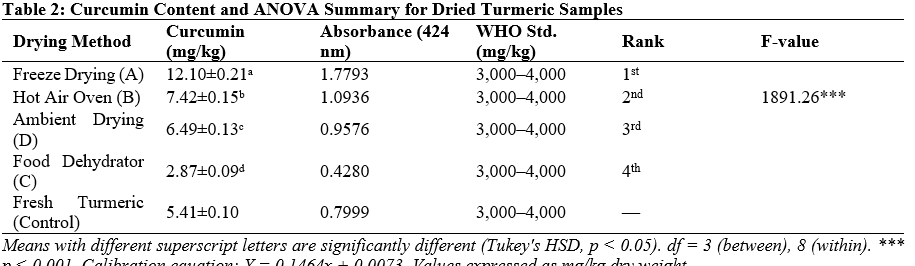
This study evaluates the effects of four drying techniques freezing drying hot air oven drying, food dehydrator drying and ambient (room temperature) drying on physicochemical properties, energy value and curcumin content of curcuma longa (turmeric). fresh turmeric rhizomes were sourced from Kagarko Local Government Area, Kaduna State, Nigeria. standard AOAC methods were used to determine moisture content, crude protein, crude lipid, ash content, crude fiber, carbohydrate content and curcumin content. metabolizable energy was calculated using Atwater conversion factors. one-way ANOVA with Turkey's post hoc test (p < 0.05) was applied to all parameters. results showed significant difference (p < 0.001) across all parameters. freeze drying produced the lowest energy value (313.84 kcal/100g) but the highest curmin content (12.10 mg/kg). the food dehydrator yield the highest energy value (342.21 kcal/100g) but the lowest curmin (2.87 mg/kg). all moisture values fell within the WHO limit of 13.10%. freeze drying is recommended as the superior method for preserving the bioactive quality of turmeric.
References
Abdi, H., & Williams, L. J. (2010). Newman-Keuls test and Tukey test. Encyclopedia of Research Design, 2, 897–902. https://doi.org/10.4135/9781412961288
Ahmad, R. S., Hussain, M. B., Sultan, M. T., Arshad, M. S., Waheed, M., Shariati, M. A., Plygun, S., & Hashempur, M. H. (2020). Biochemistry, safety, pharmacological activities, and clinical applications of turmeric: A mechanistic review. Evidence-Based Complementary and Alternative Medicine, 2020, Article 8072865. https://doi.org/10.1155/2020/8072865
Ali, A., Ali, A., Tahir, A., & Bakht, M. (2021). Molecular engineering of curcumin, an active constituent of Curcuma longa L. of the family Zingiberaceae with improved antiproliferative activity. Plants, 10(8), 1559. https://doi.org/10.3390/plants10081559
Anandaraj, M., & Sudharshan, M. (2011). Cardamom, ginger and turmeric. In Encyclopedia of Life Support Systems (EOLSS): Soils, plant growth and crop production. EOLSS Publishers.
AOAC. (1990). Official methods of analysis of the Association of Official Analytical Chemists (15th ed.). AOAC International.
Chattopadhyay, I., Biswas, K., Bandyopadhyay, U., & Banerjee, R. (2003). Turmeric and curcumin: Biological actions and medicinal applications. Current Science, 87(1), 44–53.
Enemor, V. H. A., Ogbodo, U. C., Nworji, O. F., Ezeigwe, O. C., Okpala, C. O., & Iheonunekwu, G. C. (2020). Evaluation of the nutritional status and phytomedicinal properties of dried rhizomes of turmeric (Curcuma longa). Journal of Biosciences and Medicines, 8(8), 163–179. https://doi.org/10.4236/jbm.2020.88015
FAO. (2003). Food energy: Methods of analysis and conversion factors (FAO Food and Nutrition Paper No. 77). Food and Agriculture Organization of the United Nations.
Fernando, A. J., Gunathunga, C., Brumm, T., & Amaratunga, S. (2021). Drying turmeric (Curcuma longa L.) using far-infrared radiation: Drying characteristics and process optimization. Journal of Food Process Engineering, 44(9), e13780. https://doi.org/10.1111/jfpe.13780
Hirun, S., Utama-ang, N., & Roach, P. D. (2014). Turmeric (Curcuma longa L.) drying: An optimization approach using microwave-vacuum drying. Journal of Food Science and Technology, 51(9), 2127–2133. https://doi.org/10.1007/s13197-012-0709-9
Horwitz, R., & Muller, D. (2010). Integrative rheumatology. Oxford University Press.
Ikpeama, A., Onwuka, G., & Nwankwo, C. (2014). Nutritional composition of turmeric (Curcuma longa) and its antimicrobial properties. International Journal of Scientific and Engineering Research, 5(10), 1085–1089.
Kadam, P. V., Yadav, K. N., Bhingare, C. L., & Patil, M. J. (2018). Standardization and quantification of curcumin from Curcuma longa extract using UV visible spectroscopy and HPLC. Journal of Pharmacognosy and Phytochemistry, 7(5), 1913–1918.
Kocaadam, B., & Şanlier, N. (2017). Curcumin, an active component of turmeric (Curcuma longa), and its effects on health. Critical Reviews in Food Science and Nutrition, 57(13), 2889–2895. https://doi.org/10.1080/10408398.2015.1077195
Llano, S. M., Gómez, A. M., & Duarte-Correa, Y. (2022). Effect of drying methods and processing conditions on the quality of Curcuma longa powder. Processes, 10(4), 702. https://doi.org/10.3390/pr10040702
Longvah, T., Ananthan, I., Bhaskarachary, K., & Venkaiah, K. (2017). Indian food composition tables. National Institute of Nutrition, Indian Council of Medical Research.
Merrill, A. L., & Watt, B. K. (1973). Energy value of foods: Basis and derivation (Agriculture Handbook No. 74). United States Department of Agriculture.
Mishra, S., & Goel, B. (2020). Pharmaceutical and nutritional properties of turmeric (Curcuma longa): A mini review. Advances in Zoology and Botany, 8(3), 83–86. https://doi.org/10.13189/azb.2020.080301
Prathapan, A., Lukhman, M., Arumughan, C., Sundaresan, A., & Raghu, K. (2009). Effect of heat treatment on curcuminoid, colour value and total polyphenols of fresh turmeric rhizome. International Journal of Food Science & Technology, 44(7), 1438–1444. https://doi.org/10.1111/j.1365-2621.2009.01975.x
Raza, A., Ali, A., Yusof, Y., Awan, A., & Muneer, S. (2018). Effect of different drying treatments on concentration of curcumin in raw Curcuma longa L. Food Research, 2(6), 500–504. https://doi.org/10.26656/fr.2017.2(6).109
Sharma, S., Dhalsamant, K., Tripathy, P. P., & Manepally, R. K. (2021). Quality analysis and drying characteristics of turmeric (Curcuma longa L.) dried by hot air and direct solar dryers. LWT – Food Science and Technology, 138, 110687. https://doi.org/10.1016/j.lwt.2020.110687
Udo, E., & Oguwele, J. (1986). Laboratory manual for analysis of soil, plant and water samples (3rd ed.). Department of Crop Production, University of Ilorin.
Yadav, R. P., & Tarun, G. (2017). Versatility of turmeric: A review — the golden spice of life. Journal of Pharmacognosy and Phytochemistry, 6(1), 41–46.
Downloads
Published
Issue
Section
Categories
License
Copyright (c) 2026 Muazu Bashir, Habiba Abdullahi

This work is licensed under a Creative Commons Attribution 4.0 International License.


