
Sub-Acute Oral Toxicity of Aqueous Extract of Fresh Leaves of Calotropis Procera in Wistar Rats: Biochemical and Histopathological Evaluation
DOI:
https://doi.org/10.33003/fjs-2026-1024-6290Keywords:
Calotropis Procera, Aqueous Extract, Sub-Acute Toxicity, Biochemical Parameters, Nephrotoxicity, Wistar RatsAbstract
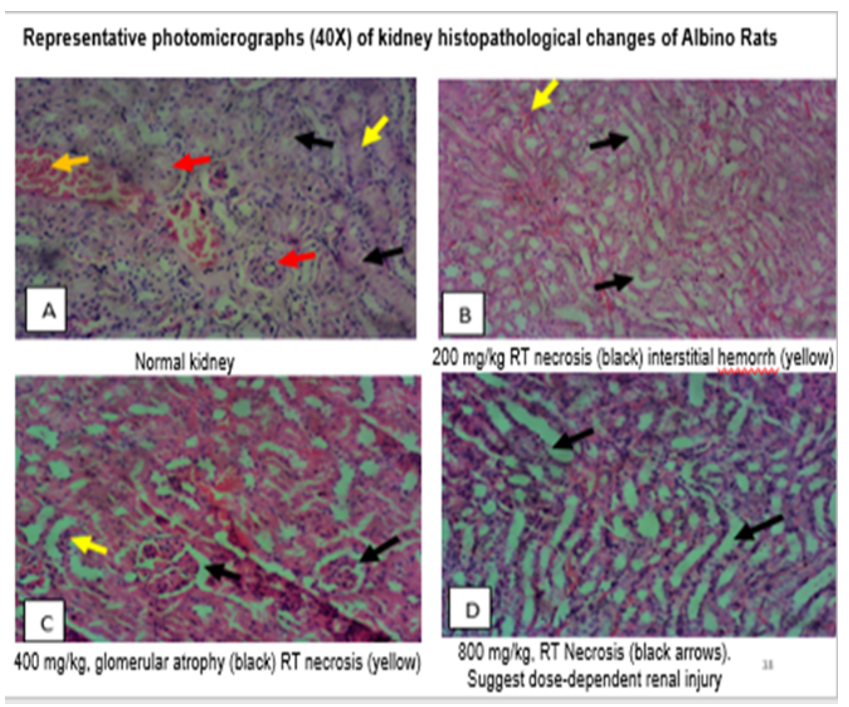
Calotropis procera is a drought-tolerant medicinal plant with recognized toxic potential. This study evaluated biochemical and histopathological changes following repeated oral administration of its aqueous fresh leaf extract in Wistar rats. Fresh leaves were collected from the University of Maiduguri campus, authenticated by a taxonomist, processed, and extracted by aqueous decoction. Sixteen Wistar rats were divided into four groups (n = 4). The control received no extract, while treatment groups received 200, 400, or 800 mg/kg body weight orally once daily for 21 days. Serum alanine aminotransferase (ALT), aspartate aminotransferase (AST), alkaline phosphatase (ALP), urea, creatinine, total protein, and albumin were assessed. The liver, kidneys, lungs, heart, stomach, and brain were examined histopathologically. AST increased from 6.3 ± 0.7 U/L in controls to 8.0 ± 0.6 U/L at 800 mg/kg, while ALT increased from 6.3 ± 0.9 to 8.0 ± 0.0 U/L. ALP increased dose-dependently from 43.7 ± 8.0 to 88.3 ± 0.9 U/L. At 800 mg/kg, urea, total protein, and albumin decreased significantly, whereas creatinine remained relatively unchanged. Histopathological findings included renal tubular necrosis, glomerular atrophy, hepatocellular necrosis, pulmonary lesions, cardiac nuclear degeneration and necrosis, and gastric mucosal injury, generally more severe at higher doses. Mild cerebral oedema occurred at 800 mg/kg. Despite limited changes in some biochemical indices, repeated administration caused histopathological alterations in multiple organs. These findings highlight the limitations of biochemical parameters alone in detecting tissue injury and warrant caution regarding prolonged oral use of C. procera leaf preparations.
References
Ahmad, H., Al-Zuhairi, A., Khalaf, J. M., & Ibrahim, S. N. (2020). Toxicological effects of aqueous extract of Calotropis procera leaves in experimentally poisoned rabbits. Iraqi Journal of Veterinary Medicine, 44(1): 46–56.
Al-Taweel, A. M., Perveen, S., Fawzy, G. A., Rehman, A. U., Khan, A., Mehmood, R., & Fadda, L. M. (2017). Evaluation of antiulcer and cytotoxic potential of the leaf, flower, and fruit extracts of Calotropis procera and isolation of a new lignan glycoside. Evidence-Based Complementary and Alternative Medicine, 2017: Article 8086791. https://doi.org/10.1155/2017/8086791.
Chambers, J. K., Watanabe, K., Michishita, M., Hatai, H., Tanaka, Y., Doge, S., Ochiai, K., Kato, S., Goto-Koshino, Y., Tanaka, M., & Izawa, T. (2025). Standardization of tissue handling in veterinary pathology: How fixation affects morphological and molecular examination results. Veterinary Pathology, 62(6): 949–962. https://doi.org/10.1177/03009858251349126.
De Lima, J. M., de Freitas, F. J. C., Amorim, R. N. L., Câmara, A. C. L., Batista, J. S., & Soto-Blanco, B. (2011). Clinical and pathological effects of Calotropis procera exposure in sheep and rats. Toxicon, 57(1): 183–185.
Egbung, J. E., Bassey, S. O., Ukam, C. I. O., Agiang, M. A., & Egbung, G. E. (2025). Effect of fresh palm oil and short time repeatedly heated palm oil on hepato-renal functions in Wistar rats. Journal of the Chemical Society of Nigeria, 50(4): 872–887. https://doi.org/10.4314/jcsn.v50i4.14.
El Badwi, S. M. A., & Bakhiet, A. O. (2010). Toxicity of Calotropis procera latex in pregnant and non-pregnant goats. Scientific Research and Essays, 5(17): 2404–2408. https://doi.org/10.5897/SRE.9000960.
Habeeb, A., Ramesh, S., & Shanmugam, R. (2024). Calotropis procera and the pharmacological properties of its aqueous leaf extract: A review. Cureus, 16(5): e60354. https://doi.org/10.7759/cureus.60354.
Hussaini, S., Turaki, A. A., Shemishere, U. B., Jamilu, B. D., Shamsudeen, A., & Abdulmalik, A. (2025). Curative effects of Neptunia oleracea hydroethanol leaf extract on gentamicin-induced liver and kidney oxidative stress in Wistar rats. Sahel Journal of Life Sciences FUDMA, 3(4): 147–157. https://doi.org/10.33003/sajols-2025-0304-18.
Jato, D. M., Jacob, K. A., Zainab, A., Okewole, P., Atiku, A., Shamaki, D., Umar, M. B., & Chudy, N. (2016). Histopathological changes in female rabbits administered with aqueous extract of Calotropis procera. African Journal of Biotechnology, 15(12): 458–464. https://doi.org/10.5897/AJB2010.1155.
Mahmoud, O. M., Adam, S. E. I., & Tartour, G. (1979). The effects of Calotropis procera on small ruminants: I. Effects of feeding sheep with the plant. Journal of Comparative Pathology, 89(2): 241–250. https://doi.org/10.1016/0021-9975(79)90063-X.
Mohammed, A., Ibrahim, S. I., & Bilbis, L. S. (2012). Toxicological investigation of aqueous leaf extract of Calotropis procera (Ait.) R. Br. in Wistar albino rats. African Journal of Biochemistry Research, 6(7): 90–97.
National Institute of Environmental Health Sciences (NIEHS). (2023). Anatomic pathology: Specifications for the conduct of toxicity studies by the Division of Translational Toxicology. In NTP Nonclinical Studies. National Center for Biotechnology Information. Access publication.
Organisation for Economic Co-operation and Development (OECD). (2025). Test No. 407: Repeated dose 28-day oral toxicity study in rodents. OECD Guidelines for the Testing of Chemicals, Section 4. OECD Publishing, Paris. https://doi.org/10.1787/9789264070684-en.
Pouokam, G. B., Ahmed, H., Dawurung, C., Atiku, A., Shamaki, D., & Okewole, P. (2011). Influence of age on sub-chronic toxicity of the aqueous extract of the leaves of Calotropis procera on rabbits. Journal of Toxicology and Environmental Health Sciences, 3(5): 119–126. https://doi.org/10.5897/JTEHS.9000044.
Sarkodie, J. A., Amponsah, S. K., Kitcher, C., Sackeyfio, A. C., Kwapong, A. A., N’guessan, B. B., Acheampong, M. B., Allotey-Babington, L., & Asiedu-Gyekye, I. J. (2022). Potential hepatic dysfunction associated with the use of the leaf and latex extracts of Calotropis procera W. T. Aiton (Asclepiadaceae) in Sprague-Dawley rats: An acute toxicity study. Current Topics in Toxicology, 18: 45–56.
Singh, Y., & Kaushik, M. (2023). Toxicological evaluation of Calotropis procera (CALP) in Wistar rats: Acute and sub-acute studies. Revista Electrónica de Veterinaria, 24(3): 650–658. https://doi.org/10.69980/redvet.v24i3.2153.
Wadhwani, B. D., Mali, D., Vyas, P., Nair, R., & Khandelwal, P. (2021). A review on phytochemical constituents and pharmacological potential of Calotropis procera. RSC Advances, 11: 35854–35878. https://doi.org/10.1039/D1RA06703F.
World Health Organization. (2025, November 28). Traditional medicine. World Health Organization. https://www.who.int/news-room/questions-and-answers/item/traditional-medicine
Downloads
Published
Issue
Section
Categories
License
Copyright (c) 2026 Isuwa Bitrus Kashimbe, Ayuba David Telta, Karagama Parnda Gadzama, Emmanuel Oluwasegun Adawaran, Bukar Umaru, Emmanuel Solomon Musa, Mohammed Hassan Gusi, Mohammed Shuaibu Auwal, Shamaki, Mohammed Bashir Tijani, Aliu Yahaya Gwoikura

This work is licensed under a Creative Commons Attribution 4.0 International License.


