
Mathematical Modelling of Lifestyle Behaviour and Diabetes Progression Dynamics
DOI:
https://doi.org/10.33003/fjs-2026-1024-6291Keywords:
Diabetes mellitus, Lifestyle behaviour adoption, Mathematical modelling, , Basic Reproduction Number, Local stability, Sensitivity analysis, MATLABAbstract
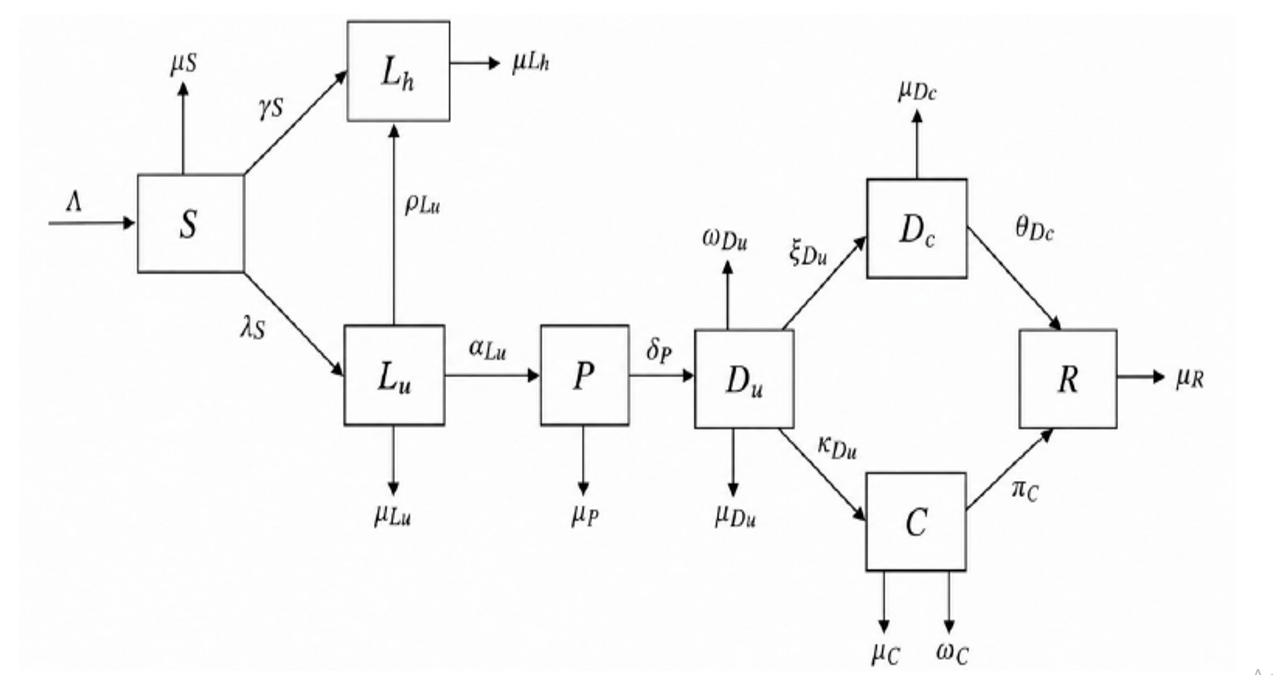
This study develops an eight-compartmental deterministic mathematical model to examine how the social adoption of unhealthy lifestyle behaviour influences the progression of diabetes mellitus in a population. Diabetes itself is not transmitted; the transmissible process in the model is the adoption of unhealthy lifestyle behaviour. The model comprises susceptible, unhealthy-lifestyle, healthy-lifestyle, prediabetic, undiagnosed, controlled, complicated and recovered classes. Positivity and boundedness of solutions are established, and the Disease-Free and Endemic Equilibria are obtained. The Basic Reproduction Number, interpreted as a behavioural-adoption threshold, is derived using the Next Generation Matrix, and the local asymptotic stability of the Disease-Free Equilibrium is established by Jacobian analysis when R0 < 1. The numerical parameter values are assumed illustrative values and are not estimates from a specific population. At the baseline parameter set, R0 = 2.833, indicating persistence of unhealthy-lifestyle adoption in the model. Sensitivity analysis identifies β as the strongest positive driver, followed by μ, while γ, α and ρ reduce R0. MATLAB simulations illustrate a larger unhealthy-lifestyle burden at higher adoption rates and a substantial reduction under increased awareness and lifestyle modification. The results are qualitative and theoretical, although it supports prevention, awareness, early diagnosis and sustained healthy-lifestyle promotion as important components of diabetes control but calibration and validation against observed data are needed before they can inform public-health practice.
References
American Diabetes Association Professional Practice Committee. (2023). 2. Classification and diagnosis of diabetes: Standards of care in diabetes—2023. Diabetes Care, 46(Supplement_1), S19–S40. https://doi.org/10.2337/dc23-S002
Boutayeb, A., & Chetouani, A. (2006). A critical review of mathematical models and data used in diabetology. BioMedical Engineering OnLine, 5, Article 43. https://doi.org/10.1186/1475-925X-5-43
Brauer, F., Castillo-Chavez, C., & Feng, Z. (2019). Mathematical models in epidemiology. Springer. https://doi.org/10.1007/978-1-4939-9828-9
Christakis, N. A., & Fowler, J. H. (2007). The spread of obesity in a large social network over 32 years. New England Journal of Medicine, 357(4), 370–379. https://doi.org/10.1056/NEJMsa066082
Ejima, K., Aihara, K., & Nishiura, H. (2013). Modeling the obesity epidemic: Social contagion and its implications for control. Theoretical Biology and Medical Modelling, 10, Article 17. https://doi.org/10.1186/1742-4682-10-17
Hu, F. B. (2011). Globalization of diabetes: The role of diet, lifestyle, and genes. Diabetes Care, 34(6), 1249–1257. https://doi.org/10.2337/dc11-0442
International Diabetes Federation. (2021). IDF diabetes atlas (10th ed.). https://diabetesatlas.org
Kouidere, A., Khajji, B., Balatif, O., & Rachik, M. (2021). A multi-age mathematical modeling of the dynamics of population diabetics with effect of lifestyle using optimal control. Journal of Applied Mathematics and Computing, 67(1–2), 375–403. https://doi.org/10.1007/s12190-020-01474-w
Kouidere, A., Labzai, A., Ferjouchia, H., Balatif, O., & Rachik, M. (2020). A new mathematical modeling with optimal control strategy for the dynamics of population of diabetics and its complications with effect of behavioral factors. Journal of Applied Mathematics, 2020, Article 1943410. https://doi.org/10.1155/2020/1943410
LaSalle, J. P. (1976). The stability of dynamical systems. Society for Industrial and Applied Mathematics. https://doi.org/10.1137/1.9781611970432
Ogurtsova, K., Guariguata, L., Barengo, N. C., Ruiz, P. L. D., Sacre, J. W., Karuranga, S., Sun, H., Boyko, E. J., & Magliano, D. J. (2022). IDF diabetes atlas: Global estimates of undiagnosed diabetes in adults for 2021. Diabetes Research and Clinical Practice, 183, Article 109118. https://doi.org/10.1016/j.diabres.2021.109118
Tabák, A. G., Herder, C., Rathmann, W., Brunner, E. J., & Kivimäki, M. (2012). Prediabetes: A high-risk state for diabetes development. The Lancet, 379(9833), 2279–2290. https://doi.org/10.1016/S0140-6736(12)60283-9
van den Driessche, P., & Watmough, J. (2002). Reproduction numbers and sub-threshold endemic equilibria for compartmental models of disease transmission. Mathematical Biosciences, 180(1–2), 29–48. https://doi.org/10.1016/S0025-5564(02)00108-6
World Health Organization. (2023). Diabetes [Fact sheet]. https://www.who.int/news-room/fact-sheets/detail/diabetes
Downloads
Published
Issue
Section
Categories
License
Copyright (c) 2026 Abdurrahman, Ayomide Jude Solomon, Adebayo Azeez Aderibigbe, Somma

This work is licensed under a Creative Commons Attribution 4.0 International License.


