
Toxicity and Developmental Biomarker Profiles of Lead, Chromium, Cadmium and Ternary Mixture in Xenopus Tropicalis
DOI:
https://doi.org/10.33003/fjs-2026-1024-6295Keywords:
Amphibian ecotoxicology, Biomarker, Heavy metals, Metal mixture, Oxidative stress, Xenopus TropicalisAbstract
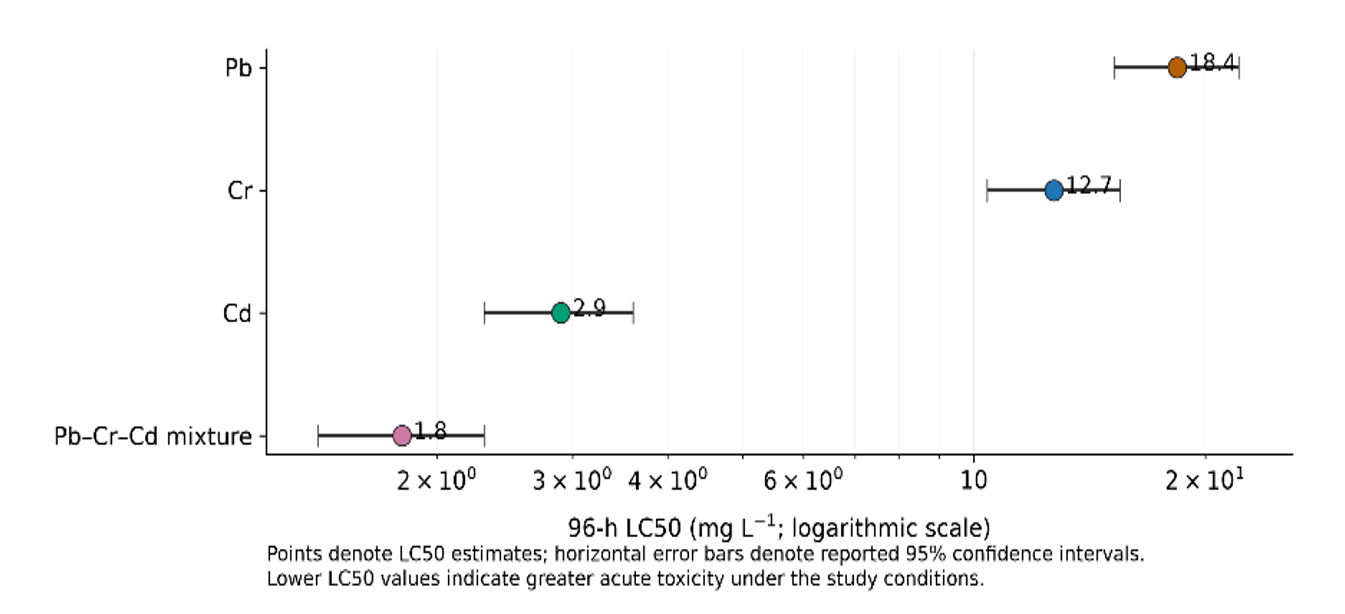
Lead (Pb), chromium (Cr), and cadmium (Cd) are metal contaminants of concern in amphibian habitats, yet developmental evidence for their combined effects in Xenopus tropicalis remains limited. This study compared 96h acute toxicity and developmental biomarker profiles following exposure to Pb, Cr, Cd, and Pb-Cr-Cd mixture. Tadpole, late larval, and froglet stages were assessed for mass, survival, malformation, antioxidant enzyme activity, malondialdehyde (MDA), and micronucleus frequency. The 96h LC50 estimates were 18.4 mg L-1for Pb, 12.7 mg L-1for Cr, 2.9 mg L-1 for Cd, and 1.8 mg L-1 for the mixture. At the froglet stage, the mixture group had lower final mass (1.927 ± 0.028 g) and survival (92.34 ± 0.36%) than the controls (2.21 ± 0.03 g and 97.44 ± 0.36% respectively), together with higher malformation (11.80 ± 0.25% and 3.50 ± 0.25%), MDA (3.410 ± 0.047 and 2.02 ± 0.05 nmol mg -1 protein), and micronucleus frequency (4.88 ± 0.10% and 1.56 ± 0.10%). Across stages, exposure was associated with reduced developmental performance and elevated oxidative stress and genotoxicity endpoints. The mixture showed the highest overall deviation from the control hence, no interaction model was tested, and the findings did not establish synergism. The results support the value of integrating acute toxicity, developmental, and biomarker endpoints when assessing metal exposure in X. tropicalis.
References
Berzins, D. W., and Bundy, K. (2002). Bioaccumulation of lead in Xenopus laevis tadpoles from water and sediment. Environment International.
Bosisio, S., Fortaner, S., Bellinetto, S., Farina, M., Del Torchio, R., Prati, M., Gornati, R., Bernardini, G., Sabbioni, E. (2009). Developmental toxicity, uptake and distribution of sodium chromate assayed by frog embryo teratogenesis assay Xenopus (FETAX). Science of the Total Environment, 407(18): 5039–5045. https://doi.org/10.1016/j.scitotenv.2009.05.047
Carvalho, C. S., Moraes Utsunomiya, H. S., Pasquoto-Stigliani, T., Costa, M. J., and Fernandes, M. (2020). Biomarkers of oxidative stress and neurotoxicity in tissues of the bullfrog, Lithobates catesbeianus, to assess exposure to metals. Ecotoxicology and Environmental Safety.
Chen, A., Deng, H., Song, X., Liu, X., and Chai, L. H. (2022). Effects of separate and combined exposure of cadmium and lead on the endochondral ossification in Bufo gargarizans. Environmental Toxicology and Chemistry, 41, 1228–1245.
Fink, N., and Salibián, A. (2005). Toxicological studies in adult amphibians: Effects of lead. Applied Herpetology.
Fort, D. J., Rogers, R. L., Thomas, J. H., Buzzard, B. O., Noll, A. M., and Spaulding, C. D. (2004). Comparative sensitivity of Xenopus tropicalis and Xenopus laevis as test species for the FETAX model. Journal of Applied Toxicology, 24(6), 443-457. https://doi.org/10.1002/jat.997
Haywood, L. K., Alexander, G. J., Byrne, M. J., and Cukrowska, E. (2004). Xenopus laevis embryos and tadpoles as models for testing for pollution by zinc, copper, lead and cadmium. African Zoology, 39(2), 163–174. https://doi.org/10.1080/15627020.2004.11657213
Ju, Z., Ya, J., Li, X., Wang, H.-Y., and Zhao, H. (2020). The effects of chronic cadmium exposure on Bufo gargarizans larvae: Histopathological impairment, gene expression alteration and fatty acid metabolism disorder in the liver. Aquatic Toxicology.
Li, Y., Zhao, Y., Deng, H., Chen, A., and Chai, L. H. (2018). Endocrine disruption, oxidative stress and lipometabolic disturbance of Bufo gargarizans embryos exposed to hexavalent chromium. Ecotoxicology and Environmental Safety.
Medina, M., González, M. E., Klyver, S. M. R., and Odstrcil, I. (2016). Histopathological and biochemical changes in the liver, kidney, and blood of amphibians intoxicated with cadmium. Turkish Journal of Biology.
Mouchet, F., Baudrimont, M., Gonzalez, P., Cuenot, Y., Bourdineaud, J. P., Boudou, A., and Gauthier, L. (2006). Genotoxic and stress inductive potential of cadmium in Xenopus laevis larvae. Aquatic Toxicology, 78(2), 157–166. https://doi.org/10.1016/j.aquatox.2006.02.029
Sharma, B., and Patiño, R. (2008). Exposure of Xenopus laevis tadpoles to cadmium reveals concentration-dependent bimodal effects on growth and monotonic effects on development and thyroid gland activity. Toxicological Sciences.
Shi, H. (2009). Application of Frog Embryo Teratogenesis Assay Xenopus in measuring the developmental toxicity of contaminants. Applied Mechanics and Materials.
Wu, C., Zhang, Y., Chai, L.-H., and Wang, H. Y. (2017). Histological changes, lipid metabolism and oxidative stress in the liver of Bufo gargarizans exposed to cadmium concentrations. Chemosphere.
Ya, J., Ju, Z., Wang, H.Y., and Zhao, H. (2019). Exposure to cadmium induced gut histopathological damages and microbiota alterations of Chinese toad (Bufo gargarizans) larvae. Ecotoxicology and Environmental Safety.
Yang, Y., Wang, W., Liu, X., Song, X., and Chai, L. H. (2020). Probing the effects of hexavalent chromium exposure on histology and fatty acid metabolism in liver of Bufo gargarizans tadpoles. Chemosphere.
Yoloğlu, E., and Ozmen, M. (2015). Low concentrations of metal mixture exposures have adverse effects on selected biomarkers of Xenopus laevis tadpoles. Aquatic Toxicology, 168, 19-27. https://doi.org/10.1016/j.aquatox.2015.09.006
Downloads
Published
Issue
Section
Categories
License
Copyright (c) 2026 Abdullahi Bala Alhassan, Ramatu Idris Sha’aba, Ibrahim Madu Katsallah Gadzama, Abdullahi Kusogi Abdullahi

This work is licensed under a Creative Commons Attribution 4.0 International License.


