
Thermal Performance of Ricehusk-Sawdust-Waste Carton Fibers Insulation Boards
DOI:
https://doi.org/10.33003/fjs-2026-1021-6300Keywords:
Thermal Insulation Boards, Rice Husks, Sawdust, Carton Fibers, Thermal Conductivity, Thermal ResistanceAbstract
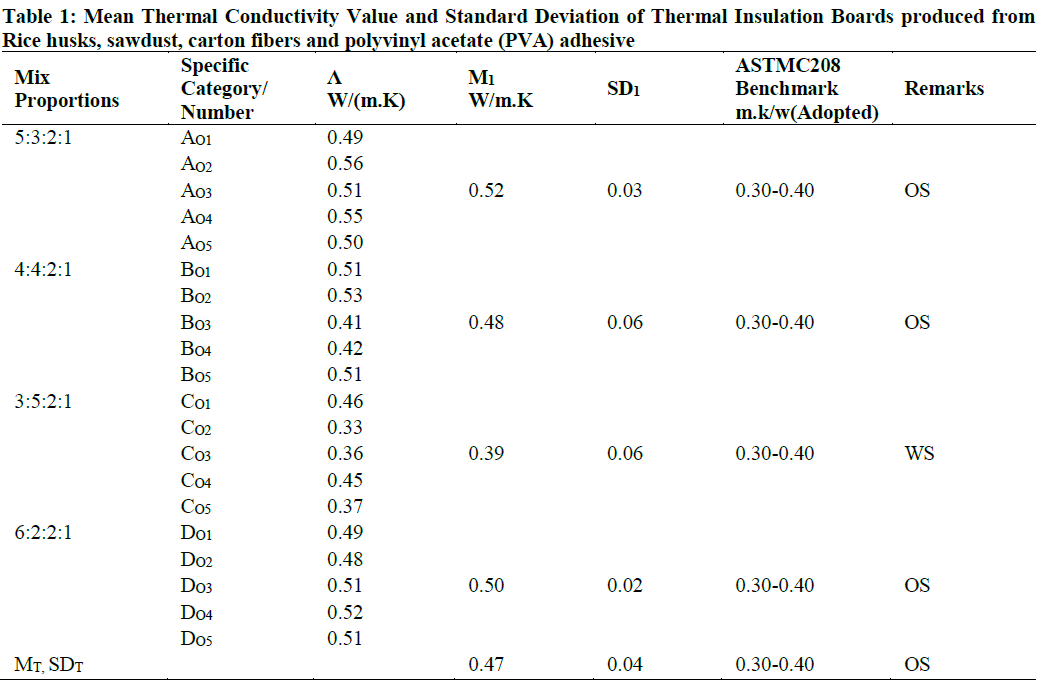
This study evaluated the thermal performance of insulation boards produced from rice husks, sawdust, carton fibers and polyvinyl acetate (PVA) adhesive, focusing on thermal conductivity and thermal resistance. A true experimental research design was adopted to produce four formulations: A (5:3:2:1), B (4:4:2:1), C (3:5:2:1) and D (6:2:2:1), with five specimens per formulation, giving 20 specimens. Laboratory testing was conducted to determine their thermal properties. Data were analysed using mean, standard deviation, one-way analysis of variance (ANOVA) and Tukey’s honestly significant difference post hoc test. The results showed mean thermal conductivity values of 0.52, 0.48, 0.39 and 0.50 W/m·K for formulations A, B, C and D, respectively, with an overall mean of 0.47 W/m·K. Formulation C recorded the lowest mean thermal conductivity and was the only formulation within the study-adopted evaluation range of 0.30–0.40 W/m·K. ANOVA revealed a statistically significant difference in thermal conductivity, F (3,16) = 8.164, p = .002. The reported mean thermal resistance values were 3.03, 3.36, 4.08 and 3.15 m·K/W for formulations A, B, C and D, respectively, with an overall mean of 3.41 m·K/W. ANOVA also indicated a statistically significant difference in thermal resistance, F(3,16) = 7.860, p = .002. However, the thermal resistance values require verification against the original specimen measurements and thickness calculations. ASTM C518 provides a method for measuring thermal transmission properties, while ASTM C208 is considered only a reference benchmark because the applicability of its scope to the composite boards.
References
References
Abobakr, H., Kakou, C. A., Bensalah, M. O., Bouhfid, R., Qaiss, A. E. K., & Raji, M. (2025). Development of lightweight insulation particleboard with superior thermo-mechanical and acoustic properties based on rice husks. Journal of Building Engineering, 104, Article 112289. https://doi.org/10.1016/j.jobe.2025.112289
Aigbomian, E. P., & Fan, M. (2013). Development of Wood-Crete building materials from sawdust and waste paper. Construction and Building Materials, 40, 361–366. https://doi.org/10.1016/j.conbuildmat.2012.11.018
Ajayi, O. T., & Afolayan, A. S. (2020). Evaluation of agricultural residues for eco-friendly composite materials. Journal of Sustainable Materials, 5(2), 112–120.
Akinyemi, A. B., Afolayan, J. O., & Ogunji, O. (2016). Some properties of composite corn cob and sawdust particle boards. Construction and Building Materials, 127, 436–441. https://doi.org/10.1016/j.conbuildmat.2016.10.040
Akinyemi, B. A., & Dai, C. (2020). Development of banana fibers and wood dust reinforced polyester composites. Construction and Building Materials,
American Society for Testing and Materials. (2017). Standard specification for cellulosic fiber insulating board (ASTM C208-12(2017)). ASTM International.
American Society for Testing and Materials. (2021). Standard test method for steady-state thermal transmission properties by means of the heat flow meter apparatus (ASTM C518-21). ASTM International.
Downloads
Published
Issue
Section
Categories
License
Copyright (c) 2026 Ibobee Isaac Hime, Daniel Momngu Tiough

This work is licensed under a Creative Commons Attribution 4.0 International License.


